If you’ve ever tried building a website, launching an app, or even planning a digital product, you’ve probably encountered a moment where someone asks, “What’s your technology stack?”
For many people—especially those newer to the tech world—that question can feel a bit like being asked to list the ingredients of a dish you’ve never cooked before. Yet your technology stack quietly determines almost everything about your digital project: how fast it loads, how easily it scales, how secure it is, how expensive it becomes, and even how much your developers enjoy working on it.
Whether you’re a business owner, a startup founder, a developer, or someone dipping your toes into tech for the first time, understanding the concept of a technology stack isn’t just helpful—it’s essential. In this guide, we’ll break it down in simple terms, walk through real-world examples, explore the best tools, highlight mistakes to avoid, and help you choose the right stack for your next project.
What Is a Technology Stack? (Beginner-Friendly Explanation)
A technology stack—often shortened to “tech stack”—is the combination of technologies used to build and run a digital product. Think of it as the recipe of programming languages, frameworks, databases, and tools that work together to make software function.
A simple analogy: building a house
Imagine you’re building a new home. You’ll need:
- Materials (wood, concrete, steel)
- Tools (saws, drills, measuring equipment)
- Professionals (architects, plumbers, electricians)
- Systems (plumbing, electrical wiring, HVAC)
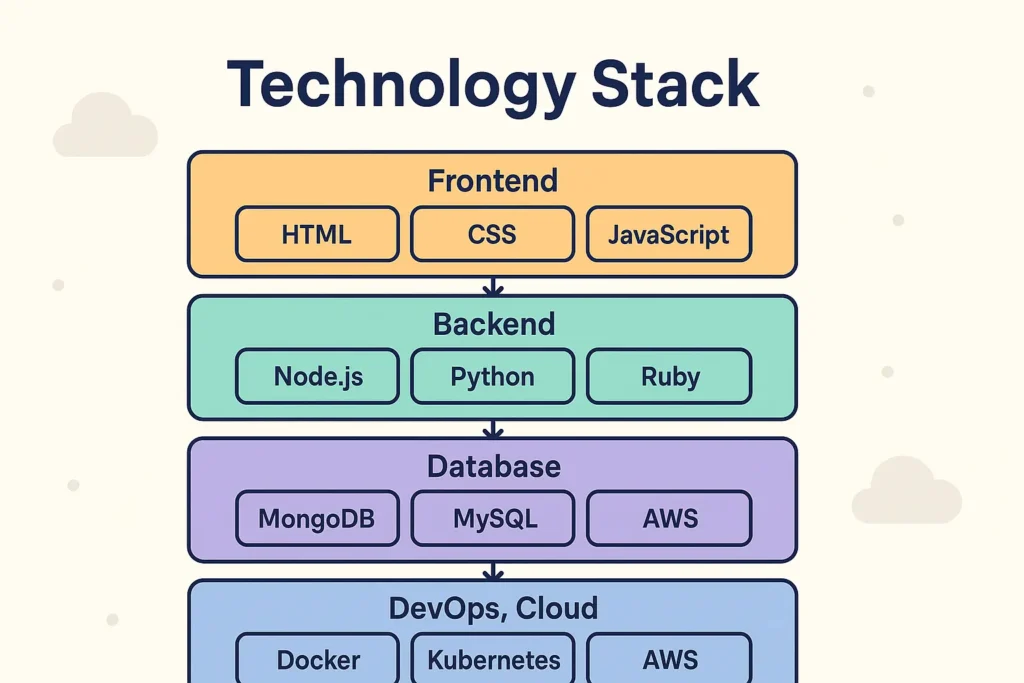
Your technology stack works the same way. It includes:
- Front-end technologies → What users see
- Back-end technologies → Processes behind the scenes
- Databases → Where information is stored
- DevOps tools → How the product gets updated, deployed, and maintained
All these pieces must work together smoothly, much like all parts of a house must fit for it to be livable.
A quick example
If someone says their tech stack is:
- React (frontend)
- Node.js (backend)
- MongoDB (database)
- AWS (cloud hosting)
…that combination forms a technology stack often used in modern web applications.
Why Understanding Your Technology Stack Matters
Even if you’re not writing code yourself, knowing your tech stack gives you clarity and control. A strong stack helps you:
- Build faster
- Avoid unnecessary costs
- Hire the right team
- Plan for long-term growth
- Prevent major technical debt
Choosing a stack isn’t about selecting the trendiest tools—it’s about picking the right ones for your goals, your timeline, and your budget. The wrong stack can lead to slow performance, increased security risks, and expensive rebuilds down the road.
Benefits & Use Cases of Technology Stacks
A well-chosen technology stack brings a wide range of advantages across industries. Let’s look at the biggest benefits and where stacks truly shine in real-world scenarios.
1. Better Performance and Scalability
Fast, responsive digital experiences rely heavily on the underlying stack. Tools designed for high scalability—like Kubernetes, Golang, or cloud-native databases—help your product grow with demand. If you expect thousands (or millions) of users, your stack is your backbone.
Use case:
A fintech app using Go, PostgreSQL, and AWS Lambda can process large volumes of transactions efficiently.
2. Lower Development and Maintenance Costs
Some stacks have massive developer communities, extensive libraries, and prebuilt solutions. All this reduces development time and long-term spending.
Use case:
A startup building a prototype with JavaScript (React + Node.js) accelerates development while keeping hiring costs manageable.
3. Stronger Security
Security is built into many modern frameworks. For example:
- Django has built-in protection against SQL injection.
- Laravel offers robust authentication scaffolding.
- Cloud platforms like AWS or GCP provide enterprise-grade security features.
Use case:
Healthcare apps often use Django + PostgreSQL because they need strict security and compliance features.
4. Better User Experiences
Front-end frameworks like React, Vue, and Svelte help teams build beautiful, fast, interactive interfaces that users love.
Use case:
E-commerce sites rely on real-time cart updates, animations, and smooth page transitions—all powered by the front-end stack.
5. Flexibility Across Platforms
Your stack determines whether you can build for:
- Web
- Mobile
- Desktop
- IoT devices
- Cloud-native environments
Use case:
Apps built with Flutter or React Native work across iOS and Android with one codebase.
The Main Components of a Technology Stack (Explained Clearly)
Every technology stack has several layers. Let’s break them down.
1. Front-End (Client Side)
The front end is what users see and interact with. It includes:
- HTML – structure
- CSS – styling
- JavaScript – interactivity
On top of JavaScript, we have powerful frameworks:
- React
- Vue.js
- Angular
- Svelte
These tools help developers build dynamic, responsive interfaces quickly and efficiently
2. Back-End (Server Side)
This is the engine room—everything users don’t see.
Common backend languages include:
- JavaScript (Node.js)
- Python
- PHP
- Java
- C#
- Ruby
- Go
Frameworks accelerate backend development:
- Express.js
- Django
- Flask
- Laravel
- Spring
3. Databases
Databases store and organize data. There are two main types:
Relational (SQL)
Great for structured data.
- PostgreSQL
- MySQL
- MariaDB
- Microsoft SQL Server
Non-relational (NoSQL)
Great for dynamic or large-scale datasets.
- MongoDB
- Cassandra
- DynamoDB
4. DevOps, Deployment & Hosting
Modern development relies heavily on cloud infrastructure and automation.
Common tools include:
- AWS, Google Cloud, Azure
- Docker & Kubernetes
- CI/CD pipelines (GitHub Actions, GitLab, Jenkins)
These tools help teams ship updates faster, more safely, and with fewer headaches.
How to Choose the Best Technology Stack (Step-by-Step Guide)
Choosing your tech stack doesn’t have to be overwhelming. Follow this clear, practical process.
Step 1: Define Your Project Goals
Ask yourself:
- What problem are you solving?
- Who is your target audience?
- Do you need mobile apps, web, or both?
- Do you expect rapid scaling?
A simple marketing website doesn’t require the same stack as a real-time trading platform.
Step 2: Set Performance & Scalability Expectations
If your product needs to handle:
- Real-time updates
- Large data volumes
- High user traffic
…then your stack must support non-blocking operations, distributed systems, and horizontal scaling.
Step 3: Evaluate Your Team’s Expertise
Your developers’ experience matters more than the “coolness” of a tool. A highly experienced PHP team will outperform a novice Node.js team every time.
Step 4: Consider Time-to-Market
For MVPs, choose a stack that allows rapid development:
- Node.js + React
- Python + Django
- No-code platforms (for early testing)
Time saved early on can make or break a launch.
Step 5: Factor in Long-Term Maintenance
Some stacks offer easier updates, stronger communities, and more stable ecosystems. This reduces long-term technical debt.
Step 6: Check Ecosystem & Community Support
A strong community means:
- More tutorials
- More ready-made components
- More third-party integrations
- Easier hiring
This is why JavaScript remains so dominant—it’s everywhere, and it has massive community support.
Step 7: Estimate Total Cost of Ownership
Think beyond development:
- Hosting costs
- Licensing fees
- Ongoing maintenance
- Developer salaries
A cheap stack today might become expensive later if talent is hard to find.
Popular Technology Stacks (Tools, Comparisons & Recommendations)
Here are the leading stacks developers and businesses rely on today.
1. MERN Stack (MongoDB, Express.js, React, Node.js)
Best for: Modern web apps, startups, SaaS
Pros:
- Full JavaScript stack
- Fast development
- Huge community
Cons:
- Can become complex at scale
2. MEAN Stack (MongoDB, Express.js, Angular, Node.js)
Best for: Large enterprise apps
Pros:
- Angular is structured and scalable
- Suited for big teams
Cons:
- Steeper learning curve
3. LAMP Stack (Linux, Apache, MySQL, PHP)
Best for: Traditional websites, CMS platforms
Pros:
- Reliable, secure, proven
- Excellent for WordPress, Drupal, Magento
Cons:
- Not ideal for high-performance real-time apps
4. Django Stack (Python, Django, PostgreSQL)
Best for: AI apps, data-driven platforms, secure applications
Pros:
- Very secure
- Easy to scale
- Perfect for rapid development
Cons:
- Less common for rich front-end interfaces unless paired with React
5. Serverless Stacks (AWS Lambda, DynamoDB, API Gateway)
Best for: Events, automation, scalable apps
Pros:
- No server management
- Scalability built-in
- Pay only for usage
Cons:
- Vendor lock-in
- Cold starts
Common Technology Stack Mistakes & How to Fix Them
Understanding what not to do can save thousands of dollars and countless hours.
Mistake 1: Choosing a stack because it’s trendy
Just because a tech influencer recommends a stack on YouTube doesn’t mean it’s right for your project.
Fix:
Align stack choice with your project needs, team skills, and long-term goals.
Mistake 2: Ignoring scalability
A stack that works for 1,000 users may fail miserably at 100,000.
Fix:
Plan for future growth by integrating scalable hosting (AWS, GCP) and architectures.
Mistake 3: Underestimating security needs
Not all stacks offer robust security out of the box.
Fix:
Use frameworks like Django, Laravel, and Spring for security-critical projects.
Mistake 4: Not considering hiring availability
Some niche stacks make it hard to find developers later.
Fix:
Research job market supply before committing.
Mistake 5: Mixing incompatible tools
Poorly combined technologies lead to constant bugs and performance bottlenecks.
Fix:
Choose tools known for working well together (e.g., MERN or Django + React).
Conclusion
Your technology stack is more than a list of tools—it’s the foundation of your digital product. Choosing the right stack sets you up for success: faster development, lower costs, better performance, and a smoother path to scaling your business.
Whether you’re building a simple website or a complex SaaS platform, understanding how stacks work empowers you to make confident, strategic decisions. Use this guide as a reference whenever you explore new tools or plan new projects—and don’t hesitate to experiment as the tech landscape evolves.
If you have questions about choosing the right stack, drop them in the comments or explore more of our in-depth guides on modern software development.
FAQs
What is a technology stack in simple terms?
A technology stack is the collection of tools, frameworks, languages, and databases used to build a software application.
What are the most popular technology stacks today?
MERN, MEAN, LAMP, Django, Ruby on Rails, and serverless stacks are widely used.
How do I choose the best tech stack for my project?
Evaluate your project goals, team skills, scalability needs, timeline, and budget.
Are technology stacks different for mobile apps?
Yes—mobile apps often use tools like Swift, Kotlin, Flutter, or React Native.
What is a full-stack developer?
Someone skilled in both the front-end and back-end technologies of a stack.
1.
2.
3.
4.
5.

Adrian Cole is a technology researcher and AI content specialist with more than seven years of experience studying automation, machine learning models, and digital innovation. He has worked with multiple tech startups as a consultant, helping them adopt smarter tools and build data-driven systems. Adrian writes simple, clear, and practical explanations of complex tech topics so readers can easily understand the future of AI.