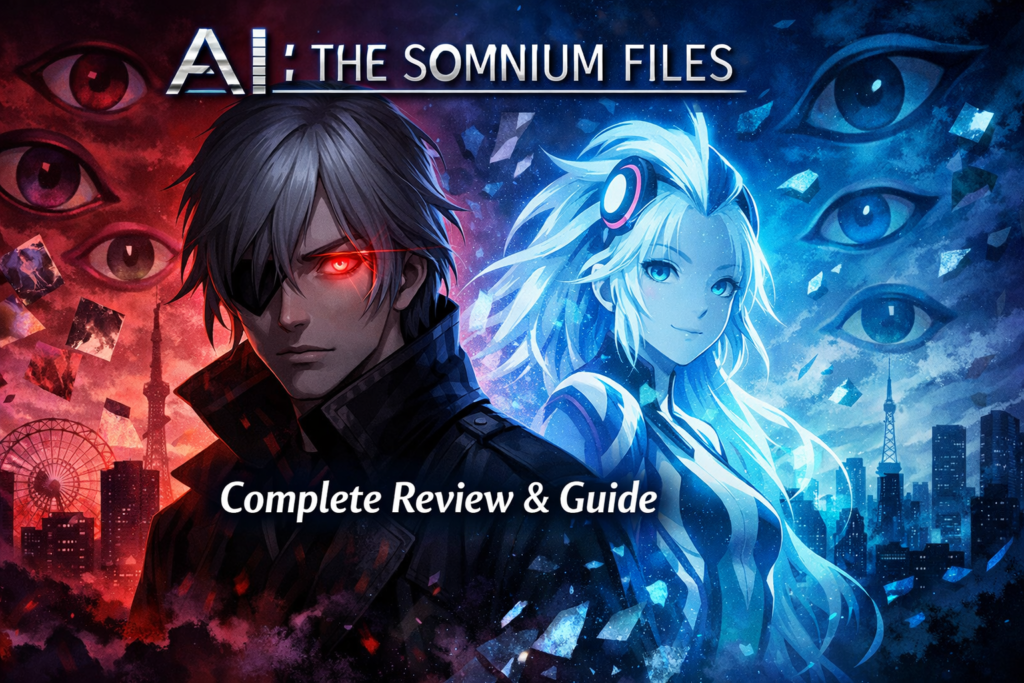
When Kotaro Uchikoshi, the acclaimed creator behind the Zero Escape series, announced his next project, fans of narrative-driven mysteries knew they were in for something special. AI: The Somnium Files, developed by Spike Chunsoft and released in 2019, delivers exactly what you’d expect from Uchikoshi: a complex, psychological murder mystery wrapped in science fiction concepts and dark humor. Playing as detective Kaname Date, you’ll investigate the New Cyclops Serial Killings using a revolutionary technology called the Psync machine that allows you to dive into suspects’ dreams to uncover hidden truths.
This graphic adventure and visual novel hybrid has garnered critical acclaim for its intricate storytelling and memorable characters, but it’s also known for its challenging dream-world puzzles that can frustrate even experienced players. Whether you’re considering your first playthrough or trying to decide which platform offers the best experience, this complete guide covers everything you need to know about AI: The Somnium Files.
What is AI: The Somnium Files? Story & Gameplay Explained
AI: The Somnium Files combines point-and-click investigation with surreal puzzle-solving in a game that defies simple genre classification. At its core, it’s a detective story about uncovering the truth behind a series of brutal murders where victims are found with their left eyes removed. But the way you investigate these crimes sets it apart from traditional adventure games.
A Dark, Branching Murder Mystery
The story begins when detective Kaname Date discovers the body of a woman in an abandoned amusement park, her left eye brutally extracted. This murder connects to previous unsolved cases known as the New Cyclops Serial Killings. As Date investigates, he encounters a cast of suspicious characters including the victim’s daughter Mizuki, the enigmatic internet idol A-set, and members of the powerful Sejima family.
What makes the narrative structure unique is its branching route system. The game features six distinct storylines that intersect and reveal different pieces of the larger puzzle. Each route focuses on different characters and provides alternative perspectives on the same events. These aren’t simple alternate endings—each path contains crucial information you’ll need to understand the complete picture. The true ending only becomes accessible after you’ve explored multiple routes and gathered enough context to piece together what’s really happening.
The story tackles mature themes including murder, corruption, human trafficking, and psychological trauma, earning its Mature rating. However, Uchikoshi’s signature dark humor provides occasional relief from the heavier subject matter, often delivered through Date’s internal monologue and his interactions with his AI partner Aiba.
Gameplay Loop: Investigation & Psyncing
AI: The Somnium Files alternates between two distinct gameplay modes, each offering different challenges and pacing.
Investigation Segments play out as traditional point-and-click adventures. You’ll explore crime scenes and various locations around Tokyo, examining objects, talking to witnesses, and gathering evidence. During these sequences, you can zoom in on specific areas, rotate the camera to find hidden clues, and use Aiba’s special visual abilities to detect things invisible to the human eye. The investigation segments are largely straightforward and focus on story progression and character development.
Somnium Segments are where the game becomes uniquely challenging. Using the Psync machine at ABIS headquarters (Advanced Brain Investigation Squad), Date can enter a subject’s subconscious mind—their Somnium—to extract hidden memories or information they’re unable to consciously recall. These dream worlds are surreal, symbolic representations of the subject’s psyche, where logic doesn’t always apply.
Here’s where it gets tricky: you have a strict six-minute time limit to navigate each Somnium and uncover the crucial information. Every action you take consumes time, with more complex actions draining more seconds. The dream worlds are filled with symbolic objects and bizarre scenarios that you must interact with correctly to progress. Making the wrong choice doesn’t just waste time—it can actively work against you. This creates a puzzle-solving experience built around experimentation and trial-and-error.
The Psync sequences introduce Mental Locks—barriers in the subject’s mind that represent psychological resistance. Breaking through these requires finding the right combination of interactions within the Somnium. Some segments also include Quick Time Events (QTEs) that demand quick reflexes.
The Key Characters: Date, Aiba, and the Cast
Kaname Date serves as your protagonist and viewpoint character. He’s a detective with ABIS who lost his left eye six years ago and now has an artificial eye that houses Aiba. Date suffers from amnesia regarding his past, creating an additional mystery layer beyond the main investigation. His personality combines hard-boiled detective tropes with genuine care for those around him, particularly his adoptive daughter Mizuki.
Aiba (Advanced Idea in Brain matter form) is Date’s AI partner who resides in his prosthetic eye. She provides constant companionship, tactical support during investigations, and is essential for performing Psyncs. Aiba has a distinct personality—logical yet capable of humor and emotional growth. The relationship between Date and Aiba forms the emotional core of the game, with their banter providing both comic relief and touching moments.
The supporting cast is extensive and well-developed:
- Mizuki, Date’s adoptive daughter, is a precocious 12-year-old with a tragic past connected to the murders
- Boss (real name Akane Kuruto), Date’s superior at ABIS who has her own mysterious agenda
- Iris Sagan (A-set), an internet idol and aspiring actress whose connection to the victims runs deeper than initially apparent
- Hitomi Sagan, Iris’s mother and the first victim whose murder sets the story in motion
- Ota Matsushita, an obsessive fan of Iris who becomes a person of interest
- The Sejima family, including patriarch Renju, his daughter So, and secretary Shoko, who are connected to the victims in multiple ways
Each major character has their own route in the story, and the branching structure ensures you’ll see different sides of everyone depending on the path you take.
In-Depth Review: Pros, Cons, and Is It Worth It?
After spending 25-30 hours exploring all routes and uncovering every secret, AI: The Somnium Files proves to be a memorable experience that excels in some areas while stumbling in others.
The Good: Story, Characters, and Atmosphere
Masterful Mystery Construction: Kotaro Uchikoshi’s writing shines in how the mystery unfolds across multiple routes. Each path reveals information that recontextualizes what you learned in previous routes, creating genuine “aha!” moments as pieces fall into place. The game respects players’ intelligence, trusting you to make connections without spelling everything out. By the time you reach the true ending, the intricate web of connections between characters and events becomes clear, and the payoff feels earned.
Strong Character Development: The cast is the heart of the experience. Even characters who initially seem like stereotypes reveal unexpected depth as you explore their routes. Date makes for an engaging protagonist—flawed and humorous but genuinely heroic when it matters. The relationship dynamics feel authentic, particularly the found family connection between Date, Aiba, and Mizuki.
Atmospheric Presentation: The visual style effectively combines realistic character models with stylized lighting and effects. The Somnium sequences are genuinely surreal and creative, with each character’s dream world reflecting their personality and fears in symbolic ways. The voice acting in both English and Japanese is excellent, with the English cast delivering particularly strong performances that capture each character’s personality. The soundtrack, composed by several artists, enhances the mood with memorable themes that range from tense investigation music to emotional character pieces.
Replay Value Through the Flowchart: The flowchart system is brilliantly implemented. You can see how different choices branch the story and jump back to any previous decision point without replaying everything. This makes exploring all routes much more manageable and encourages thorough exploration to see every outcome.
The Bad: Pacing and Puzzle Frustrations
Somnium Puzzle Design: This is the most divisive aspect of the game. The dream world puzzles operate on “dream logic” that can feel arbitrary. What seems like a reasonable action might waste precious time, while the correct solution often involves counterintuitive thinking. Some players enjoy the challenge of deciphering the symbolic logic, while others find it frustrating. The six-minute time limit adds pressure that can turn puzzle-solving into trial-and-error guessing rather than logical deduction.
The game does include items called Timies that you can collect throughout investigations—these allow Aiba to assist during Somniums, either by extending your time limit or by revealing hints. However, Timies are limited, and you might not have enough when you need them most.
Uneven Pacing: The story’s momentum can stall during certain routes. Since you’re often retreading the same time period from different perspectives, some scenes repeat with only minor variations. While this serves the narrative structure, it can make certain routes feel like filler before you reach the new revelations. The game is also heavily front-loaded with investigation segments before you reach your first Somnium, which might lose players expecting more interactive puzzle-solving from the start.
Tonal Whiplash: While many appreciate Uchikoshi’s blend of dark subject matter and humor, the tonal shifts can be jarring. Date’s internal monologue sometimes veers into inappropriate territory, making jokes about situations that should be treated more seriously. This is partly intentional character development, but it may not land well for all players.
Technical Performance on Switch: The Nintendo Switch version, while fully playable, suffers from noticeably longer load times compared to other platforms, and frame rate can occasionally dip during busier scenes. It’s not game-breaking, but it’s worth considering if you have multiple platforms available.
Despite these issues, AI: The Somnium Files succeeds at what matters most: delivering a compelling mystery with memorable characters. If you’re a fan of narrative-driven games and enjoyed titles like Danganronpa, Zero Escape, or the Ace Attorney series, this game deserves your attention. The puzzle frustrations are real, but they’re manageable with the right approach, and the story payoff makes the journey worthwhile.
Essential Tips for New Players
Going into AI: The Somnium Files blind can lead to unnecessary frustration. Here are essential strategies to enhance your experience without spoiling the story.
Understanding Somnium Puzzles and Time Limits
Save Before Every Somnium: The game autosaves, but manually saving before entering each Somnium gives you a clean restart point if things go poorly. You can reload and try a completely different approach without burning through Timies.
Exhaust All Options First: When you first enter a Somnium, take time to examine everything available even if it costs time. Understanding the full scope of your options helps you identify potential solutions. The first run through any Somnium is essentially reconnaissance.
Use Timies Strategically: Don’t hoard Timies for a rainy day—use them when you’re genuinely stuck. Aiba’s hints often point you in the right direction without giving away the complete solution. It’s better to use a Timie and progress than to waste time repeatedly failing.
Think Symbolically: Somnium puzzles operate on associations and symbolism rather than real-world logic. If an action seems bizarre or counterintuitive, it might be exactly what you need. Consider what objects or actions might mean metaphorically rather than literally.
Some Actions Reduce Time: Pay attention to which actions decrease your time penalties. Sometimes interacting with certain objects or taking specific actions can reduce the time cost of future actions, essentially giving you more total time to work with.
Don’t Fear Failure: Failed Somniums let you retry from the beginning with knowledge of what doesn’t work. Some players find it more efficient to deliberately explore “wrong” options to understand the puzzle space before attempting a serious completion run.
Using the Flowchart for Multiple Endings
The Flowchart is Your Friend: Don’t treat the branching structure as something to avoid spoiling. The flowchart shows you decision points and locked routes, helping you plan which paths to explore next. You’re meant to use it to navigate the story efficiently.
Early Routes Lock Later Options: Your first major choice determines which initial route you’ll experience. Don’t worry about making the “right” choice—every route is necessary, and you’ll need to see them all eventually. Just pick what feels interesting and trust that you’ll explore other options through the flowchart later.
Some Routes Require Prerequisites: Certain paths only become available after you’ve completed specific other routes. The flowchart clearly indicates these dependencies with lock symbols. If a route is locked, explore available paths first—the game will naturally guide you toward the content you need to unlock new routes.
The True Ending Requires Specific Steps: Without spoiling specifics, accessing the final route and true ending requires completing most other routes first. The game will make it clear when you’ve unlocked the path forward, so don’t stress about missing it.
Character-Specific Routes Reveal Different Information: Each major route focuses on a specific character and reveals information crucial to understanding that person’s role in the mystery. Don’t skip routes thinking they’re optional—every path contains pieces of the puzzle you’ll need for the complete picture.
Platforms, Editions, and Where to Buy
AI: The Somnium Files is available across multiple platforms, each with slight differences that might influence your purchase decision.
Platform Comparison (Switch vs. PS4 vs. PC)
| Feature | Nintendo Switch | PlayStation 4 | PC (Steam) | Xbox One |
|---|---|---|---|---|
| Release Date | September 2019 | September 2019 | September 2019 | July 2021 |
| Performance | 30 FPS, occasional dips | Stable 30 FPS | Up to 60 FPS | Stable 30 FPS |
| Load Times | Longest (5-10 seconds) | Moderate (3-5 seconds) | Fastest (1-3 seconds with SSD) | Moderate (3-5 seconds) |
| Resolution | 1080p docked, 720p handheld | 1080p | Up to 4K (with appropriate hardware) | 1080p |
| Controls | Joy-Con or Pro Controller | DualShock 4 | Keyboard/Mouse or Controller | Xbox Controller |
| Portability | Yes (handheld mode) | Remote Play only | Steam Deck compatible | No |
| Price | $39.99 | $39.99 | $39.99 (frequent sales) | $39.99 |
Best Platform for Most Players: If you prioritize performance and visual quality, the PC version offers the best technical experience with faster load times and higher frame rates. The improved load times particularly benefit the investigation segments where you’re frequently moving between locations.
Best Portable Option: The Nintendo Switch version’s handhobe mode makes it excellent for playing in bed or during commutes. The visual novel nature of much of the game means the performance differences are less noticeable during story segments. Just be prepared for slightly longer waits during loads.
PlayStation and Xbox Options: Both console versions offer solid, stable experiences with good controller layouts for the investigation and Somnium segments. Choose based on which controller you prefer or which platform you’re already invested in.
Control Considerations: Point-and-click investigation translates well to all control schemes. Mouse and keyboard on PC offers the most precise cursor control for examining scenes, but controller layouts on consoles work perfectly fine. The Somnium QTE sequences are equally manageable across all platforms.
Special Agent Edition Contents
At launch, Spike Chunsoft offered a Special Agent Edition for $79.99 that included:
- Full game
- 132-page hardcover art book featuring character designs, concept art, and creator commentary
- Original soundtrack CD with selected tracks from the game’s score
- Exclusive outer box packaging
The Special Agent Edition is no longer in production and is primarily available through third-party sellers at collector prices. Unless you’re a dedicated collector, the standard edition provides the complete game experience. The art book and soundtrack are nice bonuses but not essential to enjoying the game.
Where to Buy: AI: The Somnium Files is available digitally through:
- Nintendo eShop (Switch)
- PlayStation Store (PS4, PS5 via backward compatibility)
- Steam (PC)
- Microsoft Store (Xbox)
Physical copies are available at major retailers including Amazon, Best Buy, and GameStop, though availability varies by platform and region. The game frequently goes on sale digitally, with discounts up to 50% off during major sales events, so consider wishlisting it if price is a concern.
FAQ
Is AI: The Somnium Files connected to Zero Escape?
No, AI: The Somnium Files is not directly connected to the Zero Escape series (Nine Hours, Nine Persons, Nine Doors; Virtue’s Last Reward; Zero Time Dilemma). While both were created by Kotaro Uchikoshi and share similar narrative structures featuring branching routes and complex mysteries, they exist in completely separate universes with no overlapping characters or plot elements.
That said, fans of Zero Escape will find familiar elements in Somnium Files: intricate plotting, philosophical themes, pseudoscientific concepts as plot devices, and the same blend of dark subject matter with unexpected humor. If you enjoyed Zero Escape’s storytelling approach, Somnium Files delivers a similar experience with different characters and mechanics.
How long is AI: The Somnium Files?
A complete playthrough seeing all routes and reaching the true ending typically takes 25-30 hours. Your exact playtime depends on several factors:
Reading speed (the game is heavily text-based)
How much you struggle with Somnium puzzles
Whether you explore optional dialogue and investigation interactions
How much you use the flowchart to skip repeated scenes
A single route can be completed in 6-8 hours, but you’ll need to experience multiple routes to understand the full story. The flowchart system allows you to skip scenes you’ve already seen when jumping between routes, significantly speeding up subsequent playthroughs.
For completionists aiming for 100% achievements/trophies, expect 30-35 hours as you’ll need to see every possible branch and ending.
Is there a sequel?
Yes! AI: The Somnium Files – nirvanA Initiative was released in 2022 as a direct sequel. The sequel takes place six years after the events of the first game and features a new protagonist, special agent Mizuki, alongside returning characters from the original.
NirvanA Initiative maintains the same gameplay structure with investigation segments and Somnium puzzle-solving but introduces new mechanics and refinements based on feedback from the first game. The story stands alone enough that new players could theoretically start with it, but playing the original first is highly recommended for full appreciation of returning characters and references.
The sequel received similarly positive reviews and addressed some criticisms of the original, particularly regarding Somnium puzzle clarity.
Is the game scary/horror?
AI: The Somnium Files is better described as a psychological thriller rather than horror, though it contains horror elements. The game features graphic content including detailed descriptions of violence, crime scene photographs, and disturbing imagery in Somnium sequences. Bodies are shown with injuries, and the method of killing (eye removal) is central to the plot.
However, the game doesn’t rely on jump scares or traditional horror atmospherics. The tone is more investigative thriller with science fiction elements. The Somnium dream sequences can be unsettling due to their surreal nature and psychological themes, but they’re more bizarre than terrifying.
The Mature rating is earned through violence, gore, sexual themes, and strong language rather than sustained horror atmosphere. If you can handle crime procedurals or games like Danganronpa, the content in Somnium Files shouldn’t be too intense. The dark humor throughout also helps balance the heavier moments.
What are Somnium sequences in AI: The Somnium Files?
Somnium sequences are the puzzle-solving segments where detective Date uses the Psync machine to enter a subject’s subconscious mind. “Somnium” is Latin for dream, and these sequences take place in surreal dream worlds that represent the subject’s psyche, memories, and psychological barriers.
Each Somnium is unique to the specific person Date is Psyncing with, featuring symbolic representations of their fears, desires, and hidden knowledge. The environments don’t follow normal logic—objects might be oversized, locations might blend together impossibly, and the rules of physics don’t necessarily apply.
Your goal in each Somnium is to navigate the dream world, interact with symbolic objects and scenarios, and break through Mental Locks to extract the information you need. You have a strict six-minute time limit, with each action consuming time. The challenge lies in understanding the symbolic logic of the dream to find the correct sequence of actions that leads to success.
Do choices matter in AI: The Somnium Files?
Yes, choices significantly impact the story structure. Major decision points during Somnium sequences determine which route you’ll follow, and each route features different events, character focuses, and revelations about the mystery. Your choices essentially determine whose perspective and storyline you’ll experience next.
However, this isn’t a game where choices lead to dramatically different outcomes in terms of “good” or “bad” endings. Instead, each route reveals a different piece of the larger puzzle. All routes are canonical and necessary to understand the complete story—they’re different perspectives on the same truth rather than alternative realities.
The game’s flowchart system makes it clear where choices branch the story and allows you to easily return to decision points to explore other paths. This design encourages you to see all routes rather than worrying about making a single “correct” choice.
AI: The Somnium Files vs Danganronpa: How do they compare?
Both are Japanese mystery visual novels with investigation and puzzle elements, but they differ in several key ways:
Story Structure: Danganronpa follows a linear progression through chapters with class trials as climactic events. Somnium Files uses branching routes where you explore the same time period from multiple perspectives, with no single linear path.
Gameplay: Danganronpa’s trials involve debate mechanics, presenting arguments, and shooting down contradictions. Somnium Files alternates between point-and-click investigation and timed dream-world puzzle-solving that’s more abstract.
Tone: Both blend serious murder mystery with humor, but Danganronpa leans more into dark comedy and over-the-top personality clashes, while Somnium Files maintains a more consistently thriller atmosphere with occasional comedic relief.
Setting: Danganronpa confines characters to a closed environment (the school), creating a “locked room” mystery. Somnium Files takes place across Tokyo with a broader cast and setting.
If you enjoyed one, you’ll likely appreciate the other, but expect different gameplay experiences and narrative structures.
Final Verdict
AI: The Somnium Files represents Kotaro Uchikoshi at his best—intricate mystery plotting, memorable characters, and bold narrative structures that trust players to piece together complex information. While the Somnium puzzles can frustrate and the pacing occasionally drags, these issues don’t overshadow the game’s considerable strengths.
This is a game for patient players who enjoy narrative-driven experiences and don’t mind puzzle sections that require experimentation and multiple attempts. If you’re seeking action-heavy gameplay or straightforward progression, this might not be for you. But if you appreciate mysteries that reward careful attention, characters who feel genuinely developed, and stories that benefit from multiple playthroughs, AI: The Somnium Files delivers an experience worth your time.
The sequel’s existence confirms this wasn’t a one-off experiment but the beginning of a series. For fans of mystery visual novels looking for their next obsession after Danganronpa or Zero Escape, Somnium Files fills that void admirably while establishing its own identity.
Rating: 8.5/10 – A complex, engaging mystery elevated by strong characters and clever narrative structure, held back only by occasionally frustrating puzzle design.
Ready to dive into the mystery? AI: The Somnium Files is available now on Nintendo Switch, PlayStation 4, PC (Steam), and Xbox One. Once you’ve solved the New Cyclops Serial Killings, the sequel AI: The Somnium Files – nirvanA Initiative awaits with new mysteries to unravel.

Adrian Cole is a technology researcher and AI content specialist with more than seven years of experience studying automation, machine learning models, and digital innovation. He has worked with multiple tech startups as a consultant, helping them adopt smarter tools and build data-driven systems. Adrian writes simple, clear, and practical explanations of complex tech topics so readers can easily understand the future of AI.