
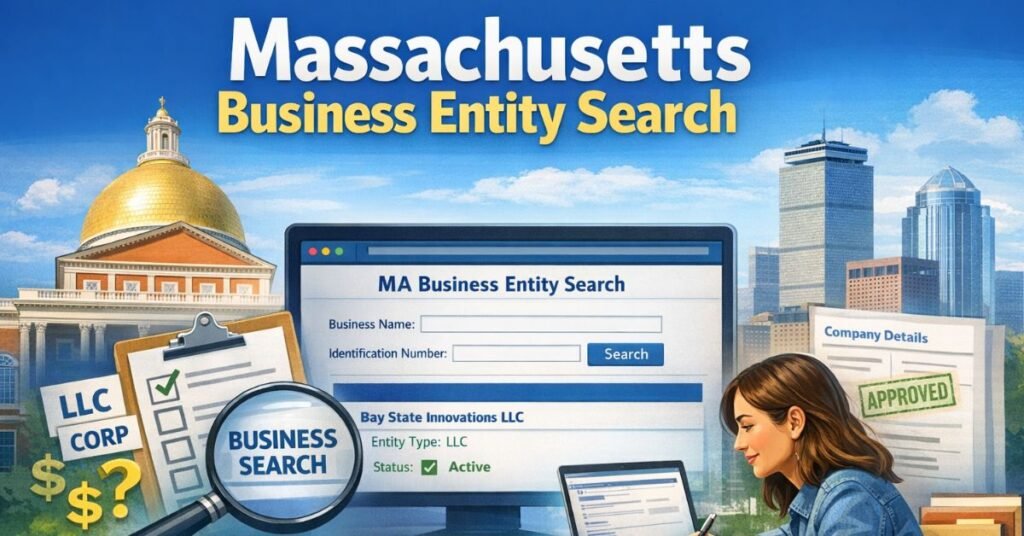
If you’re planning to start a company, verify a competitor, or confirm whether a business name is available, the first place you’ll likely land is the Massachusetts business entity search. It sounds technical, maybe even a little intimidating. But in reality, it’s one of the simplest and most powerful research tools available to entrepreneurs.
I still remember helping a friend register his first consulting LLC. He had branding ready, a logo designed, and a website halfway built—only to discover another company in Massachusetts already owned the exact same name. One quick search could have saved hours of work and a fair bit of frustration.
That’s why understanding how to properly use the Massachusetts business entity lookup system matters. In this guide, you’ll learn exactly how the search works, when to use it, what information you can uncover, and how to avoid the most common mistakes. Whether you’re forming an LLC, researching a corporation, or simply doing due diligence, this deep dive will give you the clarity and confidence to move forward.
By the end, you’ll know how to:
- Check business name availability in minutes
- Verify registrations and legal status
- Research competitors or partners
- Avoid costly filing errors
- Navigate the full process like someone who’s done it dozens of times
Let’s start with the fundamentals.
What a Massachusetts business entity search actually is and why it matters
At its core, a Massachusetts business entity search is a public database lookup that lets you find registered companies operating in the state. Think of it like a digital library catalog—but instead of books, you’re searching legal business records.
Every LLC, corporation, nonprofit, or partnership that officially registers in Massachusetts must file documentation with the Secretary of the Commonwealth. Those filings become searchable public records. The database typically reveals:
- Legal business name
- Entity type (LLC, corporation, etc.)
- Filing date and status
- Registered agent information
- Principal office address
- Filing history and amendments
In simple terms, this search tool answers one crucial question:
“Does this business legally exist in Massachusetts?”
But the importance goes far beyond curiosity.
Entrepreneurs use it to confirm name availability before forming an LLC. Investors use it to verify legitimacy before funding a deal. Freelancers check it to ensure a client is real. Even journalists and researchers rely on it when investigating organizations.
It’s similar to running a background check—except for businesses instead of people. And because the information comes directly from state filings, it’s far more reliable than a Google search or social media profile.
Understanding this single tool can prevent trademark conflicts, legal disputes, and wasted startup costs. That’s why seasoned founders always begin here.
Who should use a Massachusetts business entity search and when to run one
You don’t need to be a lawyer or accountant to benefit from a Massachusetts business lookup. In fact, everyday entrepreneurs are the people who gain the most from it.
Let’s look at the most common real-world situations.
New business owners choosing a name
Before filing formation paperwork, you must ensure your desired name isn’t already taken or confusingly similar to another registered entity. Skipping this step can lead to rejected filings or forced rebranding later.
Running the search early protects your time, money, and brand identity.
Entrepreneurs researching competitors
Curious how long a rival company has operated? Want to see if they’re active or dissolved? The database provides quick insight into a competitor’s legal standing and history.
That information can shape marketing strategy, pricing decisions, or partnership planning.
Investors and partners doing due diligence
Before signing contracts or sending funds, smart investors confirm a company’s legitimacy. A Massachusetts entity search verifies:
- Active registration
- Correct legal name
- Filing compliance
It’s a fast way to reduce risk in business deals.
Freelancers and contractors verifying clients
Unfortunately, not every “company” that emails you actually exists. Checking the state database helps confirm you’re working with a legitimate organization before delivering work or extending payment terms.
Legal and academic researchers
Because filings are public records, attorneys, journalists, and students frequently use the search tool for investigations, reporting, and case preparation.
In short, anyone interacting with a Massachusetts-based business should know how to use this search.
How the Massachusetts business entity search system works behind the scenes
To really understand the tool, it helps to know what’s happening in the background.
When a business registers in Massachusetts, it submits formation documents to the Secretary of the Commonwealth. These filings include structured legal data that gets stored in a statewide corporate registry database.
Every time someone performs a search, the system scans that registry and returns matching entities based on:
- Exact name matches
- Partial keyword matches
- Entity identification numbers
The database updates whenever businesses:
- Form new entities
- File annual reports
- Amend company details
- Dissolve or withdraw
Because of this continuous updating, the registry reflects near-real-time legal status rather than outdated information from third-party directories.
One important nuance:
The search shows legal registrations, not necessarily active operations.
A company might still appear in the system even if it stopped doing business years ago—unless it formally dissolved. That’s why reviewing status fields carefully is essential.
Understanding this distinction prevents misinterpretation of search results.
Step-by-step guide to performing a Massachusetts business entity search
Now let’s walk through the exact process in a clear, practical way.
Step 1: Access the official state search portal
Start by visiting the Massachusetts Secretary of the Commonwealth’s corporate database page. Always use the official government site rather than third-party directories to ensure accuracy.
Third-party sites often:
- Charge unnecessary fees
- Show outdated records
- Limit search results
The official database is free and most reliable.
Step 2: Choose your search method
You’ll usually see several search options:
- Business name search
- Individual name search
- Identification number lookup
For most users, the business name search is the fastest starting point.
Enter:
- Full company name for precise results
- Partial keywords for broader discovery
If you’re checking name availability, try multiple spelling variations.
Step 3: Review the results list carefully
Search results typically display:
- Entity name
- ID number
- Status (active, inactive, dissolved)
- Entity type
This is where attention to detail matters.
Two names might look different at first glance but still be considered legally confusing. For example:
“Bay State Consulting LLC”
vs.
“Baystate Consulting Group Inc.”
Even subtle similarities can cause filing rejection.
Step 4: Open the full entity record
Clicking a result reveals deeper details such as:
- Filing date
- Registered agent
- Office address
- Annual report history
- Amendments or mergers
This full record provides the most valuable insights for due diligence.
Step 5: Confirm name availability or legitimacy
Finally, interpret the information based on your goal:
If forming a business:
- Ensure no confusingly similar active names exist.
If verifying a company:
- Confirm active status and consistent details.
If researching:
- Review history, longevity, and filings.
This entire process usually takes less than five minutes once you know what to look for.
Benefits of using the Massachusetts business entity search for smarter decisions
Running a simple search might seem minor, but its benefits ripple across every stage of business.
Preventing legal and branding conflicts
Choosing a duplicate or confusing name can lead to:
- Filing rejection
- Trademark disputes
- Forced rebranding
A quick search eliminates that risk early.
Saving money during startup
Rebranding after launch costs far more than checking availability upfront. Entrepreneurs who skip this step often pay for:
- New logos
- Domain changes
- Updated marketing materials
Five minutes of research can save thousands of dollars.
Increasing trust in partnerships
Verifying registration builds confidence when:
- Hiring vendors
- Signing contracts
- Sending payments
It’s a foundational due-diligence habit.
Gaining competitive intelligence
Entity records reveal:
- How long competitors have existed
- Whether they’re expanding or dissolving
- Structural changes like mergers
These clues inform smarter strategic decisions.
Supporting legal compliance
Businesses must maintain accurate records and annual filings. Monitoring your own entity through the search helps ensure:
- Active status remains intact
- No filings are missed
- Information stays current
In essence, this tool isn’t just administrative—it’s strategic.
Best tools and alternatives for business entity research in Massachusetts
While the official state database is primary, experienced researchers often combine multiple tools for a fuller picture.
Free tools
State corporate registry
The most accurate legal source.
Search engines
Helpful for websites, reviews, and news.
Trademark databases
Important for brand protection beyond state registration.
Paid tools
Business intelligence platforms
Provide credit data, ownership insights, and financial indicators.
Legal research databases
Useful for attorneys investigating litigation or compliance history.
When to use each option
Use the state registry for:
- Legal existence
- Name availability
- Filing status
Use paid tools for:
- Financial risk
- Ownership structure
- Litigation history
Combining both creates a comprehensive due-diligence approach.
Common mistakes people make during a Massachusetts business entity search and how to avoid them
Even though the search is simple, several frequent errors can lead to confusion or bad decisions.
Only checking exact name matches
Many users type one exact name and assume availability if nothing appears. But similar spellings or abbreviations can still conflict.
Fix:
Search multiple variations and partial keywords.
Ignoring entity status
Seeing a name in the database doesn’t always mean it’s unavailable. Some entities are dissolved or inactive.
Fix:
Check status fields carefully before deciding.
Using third-party sites as primary sources
Some websites charge fees for information that’s free on the official portal.
Fix:
Start with the government database every time.
Misinterpreting registered agent or address details
These fields don’t necessarily reflect current operating locations.
Fix:
Treat them as legal contact information, not business headquarters.
Avoiding these mistakes ensures accurate conclusions.
Advanced tips for entrepreneurs forming an LLC or corporation in Massachusetts
Once you understand the search, you can use it more strategically.
Check domain availability at the same time
Before finalizing a name:
- Search the state registry
- Check domain names
- Review social media handles
This prevents fragmented branding later.
Search neighboring states if you plan expansion
Even if Massachusetts allows the name, expansion into nearby states could create conflicts. Early research supports long-term growth.
Review filing histories of successful competitors
Look at long-standing companies’ records to understand:
- Structural changes
- Name amendments
- Longevity patterns
This provides real-world business insight beyond theory.
Monitor your own entity annually
Set a yearly reminder to confirm:
- Active status
- Accurate address
- Filed annual report
This habit protects your legal standing.
Conclusion: Why mastering the Massachusetts business entity search is a must-have entrepreneurial skill
The Massachusetts business entity search might seem like a small administrative step, but in practice, it’s one of the most powerful tools available to entrepreneurs, investors, and researchers.
It protects your brand before launch.
It verifies legitimacy before partnerships.
It reveals competitive intelligence before strategy decisions.
And best of all, it takes only minutes to use—yet can prevent months of costly problems.
If you’re planning to start a business, research a company, or simply operate more intelligently in Massachusetts, learning this process is not optional. It’s foundational.
Take a few minutes today to run a search, explore the records, and become comfortable with the system. That small action could save you significant time, money, and stress down the road.
And if you’ve used the search before or discovered something surprising in a company record, consider sharing your experience. Real-world insights help everyone make smarter business decisions.
FAQs
Is the Massachusetts business entity search free to use?
Yes. The official state database is completely free for public searches.
Can I reserve a business name through the search portal?
No. The search only checks availability. Name reservation requires a separate filing.
How often is the database updated?
Updates occur whenever businesses file new documents, often daily.
Does an inactive name become available immediately?
Not always. Some dissolved names remain restricted for a period.
Can I search by owner name?
Certain searches allow individual name lookups, depending on entity type.

Michael Grant is a business writer with professional experience in small-business consulting and online entrepreneurship. Over the past decade, he has helped brands improve their digital strategy, customer engagement, and revenue planning. Michael simplifies business concepts and gives readers practical insights they can use immediately.





The app is very intuitive and the game selection is massive. It runs perfectly on my phone without any glitches. Definitely download jljl333apps if you’re a serious player.
The login process is super quick and I didn’t face any lag. It is definitely one of the best platforms I have used recently. Visit onyxlogin today.
The mobile app is a game changer. I can play my favorite jili games while commuting without any glitches. Get the jili979app if you want convenience on the go.
Finally found a site that doesn’t lag during the big games. The payout speed is impressive and the variety of options is great. Highly recommend 939bet43 to anyone looking for a reliable spot.
I’ve been looking for a reliable spot like this for a while. The interface is super smooth and the payouts are quick. Definitely check out inwln379 if you want a fair game.
Super easy to get started and the app runs like a dream. Everything is just where it should be. I’m sticking with superlgregisterloginapp.
This platform has a great variety of games and the bonuses are actually useful. I’ve had a great time exploring vn39bet6com lately.
This place has everything I look for in a gaming site and more. The welcome rewards are generous and the daily promotions keep things fresh. I also love how easy it is to contact support whenever I need help. Come check out ph33ph and enjoy the perfect gaming setup
Solid platform with a great selection of slots. I had a lucky streak yesterday and the withdrawal was processed in no time. Love vnnl88.
Solid platform with a great community feel. I’ve recommended this to a few friends and we are all having a blast. Check out 22tg88
The app version is a game changer. I can play on the go without any hassle and the loading times are super quick. Give sg7772app a try if you like convenience.
Really impressed with the resources available here. It is clear that the team knows what they are doing. I’m learning a lot thanks to phearnphp.
The AI integration here makes the whole experience feel modern and smart. It suggests games I actually like. Very cool stuff at vnf168ai.
Love the variety of games here. It is such a fun way to relax and maybe make some extra cash at slotgembiralogin.
Finally found a platform that doesn’t lag during the big wins. The interface is super smooth and easy to navigate. Highly recommend checking out phslotphp if you want a hassle-free experience.
Really impressed with the customer service on this platform. They answered my deposit query in minutes. Proper legit gaming experience at phbet888net.
The welcome bonus was a great way to start. I managed to double my initial deposit in one evening. krbet3 is honestly a hidden gem.
The community here is great and the promotions are always exciting. It feels like a premium experience every time I log in to phjilipark22.
No more login issues or broken links. This site is reliable and the game selection is vast. If you are looking for a stable portal, z777login is the way to go.
I’ve tried a few sites lately but this one is really smooth. The games load fast and the payouts are fair. Definitely my new favorite spot! phjili588
Everything about this site screams quality. From the graphics to the overall flow, it is just a top notch experience. brricabet
I appreciate how easy the login process is. No glitching or long wait times, just straight to the action. pkjjwinlogin makes everything so much more convenient for a busy player.
Super happy with the service here. The community is great and the games are always updated. Definitely worth a try for everyone. pkcv777