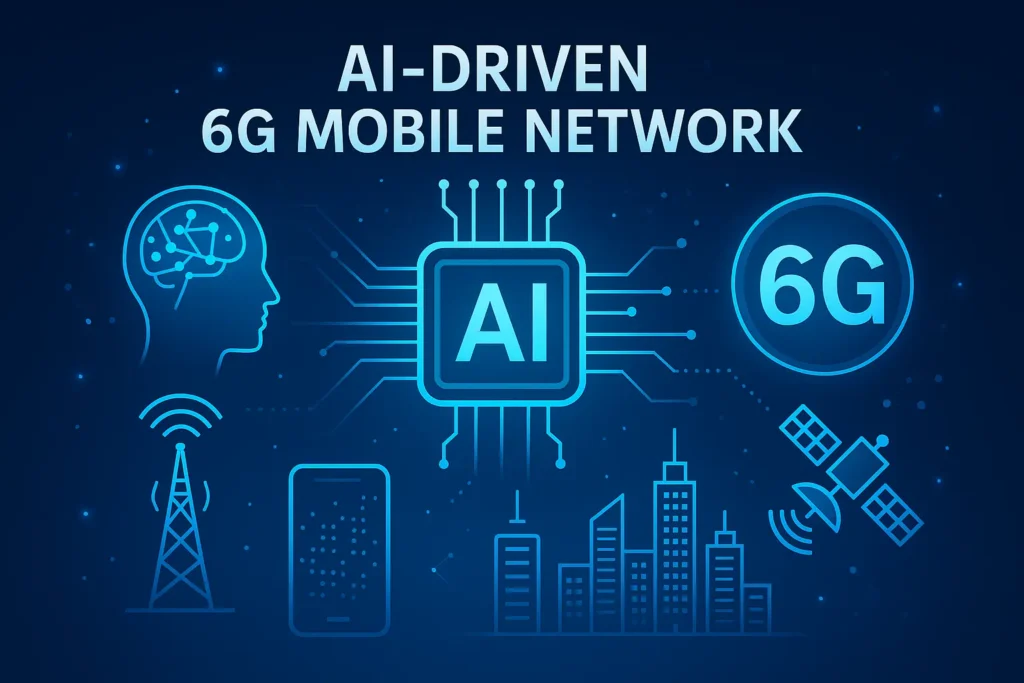
The rise of the AI Driven 6G Mobile Network represents one of the most significant technological shifts in the digital era. As global connectivity demands continue to expand—driven by smart cities, autonomous vehicles, immersive AR/VR, and the Internet of Everything (IoE)—the limitations of 5G become increasingly clear. This is where 6G steps in, offering unprecedented speed, automation, reliability, and intelligence. And at the heart of this next-generation network lies artificial intelligence (AI), enabling real-time optimization, autonomous resource management, and predictive communication capabilities.
In this in-depth guide, we explore how AI will power 6G networks, the major technologies behind it, the benefits for industries and consumers, and what the future of wireless ecosystems may look like.
What Is an AI Driven 6G Mobile Network?
A 6G mobile network is the sixth generation of wireless technology expected to support data rates up to 1 Tbps, ultra-low latency (down to microseconds), and seamless hyperconnectivity for billions of devices. What sets 6G apart is its native integration of artificial intelligence throughout every layer of the network.
Defining AI-Driven Network Intelligence
In a traditional 5G or 4G network, AI is used sporadically—mainly for analytics or limited automation.
In contrast, an AI-driven 6G network:
- Embeds machine learning (ML) models into the core, edge, and radio systems
- Enables fully autonomous network operation
- Continuously self-optimizes performance
- Predicts user behavior, traffic loads, and mobility patterns
- Enhances reliability, security, and energy efficiency
This deep AI integration is what makes 6G fundamentally different: the network becomes a thinking, learning ecosystem rather than just a communication system.
Why AI Is Essential to 6G Evolution
To understand why AI is the backbone of 6G, we must first look at the technological challenges of next-generation networks.
Unprecedented Device Density
6G networks will support:
- Trillions of IoT sensors
- Smart vehicles and drones
- Immersive AR/VR devices
- Autonomous robots in factories
- Wearable and implantable technology
Managing this volume requires AI-driven orchestration far beyond human capacity.
Ultra-Low Latency Requirements
Emerging 6G applications—remote surgery, holographic communication, tactile internet—demand microsecond-level responsiveness. AI enables:
- Edge processing for instant decisions
- Predictive algorithms to anticipate network congestion
- Real-time routing optimization
Complex Frequency Spectrum Management
6G will operate on:
- Terahertz (THz) frequencies
- Sub-THz bands
- Visible light communication (VLC)
- Hybrid satellite-terrestrial networks
AI handles spectrum allocation, interference reduction, and dynamic resource distribution more efficiently than static protocols.
Key Technologies Behind AI-Driven 6G Mobile Network
6G represents a convergence of multiple advanced technologies, each enhanced by the power of artificial intelligence.
1. Machine Learning for Network Automation
AI models will automate:
- Network configuration
- Traffic prediction
- Device handovers
- Power management
- Fault detection
Through continuous learning, networks become self-healing and self-optimizing.
2. Digital Twin Networks (DTNs)
A digital twin is a virtual replica of the physical network. AI-based DTNs allow operators to:
- Simulate changes before deployment
- Predict performance outcomes
- Identify failures in advance
This reduces downtime and improves network reliability.
3. Terahertz Communications (THz-Band)
THz frequencies offer massive bandwidth but are highly susceptible to obstacles and atmospheric absorption. AI mitigates these problems through:
- Intelligent beamforming
- Adaptive modulation
- Predictive environmental modeling
4. Edge AI Processing
With 6G’s ultra-low latency requirements, edge computing is essential. AI at the edge:
- Processes data closer to the user
- Reduces load on the cloud
- Enables autonomous systems (vehicles, drones)
- Improves privacy by keeping data local
5. RIS (Reconfigurable Intelligent Surfaces)
These AI-controlled surfaces manipulate electromagnetic waves to:
- Enhance signal coverage
- Reduce dead zones
- Improve positioning accuracy
RIS technology will be vital for indoor and urban environments.
6. Quantum Communication Integration
While still emerging, 6G is expected to support quantum-safe encryption and potentially quantum communication protocols. AI helps optimize these systems and manage complex cryptographic operations.
Major Benefits of AI-Driven 6G Mobile Networks
1. Faster Speeds and Higher Capacity
With speeds up to 1 Tbps, users can download ultra-HD content instantly and support high-density device environments. AI ensures networks allocate resources dynamically to prevent bottlenecks.
2. Ultra-Reliable, Low-Latency Communication (URLLC)
AI enhances mission-critical operations such as:
- Remote surgeries
- Autonomous vehicle navigation
- Industrial automation
- Real-time AR/VR simulations
3. Superior Energy Efficiency
AI algorithms help:
- Reduce energy waste
- Enable sleep modes during low usage
- Optimize power allocation
This makes 6G more environmentally friendly and cost-efficient.
4. Enhanced Security and Threat Detection
AI improves network security by:
- Identifying suspicious traffic patterns
- Detecting fraud or intrusion
- Predicting vulnerabilities before attacks occur
With more IoT devices, this becomes essential.
5. Seamless Global Connectivity
Through AI-optimized satellite integration, 6G will deliver global coverage even in remote regions, bridging digital divides.
Real-World Applications of AI-Driven 6G Mobile Networks
Smart Cities
AI-enabled 6G will power:
- Intelligent traffic systems
- Autonomous public transportation
- Smart energy grids
- Real-time pollution monitoring
- Seamless public services
Autonomous Vehicles
6G provides:
- Microsecond-level vehicle-to-everything (V2X) communication
- Predictive routing
- Real-time hazard detection
AI ensures synchronized traffic flow, reducing accidents and congestion.
Immersive AR, VR, and XR Experiences
6G supports:
- Holographic telepresence
- Full-sensory VR environments
- 3D remote collaboration
- Real-time motion tracking
This will redefine entertainment, education, and communication.
Industry 5.0
Factories of the future will rely on:
- Autonomous robots
- Machine vision inspection
- Predictive maintenance
- Human-machine collaboration
AI-driven 6G boosts responsiveness, accuracy, and efficiency.
Healthcare and Remote Medicine
Future medical innovations include:
- Remote surgery using haptic feedback
- Real-time patient monitoring
- AI-powered diagnostics
- Augmented reality for training
Agriculture and Environmental Monitoring
6G-enabled AI systems optimize:
- Precision farming
- Climate monitoring
- Automated irrigation
- Crop health analysis
Education and Workforce Development
6G opens doors to:
- Virtual classrooms
- AI-personalized learning
- Real-time language translation
- Metaverse-based job training
Challenges and Risks in AI-Driven 6G Networks
While promising, 6G development faces several obstacles.
1. Privacy Concerns
AI requires access to large datasets, raising questions about:
- Data ownership
- User tracking
- Algorithmic transparency
2. Infrastructure Costs
Building THz-based systems, edge AI chips, and intelligent surfaces requires significant investment.
3. Security Vulnerabilities
AI-enabled systems are susceptible to:
- Adversarial attacks
- Data poisoning
- Model manipulation
4. Global Standardization
6G requires global alignment on:
- Frequencies
- Protocols
- Security methods
This is a complex and lengthy process.
The Future of AI-Driven 6G Mobile Networks
By 2030, 6G networks are expected to become commercially available. Their adoption will impact nearly every industry and redefine how humans interact with technology. Key predictions include:
- Full integration of AI-native architecture
- Merging physical and digital worlds through holograms
- Hyper-personalized services
- Expanding automation and autonomy
- Ubiquitous global connectivity
The AI-driven 6G future brings us closer to a seamlessly connected, intelligent society.
Conclusion
The emergence of an AI-driven 6G mobile network represents a monumental leap in wireless communication technology. With intelligent automation, real-time optimization, unprecedented speeds, and ultra-low latency, 6G will unlock new possibilities across industries including healthcare, transportation, education, manufacturing, and entertainment.
As AI becomes deeply embedded in network infrastructure, 6G will transform the way we live, work, and interact with the world. This next-generation ecosystem won’t just connect devices—it will create an intelligent, adaptive, predictive network capable of supporting the innovations of tomorrow.
FAQs
What is an AI-driven 6G mobile network?
An AI-driven 6G mobile network is a next-generation wireless system that uses artificial intelligence to automate, optimize, and manage network operations in real time.
How fast will 6G be compared to 5G?
6G is projected to reach speeds up to 1 terabit per second (Tbps), which is more than 1,000 times faster than current 5G networks.
Why does 6G need AI?
AI manages complex tasks like real-time traffic routing, predictive maintenance, and device coordination—capabilities that manual systems can’t handle at 6G scale.
When will 6G be available?
Most experts expect early 6G deployment around 2030, with research and testing expanding throughout the 2020s.
What technologies power 6G networks?
Key technologies include AI automation, terahertz (THz) communication, edge computing, digital twin networks, and reconfigurable intelligent surfaces (RIS).

Adrian Cole is a technology researcher and AI content specialist with more than seven years of experience studying automation, machine learning models, and digital innovation. He has worked with multiple tech startups as a consultant, helping them adopt smarter tools and build data-driven systems. Adrian writes simple, clear, and practical explanations of complex tech topics so readers can easily understand the future of AI.