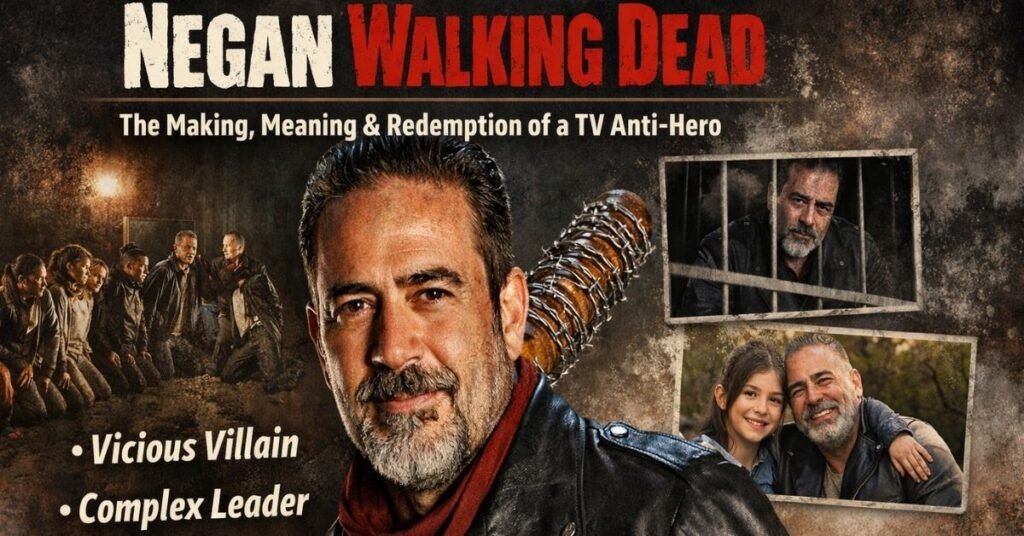
Introduction
What makes a character unforgettable? Is it fear, charisma, or the uncomfortable way they hold up a mirror to us? When people search for negan walking dead, they’re rarely just asking who he is. They’re trying to understand why he still matters years after his brutal introduction. Negan didn’t just walk into The Walking Dead—he stomped in, laughed in the face of chaos, and changed the emotional gravity of the show forever.
I remember the first time he appeared. Viewers leaned forward. Social media froze. Some turned away in disgust; others couldn’t stop watching. That reaction—love, hate, fascination—doesn’t happen by accident. It happens when writers, performers, and storytelling align to create something disturbingly human.
In this long-form guide, we’ll unpack Negan from every angle: his origins, psychology, leadership style, redemption arc, cultural impact, and why he’s still one of TV’s most talked-about characters. Whether you’re a longtime fan, a curious newcomer, or a content creator looking for deep context, this is your definitive, human-first breakdown.
Topic Explanation: Who Is Negan in The Walking Dead?
Negan is a fictional character from the TV series The Walking Dead, introduced in Season 6 and fully unleashed in Season 7. Portrayed by Jeffrey Dean Morgan, Negan is the iron-fisted leader of the Saviors, a group that survives by dominating others through fear, intimidation, and strict hierarchy.
At a surface level, Negan looks like a classic villain: leather jacket, barbed-wire baseball bat named Lucille, sadistic humor, and a willingness to kill to make a point. But reducing him to “just a bad guy” misses the point entirely. Negan is best understood as a distorted response to a broken world.
Think of Negan as what happens when charisma meets apocalypse logic. He believes civilization only survives through order—and order, in his mind, requires absolute authority. Where Rick Grimes leads through moral struggle, Negan leads through certainty. He never doubts himself, and that confidence is intoxicating to followers who are exhausted by chaos.
What truly defines Negan isn’t violence alone—it’s his code. Twisted as it may be, he has rules: no rape, loyalty above all, and punishment designed to deter rebellion. This warped sense of justice makes him terrifyingly believable. In another context, with fewer skulls crushed, he might even resemble a brutal corporate CEO or authoritarian ruler from history.
Benefits & Use Cases: Why Negan Still Resonates with Audiences
So why does Negan remain one of the most searched and discussed characters in The Walking Dead universe? Because he serves multiple narrative and psychological purposes at once.
First, Negan forces moral comparison. When he arrives, viewers suddenly reassess characters they once saw as unquestionably “good.” Rick, Maggie, and even Daryl are pushed to their ethical limits. Negan becomes a measuring stick for leadership under pressure.
Second, Negan is a masterclass in character evolution. Few TV characters undergo such a radical transformation—from pure antagonist to reluctant ally—while remaining consistent at their core. Writers didn’t erase his past; they made him live with it. That accountability resonates in a world increasingly focused on redemption, cancel culture, and second chances.
Third, Negan works as a storytelling catalyst. Every major arc he touches gains intensity:
- Group dynamics become unstable
- Power structures are questioned
- Emotional stakes skyrocket
For fans, Negan offers:
- A case study in complex villain writing
- One of TV’s strongest redemption arcs
- Endless debate fuel for forums, podcasts, and essays
For creators and analysts, Negan is useful as:
- An example of anti-hero evolution
- A lesson in performance-driven character depth
- Proof that audiences crave moral ambiguity
Negan isn’t likable in a traditional sense—but he’s compelling. And in storytelling, compelling always wins.
Step-by-Step Guide: Understanding Negan’s Character Arc
To truly “get” Negan, it helps to break his journey into clear phases. Each stage adds a layer, like peeling back armor you didn’t know was emotional.
Step 1: The Shock Introduction
Negan’s entrance is intentionally traumatic. The lineup scene isn’t just about death—it’s about dominance. He establishes control psychologically before physically. This is Negan at his most theatrical and cruel.
Step 2: Absolute Power
As leader of the Saviors, Negan thrives. He jokes, taunts, and punishes with confidence. At this stage, he believes fear equals stability. From his perspective, he’s saving more lives than he’s taking.
Step 3: Cracks in the Armor
Over time, small inconsistencies appear. His reactions to children, his refusal to tolerate sexual violence, and moments of genuine loss hint at buried humanity. These aren’t redemption yet—just fissures.
Step 4: Defeat and Captivity
Negan’s imprisonment is where real transformation begins. Stripped of power, he’s forced into reflection. Isolation becomes his punishment, and remorse slowly replaces arrogance.
Step 5: Earned Redemption
Negan doesn’t get forgiven easily—and that’s key. He saves lives, protects Judith, and repeatedly proves he understands the weight of his actions. Redemption here isn’t a reset; it’s a debt repayment.
Best practices for analyzing Negan:
- Watch for consistency, not likability
- Separate intent from outcome
- Track how his humor evolves—from cruelty to coping
This arc is why Negan feels human. Monsters don’t change. People do.
Tools, Comparisons & Recommendations: Negan vs Other Walking Dead Leaders
Understanding Negan becomes clearer when you compare him to other leaders in The Walking Dead universe.
Negan vs Rick Grimes
Rick leads through empathy and adaptability. Negan leads through fear and structure. Rick asks, “What’s right?” Negan asks, “What works?” Both are shaped by loss—but choose opposite philosophies.
Negan vs The Governor
The Governor hides cruelty behind charm. Negan weaponizes honesty. Ironically, Negan is more transparent about who he is, which makes him more trustworthy to followers—even when he’s brutal.
Negan vs Alpha
Alpha represents survival stripped of civilization. Negan, despite everything, believes in rebuilding society. His rules, language, and symbols all point toward order, not savagery.
Recommendations for deeper exploration:
- Rewatch Negan-heavy episodes back-to-back to see tonal shifts
- Pay attention to how other characters talk about Negan
- Notice how his body language softens over later seasons
Negan isn’t the strongest or smartest leader—but he’s the most intentional.
Common Mistakes & Fixes: Misunderstanding Negan’s Role
Even seasoned fans fall into traps when analyzing Negan. Let’s clear them up.
Mistake 1: “Negan was right all along”
Fix: No—Negan’s methods caused unnecessary trauma. Understanding his logic doesn’t mean endorsing it.
Mistake 2: “His redemption erases his crimes”
Fix: The show never forgets what he did. Redemption here is about responsibility, not forgiveness.
Mistake 3: “Negan is just comic relief later on”
Fix: Humor becomes a defense mechanism, not a gag. It’s how he survives guilt.
Mistake 4: “He changed too fast”
Fix: His arc spans multiple seasons. Growth is gradual, painful, and often resisted by others.
Mistake 5: “Fans only like him because he’s charismatic”
Fix: Charisma opens the door—but depth keeps people invested.
Seeing Negan clearly requires nuance. Flatten him, and you miss the point.
Conclusion
The reason negan walking dead remains such a powerful search term isn’t nostalgia—it’s relevance. Negan represents uncomfortable truths about leadership, power, and survival. He asks questions we don’t like answering: How far is too far? Who decides the rules? Can someone who did unforgivable things ever do enough good?
What makes Negan unforgettable isn’t Lucille or his one-liners. It’s the fact that he evolves without pretending the past didn’t happen. In a genre full of zombies, Negan feels the most alive.
If you’re revisiting The Walking Dead or exploring its deeper themes, Negan isn’t optional viewing—he’s essential. And if you’re still debating him years later? That’s the mark of truly great storytelling.
FAQs
Is Negan a villain or a hero?
Negan starts as a villain and evolves into an anti-hero. He exists in the gray area between redemption and accountability.
Why did Negan kill Glenn?
Narratively, it established stakes and cemented Negan’s dominance. Thematically, it marked the cost of defiance.
Does Negan regret his actions?
Yes—but regret in The Walking Dead is shown through behavior, not apologies.
Why do fans like Negan so much?
Because he’s complex, well-acted, and evolves realistically over time.
Is Negan based on the comics?
Yes, but the TV version expands his emotional depth significantly.

Michael Grant is a business writer with professional experience in small-business consulting and online entrepreneurship. Over the past decade, he has helped brands improve their digital strategy, customer engagement, and revenue planning. Michael simplifies business concepts and gives readers practical insights they can use immediately.