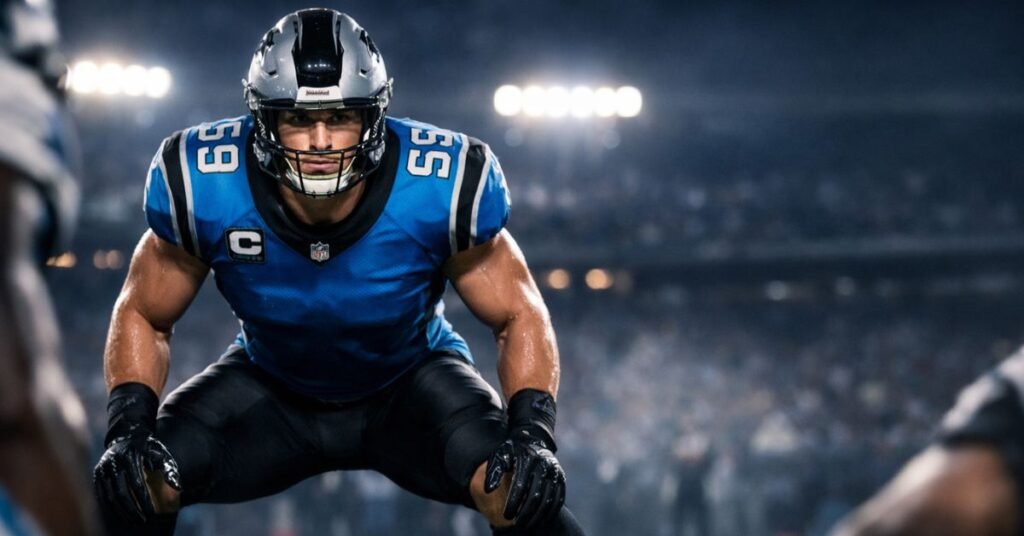
What if I told you that one of the most dominant defensive players in NFL history walked away from the game in his prime—not because he couldn’t play anymore, but because he was smart enough to know when to stop?
That’s the story of Luke Kuechly.
If you watched football anytime between 2012 and 2019, you didn’t just see a linebacker making tackles—you saw a defensive general diagnosing plays before the snap, dragging teammates into position, and erasing offenses with preparation as much as physicality.
Luke Kuechly matters today because his career challenges how we define greatness in professional sports. It wasn’t about longevity at all costs. It was about dominance, intelligence, leadership, and self-awareness.
In this article, I’ll break down who Luke Kuechly really was as a player, why he was so effective, what made him different from other elite linebackers, and the lessons athletes, coaches, and even everyday professionals can learn from his approach to excellence.
Who Is Luke Kuechly and Why He Matters
Luke Kuechly is a former NFL middle linebacker who spent his entire career with the Carolina Panthers. Drafted ninth overall in the 2012 NFL Draft, he immediately stepped into the league and played like a ten-year veteran.
At his core, Kuechly was a field general.
Think of a quarterback, but on defense. While most fans notice sacks and big hits, Kuechly’s real value showed up before the ball was even snapped. He read offensive formations, anticipated routes, adjusted coverages, and put teammates in the exact spot they needed to be.
What Made Luke Kuechly Different?
Most linebackers win with:
- Size
- Speed
- Aggression
Kuechly won with:
- Processing speed
- Film study
- Instincts
- Discipline
If football were chess, Luke Kuechly was playing three moves ahead while everyone else was reacting.
He wasn’t flashy. He didn’t trash-talk. He didn’t chase highlight hits. He just showed up every Sunday and owned the middle of the field.
A Quick Snapshot of His Career
- NFL Defensive Rookie of the Year (2012)
- NFL Defensive Player of the Year (2013)
- 7× Pro Bowl selection
- 5× First-Team All-Pro
- Member of the NFL 2010s All-Decade Team
And yet, despite all of that, he retired at just 28 years old.
That decision alone tells you a lot about who Luke Kuechly is.
Benefits & Use Cases: What Luke Kuechly’s Career Teaches Us
Luke Kuechly’s impact goes far beyond football highlights. His career offers real-world lessons for athletes, coaches, leaders, and anyone trying to perform at an elite level without burning out.
1. Preparation Beats Raw Talent
I’ve watched hundreds of linebackers over the years, and here’s the truth: plenty were faster or stronger than Kuechly.
Very few were better prepared.
Kuechly reportedly spent countless hours:
- Studying offensive tendencies
- Memorizing formations
- Learning quarterback habits
- Recognizing subtle tells from linemen
Use case:
- Athletes learning their opponents
- Coaches teaching football IQ
- Professionals mastering their craft through preparation
2. Leadership Without Ego
Luke Kuechly wasn’t a rah-rah speech guy. His leadership was quiet, direct, and respected.
He led by:
- Being the most prepared player in the room
- Holding teammates accountable without embarrassing them
- Communicating constantly on the field
Who this is best for:
- Team captains
- Managers
- Coaches
- Anyone leading peers rather than subordinates
Who should avoid this model?
- People seeking attention over results
- Those unwilling to put in unseen work
3. Knowing When to Walk Away
This is the hardest lesson—and the most important.
Kuechly suffered multiple concussions during his career. Instead of gambling with his long-term health, he chose to step away while still at the top of his game.
That decision reframed how many fans and players think about success.
Step-by-Step Guide: How Luke Kuechly Dominated the Game Mentally
You can’t copy Luke Kuechly’s genetics—but you can learn from his process.
Here’s a simplified breakdown of how he approached football preparation.
Step 1: Film Study with Purpose
Kuechly didn’t just “watch tape.” He studied it like a language.
He focused on:
- Down-and-distance tendencies
- Formation tells
- Personnel groupings
- Offensive line stances
Tip:
Watch film in short, focused sessions. Look for patterns, not highlights.
Step 2: Pre-Snap Communication
Before the snap, Kuechly was constantly talking:
- Calling out coverage changes
- Adjusting run fits
- Alerting teammates to motion
This reduced confusion and eliminated blown assignments.
Best practice:
If you see something early, say it early.
Step 3: Trust Instincts, Not Guesswork
Because of his preparation, Kuechly could react instantly. He didn’t hesitate.
Hesitation is what gets defenders beat.
Common challenge:
Overthinking during live play.
Fix:
Do the thinking before game day.
Step 4: Play Within the System
Kuechly rarely freelanced. He trusted the defense and did his job perfectly.
That discipline allowed everyone else to play faster.
Tools, Comparisons & Recommendations
To truly understand Luke Kuechly’s greatness, it helps to compare him to other elite linebackers and the tools they relied on.
Luke Kuechly vs. Ray Lewis vs. Patrick Willis
Luke Kuechly
- Strength: Diagnosis, coverage, communication
- Style: Surgical, precise, disciplined
Ray Lewis
- Strength: Emotional leadership, power
- Style: Intimidating, aggressive, explosive
Patrick Willis
- Strength: Athleticism, tackling
- Style: Physical, fast, relentless
Expert take:
Kuechly was the most complete mental linebacker of the three.
Training & Preparation Tools Linebackers Use Today
- Film breakdown software (Hudl, NFL Game Pass)
- VR reaction training
- Position-specific coaching clinics
Free vs. Paid
- Free: Basic film access, YouTube breakdowns
- Paid: Advanced analytics, team-level insights
Recommendation:
If you’re coaching or playing, invest in film tools before physical gadgets.
Common Mistakes & Fixes When Studying Luke Kuechly
Mistake 1: Only Watching Highlights
Highlights don’t show:
- Alignment
- Communication
- Coverage responsibilities
Fix:
Watch full-game or all-22 film when possible.
Mistake 2: Assuming Intelligence Means Playing Soft
Kuechly was physical—he just chose the right moments.
Fix:
Teach smart aggression, not reckless hits.
Mistake 3: Ignoring the Health Conversation
Many fans criticize early retirement without understanding the cost.
Fix:
Normalize conversations about long-term health and life after sports.
Conclusion
Luke Kuechly wasn’t just one of the best linebackers of his era—he was a blueprint for how to dominate with intelligence, preparation, and integrity.
He showed us that:
- Greatness doesn’t require flash
- Leadership can be quiet
- Walking away can be a form of winning
In a league built on violence and bravado, Luke Kuechly proved that thinking faster than your opponent can be just as powerful as hitting harder.
If you’re studying football, leadership, or personal excellence, his career is worth revisiting—again and again.
If you have thoughts on Luke Kuechly’s legacy or want deeper breakdowns of elite defensive minds, drop a comment or explore more long-form analysis.
FAQs About Luke Kuechly
1. Why did Luke Kuechly retire so early?
Luke Kuechly retired due to concerns about concussions and long-term brain health, choosing quality of life over extending his career.
2. What position did Luke Kuechly play?
He played middle linebacker for the Carolina Panthers.
3. Was Luke Kuechly a Hall of Fame player?
Yes, based on accolades, impact, and dominance, Luke Kuechly is widely considered a future Hall of Famer.
4. What made Luke Kuechly so good?
Elite football IQ, film study, instincts, communication, and discipline.
5. Did Luke Kuechly win Defensive Player of the Year?
Yes, he won NFL Defensive Player of the Year in 2013.
6. How many teams did Luke Kuechly play for?
Only one—the Carolina Panthers.
7. Is Luke Kuechly involved in football today?
He has worked in scouting and football operations roles since retirement.
8. How is Luke Kuechly remembered by teammates?
As a humble leader, relentless worker, and defensive genius.

Hannah Price is a digital journalist who covers breaking news, global events, and trending stories with accuracy and speed. She has previously contributed to several online magazines and has built a reputation for verifying facts before publishing. Hannah believes in responsible reporting and aims to present stories in a way that readers can trust.