1. What Is Qwen AI?
1.1 The Open-Source LLM Family from Alibaba Cloud
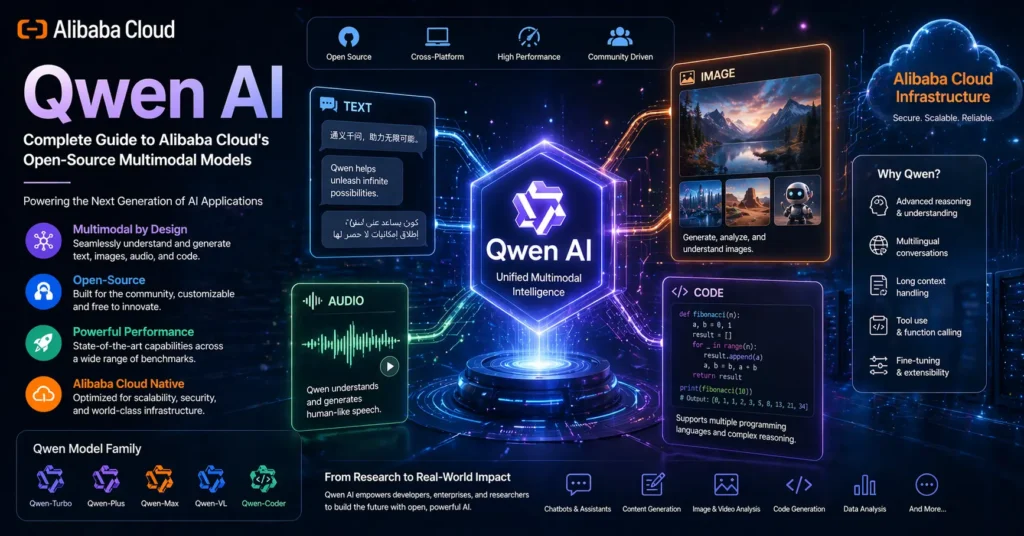
Qwen AI is a family of large language models (LLMs) and multimodal foundation models developed by Alibaba Cloud, one of the world’s leading cloud computing providers. The name ‘Qwen’ is short for Qianwen — meaning ‘thousands of questions’ in Chinese — reflecting the model’s ambition to handle virtually any query a user or developer might throw at it.
Released progressively since 2023, Qwen has grown into one of the most downloaded open-source AI model families in the world. The ecosystem now spans text generation, reasoning, image creation, video generation, speech synthesis, coding assistance, and autonomous agent frameworks — all accessible through a unified API on Alibaba Cloud Model Studio, GitHub, and Hugging Face.
Unlike many proprietary models, the Qwen family is largely open-weight, allowing researchers, startups, and enterprises to download, fine-tune, and self-host models without being locked into a single vendor ecosystem. This open approach, combined with competitive benchmark performance, has made Qwen a favourite among LLM startups and the global developer community.
1.2 Key Capabilities at a Glance
The Qwen ecosystem supports a broad and expanding range of AI tasks:
- Text Generation & Reasoning – Multi-step reasoning, long-context understanding, chain-of-thought, and multilingual text generation across 92+ languages.
- Image Generation – Photorealistic and styled image creation with accurate text rendering, natural skin textures, and bilingual prompt support.
- Video Generation – Text-to-video and image-to-video synthesis with consistent motion and frame-level control (via the Wan model).
- Coding & Agentic Coding – SOTA performance on SWE-bench Verified and SWE-bench Pro; autonomous software engineering agents with terminal access.
- Multimodal Reasoning – Vision-language thinking and non-thinking modes for document understanding, chart analysis, and visual Q&A.
- Translation – Qwen-MT supports 92 languages with domain-specific fine-tuning.
- Voice & Speech – Qwen3-TTS offers streaming speech synthesis and voice cloning.
- Safety & Moderation – Qwen3Guard provides real-time prompt and response safety guardrails in English and Chinese.
- Agent Frameworks – Qwen-Agent supports function calling, RAG (retrieval-augmented generation), code interpreter, and MCP integration.
2. Qwen AI Model Lineup – Which One Should You Choose?
The Qwen family is not a single model but a growing ecosystem of specialised models. Below is a structured overview of each category to help you choose the right model for your use case.
2.1 Text & Reasoning Models
These are the flagship language models designed for general intelligence, coding, reasoning, and conversation.
| Model | Parameters | Highlights | Best For |
| Qwen3.6-27B | 27B (dense) | SOTA on SWE-bench Verified (77.2), multi-step reasoning, think/non-think modes | Coding, reasoning, agents |
| Qwen3-Max | Undisclosed | Top-tier intelligence, highest accuracy, outperforms Qwen3.5-397B-A17B | Complex enterprise tasks |
| Qwen3.6-Max-Preview | Undisclosed | Preview of next-gen capabilities, RL-trained with GSPO | Early adopters, research |
| Qwen-Plus | Mid-range | Balance of speed and quality, affordable API pricing | Production apps, chatbots |
| Qwen-Plus-Character | Mid-range | Persona fine-tuning, roleplay-friendly, consistent character voice | Virtual influencers, roleplay agents |
Qwen3.6-27B is the standout open-weight model, surpassing the much larger Qwen3.5-397B-A17B on multiple benchmarks with only 27 billion parameters — a dramatic improvement in parameter efficiency thanks to reinforcement learning training with GSPO.
2.2 Image & Video Generation Models
Qwen’s generative media suite handles everything from product photography to full-motion video.
| Model | Type | Key Features | Free Tier |
| Qwen-Image-Max | Text-to-Image | High resolution, natural skin textures, accurate text rendering, bilingual prompts | 2,000 images free |
| Qwen-Image-Edit | Image Editing | AI-powered region editing, inpainting, style transfer | Included in free tier |
| Z-Image-Turbo | Fast Image Generation | Speed-optimised variant, ideal for batch generation | 2,000 images free |
| Wan (Text-to-Video) | Text-to-Video | Consistent motion, cinematic quality, temporal coherence | 1,650 seconds free |
| Wan (Image-to-Video) | Image-to-Video | Frame-level control, smooth animation from static images | 1,650 seconds free |
📌 Accurate text rendering in AI images remains a major industry challenge. Qwen-Image-Max is specifically optimised to handle Chinese and English text inside images — a significant advantage for marketing and localisation teams.
2.3 Specialised Models
Beyond the core models, Qwen offers purpose-built solutions for safety, language, code, and speech:
- Qwen3Guard – A real-time safety model that moderates both input prompts and output responses. Supports risk-level classifications in English and Chinese for enterprise-grade compliance.
- Qwen-MT – A dedicated translation model supporting 92 languages with domain-specific fine-tuning for legal, medical, technical, and commercial content.
- Qwen3-Coder – A code-specialised model ranked #7 on Code Arena, optimised for code generation, debugging, refactoring, and multi-file repository understanding.
- Qwen3-TTS – A text-to-speech model with streaming synthesis and voice cloning capabilities, ideal for podcasts, audiobooks, and real-time voice applications.
- Qwen-Agent – An agent framework that wraps any Qwen model with function calling, RAG, web browsing, code execution, MCP server integration, and a Chrome extension.
3. How to Access Qwen AI – Free Tier & Platforms
3.1 Free Tier Details
Qwen AI offers one of the most generous free tiers among major AI providers — making it an ideal starting point for startups, researchers, and individual developers.
| Resource | Free Tier Allocation | Perfect For |
| Text Tokens | 70,000,000+ tokens | LLM startups, chatbot prototyping, coding tools |
| Images | 2,000 images | Content studios, e-commerce, marketing automation |
| Video Seconds | 1,650 seconds | AI video startups, social media creators |
| API Calls | Rate-limited, no credit card required | Developers, researchers, hackathons |
📌 No credit card is required to start. Simply register on Alibaba Cloud Model Studio and you receive free credits immediately upon account creation.
3.2 Platforms & Integration
You can access Qwen AI through multiple official channels:
- Alibaba Cloud Model Studio – The primary API hub. Register, get an API key, and access all Qwen models through a unified REST interface. Includes usage dashboards and billing management.
- Qwen Chat (qwen.ai) – A web-based chat interface for direct interaction with Qwen models. No coding required. Suitable for non-developers.
- GitHub (github.com/QwenLM) – Open-source repositories for model weights, agent frameworks (qwen-agent, qwen-code), and community contributions. Apache 2.0 license.
- Hugging Face – Download model weights directly for self-hosting. Supports Transformers, vLLM, and Ollama deployments.
- ModelScope – Alibaba’s own model hub, offering additional fine-tuned variants and Chinese-language resources.
- Discord – Community server for developer discussions, announcements, bug reports, and model release previews.
3.3 Pricing After the Free Tier
After exhausting the free tier, Qwen AI transitions to pay-as-you-go pricing. While Alibaba Cloud updates pricing regularly, the general structure is as follows:
| Model Tier | Approximate Cost | Notes |
| Qwen-Plus (text) | ~$0.0004 / 1K tokens input | Highly competitive; lower than GPT-4o-mini |
| Qwen3-Max (text) | ~$0.002 / 1K tokens input | Premium tier; high accuracy |
| Qwen-Image-Max | ~$0.02–$0.05 / image | Varies by resolution |
| Wan Video | ~$0.01–$0.03 / second | Varies by quality setting |
| Qwen-MT | ~$0.0003 / 1K characters | Per-character billing for translation |
📌 Visit the official Alibaba Cloud Model Studio pricing page for the most current rates. Enterprise volume discounts are available for high-usage deployments.
4. Benchmark Performance & Real-World Results
Qwen models have demonstrated consistently strong results across industry-standard benchmarks, often outperforming models with significantly more parameters.
4.1 Coding & Agentic Benchmarks
The Qwen3.6-27B model set new standards for efficiency in software engineering tasks:
| Benchmark | Qwen3.6-27B Score | Previous Best (Qwen3.5-397B) | What It Measures |
| SWE-bench Verified | 77.2 | ~70 (estimated) | Real-world GitHub issue resolution by AI agents |
| SWE-bench Pro | 53.5 | Baseline | Harder, curated version of SWE-bench |
| Terminal-Bench 2.0 | 59.3 | Baseline | Terminal-based coding task completion |
| Code Arena Ranking | #7 (+16 pts) | Outside top 20 | Community coding performance leaderboard |
The fact that Qwen3.6-27B — a 27B parameter dense model — surpasses the 397B Mixture-of-Experts Qwen3.5 model represents a remarkable leap in training efficiency, primarily attributed to reinforcement learning with GSPO (Group Sampling Policy Optimisation).
4.2 Multimodal & Arena Rankings
Beyond coding, Qwen models rank competitively in general language and multimodal arenas:
- Text Arena: Qwen3.6 Plus ranks #36 globally — competitive with leading proprietary models.
- Code Arena: Ranked #7 with a +16 point jump, the largest single-cycle improvement on the leaderboard.
- Vision-Language: Think and non-think modes allow Qwen models to trade reasoning depth for speed depending on task requirements.
- Translation: Qwen-MT achieves top-tier BLEU scores on legal and medical domain benchmarks across 92 language pairs.
5. How to Use Qwen AI – Practical Examples
Getting started with Qwen AI takes less than five minutes. Below are three practical walkthroughs covering text generation, image creation, and agent building.
5.1 First Text Generation via API (Python)
Step 1: Install the OpenAI-compatible Python SDK (Qwen uses the same interface):
pip install openai
Step 2: Obtain your API key from Alibaba Cloud Model Studio → API Keys → Create New Key.
Step 3: Run your first completion:
import openai
client = openai.OpenAI(
api_key=”YOUR_QWEN_API_KEY”,
base_url=”https://dashscope.aliyuncs.com/compatible-mode/v1″
)
response = client.chat.completions.create(
model=”qwen-plus”,
messages=[
{“role”: “system”, “content”: “You are a helpful assistant.”},
{“role”: “user”, “content”: “Explain quantum entanglement in simple terms.”}
],
max_tokens=512
)
print(response.choices[0].message.content)
📌 Qwen’s API is OpenAI-compatible, so any existing OpenAI SDK integration requires only a base_url change to migrate.
5.2 Generate an Image with Qwen-Image-Max
Qwen-Image-Max excels at generating photorealistic images with accurate text rendering. Here is a minimal Python example:
import dashscope
from dashscope import ImageSynthesis
dashscope.api_key = “YOUR_QWEN_API_KEY”
response = ImageSynthesis.call(
model=”wanx-v1″,
prompt=”A futuristic city skyline at sunset, neon signs in English and Chinese, “
“photorealistic, 4K”,
n=1,
size=”1024*1024″
)
print(response.output.results[0].url)
Key tips for best results with Qwen image models: use bilingual prompts (English + Chinese) for text-heavy designs; specify lighting, style, and resolution explicitly; and use Qwen-Image-Edit for iterative refinement of generated outputs.
5.3 Build a Simple Agent with Qwen-Agent
Qwen-Agent is an open-source framework that lets you build autonomous AI agents with tool use, RAG, and code execution. Install it from GitHub:
pip install qwen-agent
A minimal web-browsing agent:
from qwen_agent.agents import Assistant
# Define tools available to the agent
tools = [“web_search”, “code_interpreter”]
agent = Assistant(
llm={“model”: “qwen-plus”},
system_message=”You are a research assistant. Search the web and summarise findings.”,
function_list=tools
)
messages = [{“role”: “user”, “content”: “What are the latest AI safety papers from 2025?”}]
for response in agent.run(messages=messages):
print(response[-1][“content”])
Qwen-Agent also integrates with MCP (Model Context Protocol) servers, enabling seamless connection to databases, APIs, and external services without custom tool wrappers.
6. Run Qwen Locally – Self-Hosting Guide
One of Qwen’s greatest advantages is that open-weight models can be deployed on your own hardware, giving you full data privacy and offline capability.
6.1 Using Ollama (Easiest Method)
Ollama is the simplest way to run Qwen models locally on Mac, Windows, or Linux:
# Install Ollama from https://ollama.com
ollama pull qwen2.5:7b
ollama run qwen2.5:7b
Ollama supports Qwen2.5 in 0.5B, 1.5B, 3B, 7B, 14B, 32B, and 72B parameter sizes.
6.2 Using Hugging Face Transformers
from transformers import AutoModelForCausalLM, AutoTokenizer
model_name = “Qwen/Qwen2.5-7B-Instruct”
tokenizer = AutoTokenizer.from_pretrained(model_name)
model = AutoModelForCausalLM.from_pretrained(model_name, device_map=”auto”)
prompt = “Write a Python function to sort a list of dictionaries by a key.”
inputs = tokenizer(prompt, return_tensors=”pt”).to(model.device)
output = model.generate(**inputs, max_new_tokens=256)
print(tokenizer.decode(output[0], skip_special_tokens=True))
6.3 Using vLLM for Production Serving
For high-throughput production deployments, vLLM offers PagedAttention and continuous batching:
pip install vllm
# Serve Qwen3.6-27B on GPU
python -m vllm.entrypoints.openai.api_server \
–model Qwen/Qwen2.5-72B-Instruct \
–served-model-name qwen \
–tensor-parallel-size 4
📌 vLLM’s OpenAI-compatible server lets you point any existing ChatGPT client at your self-hosted Qwen instance.
7. Safety & Responsible AI – Qwen3Guard
As AI models become more capable, safety becomes a critical deployment concern. Alibaba Cloud has invested significantly in responsible AI tooling for the Qwen ecosystem, most notably through Qwen3Guard.
7.1 Real-Time Prompt & Response Moderation
Qwen3Guard is a dedicated safety model that monitors both input prompts and generated responses in real time. It operates as a parallel inference layer, meaning it does not significantly slow down the primary model.
Key features of Qwen3Guard:
- Risk Level Classification – Assigns risk levels (low / medium / high / critical) to inputs and outputs.
- Categorised Classifications – Identifies specific harm categories: violence, self-harm, misinformation, hate speech, illegal content, and more.
- Multilingual Support – Full coverage in English and Chinese, with partial support for other Qwen-MT languages.
- Token-Stream Safety – Can evaluate safety on a per-token basis during streaming generation, enabling early stopping.
- Enterprise Compliance – Configurable thresholds for different industry verticals (healthcare, finance, education).
7.2 How Qwen3Guard Compares to Other Guardrails
Qwen3Guard achieves state-of-the-art performance on multilingual safety benchmarks, particularly excelling in Chinese-language moderation — an area where many Western-built guardrail systems fall short. It has been evaluated against Meta’s LlamaGuard and comparable systems, demonstrating superior recall on cross-lingual attack detection.
8. Qwen AI vs Other LLMs – Comparison
When evaluating Qwen against other leading models, the comparison reveals compelling advantages — especially for cost-sensitive and open-source deployments.
| Feature | Qwen3.6-27B | GPT-4o | Llama 3.1-70B | Claude 3.5 Sonnet |
| Open-Source / Open-Weight | Yes (Apache 2.0) | No (proprietary) | Yes (Meta license) | No (proprietary) |
| Multimodal (text+image+video) | Yes (full suite) | Yes (text+image) | Partial (text+image) | Yes (text+image) |
| Video Generation | Yes (Wan model) | No | No | No |
| On-Device / Local Deploy | Yes | No | Yes | No |
| Coding Performance (SWE-bench) | 77.2 (Verified) | ~72 (est.) | ~45 (est.) | ~70 (est.) |
| Languages Supported | 92 (via Qwen-MT) | ~50 | ~30 | ~40 |
| Free Tier | Very generous (70M tokens) | Limited (ChatGPT free) | Community (self-host) | Limited (Claude.ai free) |
| Safety Guardrails Included | Yes (Qwen3Guard) | Yes (OpenAI Moderation) | Partial (LlamaGuard) | Yes (Constitutional AI) |
| Agent Framework | Yes (Qwen-Agent) | Yes (Assistants API) | Community plugins | Yes (computer use) |
📌 Benchmark estimates for non-Qwen models are approximate and based on publicly reported figures. Always verify against the latest official benchmarks before making procurement decisions.
9. faqs
What is Qwen AI used for?
Qwen AI is used for text generation, coding assistance, autonomous agents, image creation, video production, speech synthesis, document analysis, and multilingual translation. It serves developers, enterprises, content creators, researchers, and AI startups.
Is Qwen AI free?
Yes — Qwen offers a highly generous free tier: 70M+ text tokens, 2,000 images, and 1,650 seconds of video generation. No credit card is required to get started. After free limits are exhausted, pay-as-you-go pricing applies.
How does Qwen compare to ChatGPT?
Qwen3.6-27B outperforms GPT-4o on coding benchmarks (SWE-bench Verified: 77.2 vs ~72) and offers a more generous free tier. Qwen is open-weight (can be self-hosted), while ChatGPT is proprietary. GPT-4o may still have an edge in certain reasoning and instruction-following tasks.
Can I run Qwen locally?
Yes. Qwen open-weight models are available on Hugging Face and can be run locally using Ollama (easiest), Hugging Face Transformers, or vLLM for production serving. Qwen2.5 models are available in sizes from 0.5B to 72B parameters.
What models are in the Qwen family?
The Qwen family includes: Qwen3.6-27B, Qwen3-Max, Qwen-Plus, Qwen-Plus-Character (text); Qwen-Image-Max, Qwen-Image-Edit, Z-Image-Turbo (image); Wan text-to-video and image-to-video; Qwen3-Coder, Qwen3-TTS, Qwen-MT, Qwen3Guard, and Qwen-Agent.
Does Qwen support video generation?
Yes. The Wan model family supports both text-to-video and image-to-video generation with consistent motion, frame-level control, and cinematic quality. The free tier includes 1,650 seconds of video.
How do I get API access for Qwen?
Register on Alibaba Cloud Model Studio (dashscope.aliyuncs.com), create a free account, and generate an API key under ‘API Keys’. Qwen’s API is OpenAI-compatible, so existing OpenAI integrations need only a base_url and api_key change.
What is Qwen3Guard?
Qwen3Guard is Alibaba Cloud’s real-time AI safety model. It classifies both input prompts and output responses by risk level and harm category in English and Chinese, providing enterprise-grade content moderation without third-party dependencies.
Which Qwen model is best for coding?
Qwen3-Coder and Qwen3.6-27B are the top choices for coding tasks. Qwen3.6-27B achieves 77.2 on SWE-bench Verified and ranks #7 on Code Arena. For agentic coding (multi-file, terminal-access), combine Qwen3.6-27B with the Qwen-Agent framework.
Is Qwen truly open-source?
Qwen models are open-weight under the Apache 2.0 license for most variants, which permits commercial use, fine-tuning, and redistribution. However, model weights are not ‘fully open-source’ in that training data and code are not always fully disclosed.
10. Qwen AI Roadmap & Future Models
Alibaba Cloud has signalled several upcoming developments for the Qwen ecosystem. While official roadmaps are not always published in detail, the following directions have been previewed through model announcements and community posts.
- Qwen3.6-Max (Full Release) – The preview version (Qwen3.6-Max-Preview) has demonstrated top-tier reasoning. A full production release with extended context and improved tool use is expected.
- GSPO Scaling – Reinforcement learning with Group Sampling Policy Optimisation (GSPO) has shown dramatic efficiency gains. Expect further model sizes trained with this technique.
- Expanded Qwen3-TTS – Streaming speech with more voice cloning options, emotional tone control, and lower latency for real-time voice assistants.
- Advanced Image Editing – Qwen-Image-Edit is being expanded with region-aware inpainting, multi-image composition, and style-consistent editing workflows.
- Longer Video Generation – The Wan video model is expected to support longer clip durations, higher resolutions, and audio-video synchronisation.
- Qwen-Agent MCP Expansion – Deeper integration with Model Context Protocol servers to connect Qwen agents to enterprise data sources, databases, and business APIs.
- Multilingual Safety (Qwen3Guard v2) – Extending safety coverage beyond English and Chinese to all 92 Qwen-MT supported languages.
📌 Follow the official QwenLM GitHub (github.com/QwenLM) and the Qwen blog (qwenlm.github.io) for the latest model releases and technical deep-dives.
11. Conclusion – Start Building with Qwen AI Today
Qwen AI has established itself as one of the most comprehensive and accessible AI model ecosystems available today. Whether you are a solo developer building a coding assistant, a startup creating an AI video platform, or an enterprise deploying multilingual safety guardrails, there is a Qwen model designed for your needs.
The combination of open-weight availability, a highly generous free tier, SOTA benchmark performance, and a full-spectrum model suite — covering text, image, video, speech, translation, safety, and agents — sets Qwen apart from most competing ecosystems.
Here is how to get started today:
- Visit Alibaba Cloud Model Studio at dashscope.aliyuncs.com to create a free account.
- Explore models on Qwen Chat at qwen.ai for zero-code experimentation.
- Download open-weight models on Hugging Face (search ‘Qwen’ under the QwenLM organisation).
- Clone the Qwen-Agent repository on GitHub to start building autonomous agents.
- Join the Discord community for developer support and early access to new model previews.
The Qwen ecosystem is evolving rapidly. With each release cycle, Alibaba Cloud is pushing the frontier of what open-source AI can achieve — both in raw capability and responsible deployment. The best time to start building with Qwen is now.

Adrian Cole is a technology researcher and AI content specialist with more than seven years of experience studying automation, machine learning models, and digital innovation. He has worked with multiple tech startups as a consultant, helping them adopt smarter tools and build data-driven systems. Adrian writes simple, clear, and practical explanations of complex tech topics so readers can easily understand the future of AI.