If you’ve ever wondered why your smartphone loads photos instantly, your laptop wakes up in seconds, or massive AI models can process oceans of data in real time, you’re already touching the work of Micron Technology—even if you’ve never seen the name on a device.
Over the last decade, I’ve watched the semiconductor conversation shift dramatically. Memory used to be a background component—important, yes, but rarely discussed outside engineering circles. Today, memory is the bottleneck and the accelerator at the same time. And that shift has quietly pushed Micron Technology from a behind-the-scenes manufacturer into one of the most strategically important companies in modern tech.
This article is for several kinds of readers:
- Investors trying to understand why Micron shows up in so many long-term semiconductor theses
- Engineers, students, or technologists who want a real-world view beyond textbook explanations
- Business leaders and content creators who need clarity on what Micron actually does and why it matters
- Curious readers who keep hearing “memory shortages,” “AI demand,” or “chip cycles” and want it explained plainly
What I’m not going to do is repeat generic definitions or copy surface-level explanations. Instead, you’ll get a grounded, experience-informed walkthrough—how Micron Technology works, where it wins, where it struggles, and why its role is becoming more critical as computing enters its next phase.
By the end, you’ll understand not just what Micron Technology is, but why it sits at the heart of everything from AI and cloud computing to cars and data security—and how to think about it with expert-level clarity.
Micron Technology Explained: From Simple Memory to Global Infrastructure
At its core, Micron Technology is a semiconductor company that designs and manufactures memory and storage solutions. That sounds straightforward—until you realize how foundational memory really is.
Think of computing like a kitchen. The processor (CPU or GPU) is the chef. The storage drive is the pantry. Memory—RAM and flash—is the countertop. If the countertop is too small or cluttered, the chef slows down no matter how skilled they are. Micron builds that countertop at a global scale.
Formally, Micron Technology specializes in:
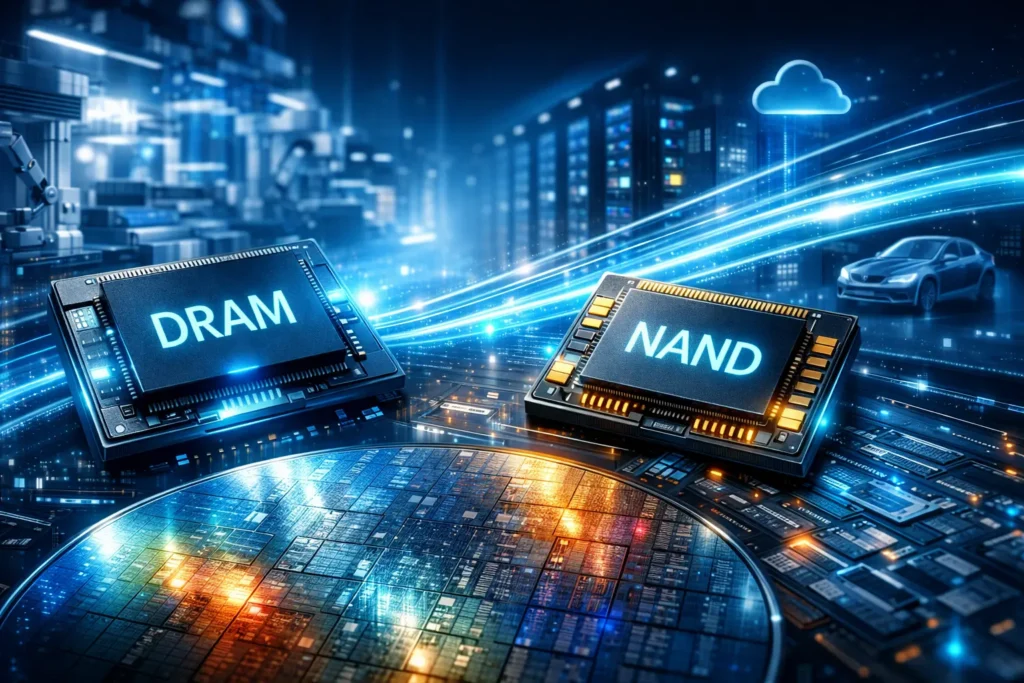
- DRAM (Dynamic Random Access Memory)
- NAND flash memory
- Emerging memory technologies
DRAM handles active, short-term data—the information your system needs right now. NAND handles longer-term storage—photos, videos, files, and increasingly, massive datasets. Micron doesn’t just make chips; it engineers the balance between speed, density, power efficiency, and reliability.
What makes Micron distinct is vertical integration. Many companies design chips but outsource manufacturing. Micron does both. That gives it deeper control over performance, cost structures, and long-term innovation. In practice, this means Micron can respond faster to shifts in demand—whether that’s a surge in AI workloads or a downturn in consumer electronics.
Another important nuance: Micron operates in cycles. Memory demand rises and falls, prices fluctuate, and capacity planning is a high-stakes game. Understanding Micron means understanding how it navigates these cycles without losing technological leadership.
How Micron Technology Evolved Into a Memory Powerhouse
Micron’s story isn’t one of overnight success. It’s a decades-long lesson in endurance, reinvention, and technical discipline.
Founded in the late 1970s, Micron began as a small semiconductor startup at a time when the industry was dominated by much larger players. Early on, the company made a critical decision: focus relentlessly on memory rather than spreading itself across dozens of chip categories. That focus shaped everything that followed.
Through the 1990s and early 2000s, Micron survived brutal price wars, global competition, and rapid technological shifts. Many memory companies disappeared or were absorbed. Micron stayed independent, largely because it invested heavily in process technology—how memory is actually fabricated at the atomic level.
I’ve spoken with engineers who worked through those transitions, and one theme comes up repeatedly: Micron learned how to operate under pressure. When margins collapsed, the company doubled down on efficiency. When demand surged, it avoided reckless expansion that could destroy long-term value.
A defining moment came with Micron’s expansion into advanced NAND and mobile memory. Smartphones, data centers, and cloud infrastructure didn’t just increase demand—they changed what kind of memory was required. Lower power consumption, higher endurance, and tighter integration became non-negotiable. Micron adapted.
Today, Micron operates fabrication facilities across multiple regions, balancing geopolitical risk, supply chain resilience, and cutting-edge research. That evolution is why Micron Technology is still relevant—and arguably more important than ever.


Real-World Benefits and Use Cases of Micron Technology
It’s easy to talk about memory in abstract terms. It’s harder—and more useful—to see where Micron Technology shows up in everyday and industrial contexts.
Consumer Electronics and Personal Computing
Every time a laptop boots quickly or a smartphone handles multiple apps without freezing, memory quality is at work. Micron’s DRAM and NAND solutions are used by major device manufacturers to balance speed, battery life, and reliability.
Before high-performance memory:
- Apps reloaded constantly
- Multitasking felt sluggish
- Battery drain was severe
After modern memory integration:
- Seamless multitasking
- Faster boot and load times
- Improved energy efficiency
Data Centers and Cloud Computing
This is where Micron’s impact becomes massive. Data centers are memory-hungry environments. AI training, virtualization, and real-time analytics all rely on fast, dense, reliable memory.
Micron’s server-grade DRAM helps:
- Reduce latency in cloud applications
- Improve throughput for AI workloads
- Lower total cost of ownership through efficiency
In practical terms, better memory means fewer servers are needed to do the same work—a huge cost and energy advantage.
Automotive and Industrial Systems
Modern vehicles are computers on wheels. Advanced driver-assistance systems, infotainment, and real-time sensors all require memory that can withstand heat, vibration, and long lifespans.
Micron’s automotive-grade memory is designed for:
- Extreme temperatures
- Long operational life
- Safety-critical reliability
In industrial automation, similar requirements apply. Downtime isn’t just inconvenient—it’s expensive.
AI and Emerging Technologies
AI workloads stress memory in unique ways. Large models need to move enormous datasets quickly. Bandwidth and latency matter as much as raw compute power.
Micron’s high-bandwidth memory solutions help unlock:
- Faster AI model training
- More efficient inference
- Lower energy consumption per operation
This is one reason Micron is increasingly mentioned alongside AI leaders, even though it doesn’t build GPUs or CPUs.
A Practical, Step-by-Step Look at How Micron Technology Is Used
Understanding Micron’s role becomes clearer when you trace how its products move from concept to real-world deployment.
Step 1: Identifying the Workload
The first decision isn’t about chips—it’s about use case. Is this memory going into a smartphone, a data center, or a vehicle? Each environment demands different trade-offs.
- Mobile devices prioritize power efficiency
- Servers prioritize bandwidth and capacity
- Automotive systems prioritize durability
Micron designs memory families specifically around these profiles.
Step 2: Architecture and Design
Once the use case is defined, Micron engineers design memory architectures that balance density, speed, and reliability. This involves:
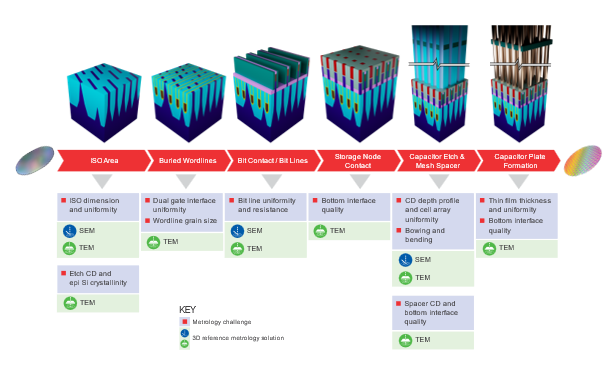
- Cell design at nanometer scales
- Error correction mechanisms
- Power management features
Small design choices here can translate into major performance differences downstream.
Step 3: Fabrication and Testing
Manufacturing memory is where theory meets reality. Micron operates advanced fabrication plants that run continuously, producing wafers under extreme precision.
Every batch undergoes rigorous testing:
- Performance validation
- Error rate analysis
- Environmental stress testing
This is where Micron’s vertical integration becomes a competitive advantage.
Step 4: Integration Into Systems
Memory doesn’t operate alone. It must integrate seamlessly with processors, controllers, and software stacks. Micron works closely with OEMs and platform designers to ensure compatibility and optimization.
Step 5: Lifecycle Support
In enterprise and automotive markets, memory isn’t a one-off purchase. Micron provides long-term support, consistent supply, and roadmap visibility—critical for customers planning years ahead.
Tools, Comparisons, and Expert Recommendations
When people ask whether Micron is “better” than other memory manufacturers, the honest answer is: it depends on context.
Micron vs. Commodity Memory Suppliers
Micron stands out in:
- Process innovation
- Long-term reliability
- Enterprise and automotive credibility
Commodity suppliers may compete on price, but often lack consistency or lifecycle support.
Micron in High-End vs. Entry-Level Applications
For entry-level consumer devices, the differences may be subtle. In high-end systems—servers, AI accelerators, industrial platforms—Micron’s engineering depth becomes obvious.
Expert Insight
From experience, organizations that treat memory as a strategic component—not a commodity—tend to favor suppliers like Micron. The upfront cost may be slightly higher, but the long-term stability often pays for itself.
Common Mistakes People Make When Evaluating Micron Technology
One of the most common mistakes is viewing memory purely through pricing cycles. Yes, memory prices fluctuate. But focusing only on short-term price misses the structural role Micron plays.
Another mistake is assuming all memory is interchangeable. In practice, differences in latency, endurance, and error handling can make or break a system.
A third issue is ignoring geopolitical and supply chain resilience. Micron’s diversified manufacturing footprint reduces risk—a factor that became painfully clear during recent global disruptions.
Conclusion: Why Micron Technology Remains a Cornerstone of Modern Computing
Micron Technology isn’t flashy. It doesn’t launch consumer gadgets or dominate headlines. But it underpins nearly everything digital.
From personal devices to cloud infrastructure, from AI to automotive systems, Micron’s memory solutions quietly enable progress. Its strength lies in focus, engineering discipline, and long-term thinking—qualities that matter more as computing grows more complex.
If there’s one takeaway, it’s this: memory is no longer a background component. It’s a strategic asset. And Micron Technology is one of the companies shaping how that asset evolves.
FAQs
What does Micron Technology actually manufacture?
Micron designs and manufactures DRAM, NAND flash memory, and related storage solutions used in consumer, enterprise, automotive, and industrial systems.
Is Micron Technology involved in AI?
Yes. While Micron doesn’t build AI processors, its memory products are critical for AI training and inference workloads.
How is Micron different from other semiconductor companies?
Micron focuses almost exclusively on memory and maintains vertical integration, handling both design and manufacturing.
Why do memory prices fluctuate so much?
Memory is cyclical due to supply-demand dynamics, capacity planning, and rapid shifts in end markets like smartphones and data centers.
Is Micron Technology a long-term player?
Historically, Micron has demonstrated resilience across multiple industry cycles, maintaining technological relevance over decades.

Adrian Cole is a technology researcher and AI content specialist with more than seven years of experience studying automation, machine learning models, and digital innovation. He has worked with multiple tech startups as a consultant, helping them adopt smarter tools and build data-driven systems. Adrian writes simple, clear, and practical explanations of complex tech topics so readers can easily understand the future of AI.