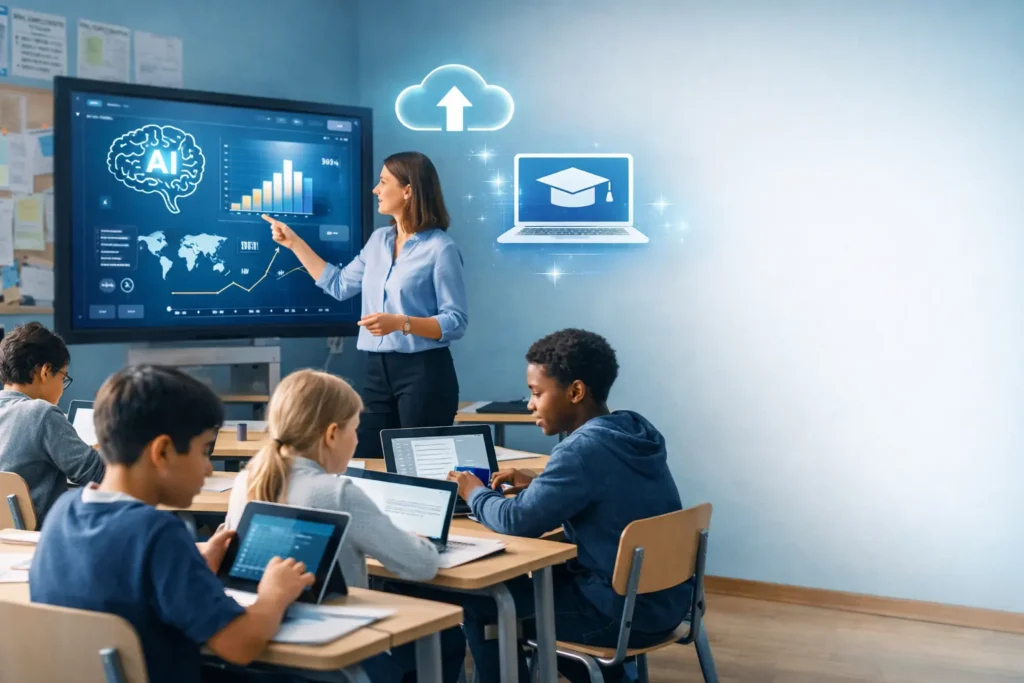
Few forces have reshaped modern society as rapidly or as profoundly as digital technology—and nowhere is that transformation more keenly felt, or more fiercely debated, than in education. From one-room schoolhouses wired with high-speed internet to universities deploying artificial intelligence to personalise every student’s learning journey, educational technology (EdTech) promises to democratise knowledge and unlock human potential at an unprecedented scale. Yet that same promise is shadowed by real perils: widening inequalities, erosion of privacy, commercialisation of learning, and the risk of displacing the irreplaceable human heart of good teaching.
This guide offers a full-spectrum view of technology in education. Whether you are a classroom teacher choosing your first learning app, a school administrator drafting a digital-readiness policy, a parent trying to understand your child’s screen time, or a researcher tracking EdTech trends, you will find here a balanced, evidence-informed resource that acknowledges both the excitement and the caution that this field demands.
What is Education with Technology (EdTech)? Defining the Landscape
Education with Technology is both a field of study and a set of practices. In its broadest sense, EdTech refers to the use of digital tools, platforms, and pedagogical methods to facilitate, enhance, and expand learning. It is emphatically not just a synonym for “having devices in classrooms.” A laptop gathering dust on a shelf is not EdTech; a teacher using that laptop to connect her students with peers on another continent for a joint science project very much is.
The Association for Educational Communications and Technology defines the field as “the study and ethical practice of facilitating learning and improving performance by creating, using, and managing appropriate technological processes and resources.” That definition highlights three things that matter: learning outcomes, ethical responsibility, and deliberate management—themes that run throughout this guide.
Core Components of EdTech
Digital Tools and Platforms
The most visible layer of EdTech is the software and services students and teachers interact with daily. Learning Management Systems (LMS) such as Canvas, Moodle, and Google Classroom act as the organisational backbone of digital learning—housing course content, assignments, gradebooks, and communication channels in one place. Video conferencing tools, collaborative document editors, and interactive quiz platforms extend the classroom beyond physical walls, enabling synchronous lessons, asynchronous discussions, and real-time formative assessment.
Immersive Technologies
Virtual reality (VR), augmented reality (AR), 3D animation, and simulation software represent a newer frontier. Rather than reading about the structure of a human cell, students can navigate inside one. Rather than watching a documentary about ancient Rome, they can walk its streets in a VR reconstruction. Simulations in fields like medicine, engineering, and aviation allow learners to practise high-stakes skills in a consequence-free environment, compressing years of experiential learning into manageable, repeatable sessions.
“Smart” Technologies: AI and Adaptive Learning
Artificial intelligence is increasingly woven into educational platforms—sometimes visibly, sometimes invisibly. Adaptive learning systems analyse each student’s responses in real time and adjust the difficulty, format, and sequencing of content accordingly. AI-powered writing assistants provide instant feedback on drafts. Intelligent tutoring systems have demonstrated, in controlled research settings, learning gains comparable to one-to-one human tutoring. Large language models now serve as on-demand research aids, brainstorming partners, and language practice companions. The pedagogical and ethical implications of these tools are vast—and explored in detail later in this guide.
The Transformative Power: Key Benefits and Opportunities of Technology in Education
When implemented thoughtfully, technology amplifies what the best teachers and schools already do well. The following sections explore the most significant benefits identified by research and practice.
Enhancing Access and Inclusion
Geography has always been one of education’s cruellest gatekeepers. A child born in a remote rural community, a conflict zone, or a low-income urban neighbourhood has historically had access to far fewer educational resources than a peer in a well-funded suburb or a prosperous city. Digital learning fundamentally challenges that inequality. Massive Open Online Courses (MOOCs), open educational resources (OER), and distance education programmes make world-class content available to anyone with an internet connection.
Inclusive education also benefits directly from technology. Text-to-speech software and screen readers open up written content to students with visual impairments or dyslexia. Captioning and sign-language interpretation tools make video content accessible to the deaf and hard of hearing. Adjustable font sizes, high-contrast displays, and alternative input devices extend participation to students with a range of physical disabilities. When designed with universal design for learning (UDL) principles in mind, EdTech tools can serve every learner, not just the majority.
Personalising the Learning Journey
Traditional classroom instruction faces a fundamental tension: a single teacher must simultaneously meet the needs of students who are working ahead, students who are on pace, and students who need more time or a different approach. Technology offers a partial but powerful resolution. Adaptive learning platforms track each student’s performance and dynamically serve content pitched at precisely the right level of challenge—a concept called the “zone of proximal development” in educational psychology. Self-paced modules allow students to master one concept before advancing, reducing the anxiety and knowledge gaps that accumulate when a class moves on before everyone is ready.
Data dashboards give teachers a granular view of class and individual progress, enabling them to intervene early when a student is struggling and to accelerate those who are ready for greater challenge. Crucially, personalisation is not about replacing teacher judgment; it is about giving teachers better information and more time to do what machines cannot—build relationships, inspire curiosity, and nurture emotional and social development.
Fostering Collaboration and Global Connection
The workplace that today’s students will enter is characterised by distributed teams, cross-cultural collaboration, and rapid knowledge exchange across time zones. Digital tools prepare students for that reality by making collaboration a lived, daily experience rather than an occasional exercise. Shared documents allow multiple students to co-author, edit, and comment simultaneously. Project management tools teach coordination and accountability. Video conferencing connects classrooms across continents for joint inquiries, debate tournaments, and cultural exchanges that broaden perspective in ways no textbook can.
Schools that have embraced global collaboration report that students develop not only stronger communication and teamwork skills but also greater empathy and intercultural competence. Learning to negotiate meaning with someone whose first language, religious background, or political context differs from your own is, in the fullest sense, an education.
Building Essential 21st-Century Skills
The International Society for Technology in Education (ISTE) has codified the competencies students need in a digital world into seven roles: Empowered Learner, Digital Citizen, Knowledge Constructor, Innovative Designer, Computational Thinker, Creative Communicator, and Global Collaborator. Each represents a cluster of skills that technology, when thoughtfully integrated, can develop.
Critical thinking and problem-solving flourish when students use real data, simulate complex systems, or debug code. Creativity is exercised when students produce digital media, design apps, or compose music with technology tools. Digital literacy—the ability to find, evaluate, curate, and ethically use information—is increasingly indistinguishable from basic literacy itself. Computational thinking, the capacity to decompose problems, identify patterns, and design algorithmic solutions, underpins careers far beyond software engineering. These are not supplementary skills; they are core competencies for full participation in contemporary society.
A guide that catalogued only EdTech’s benefits would be neither honest nor useful. The UNESCO Global Education Monitoring (GEM) Report and a growing body of rights-based scholarship document serious, systemic problems that advocates of digital learning must confront rather than dismiss. The following sections address each challenge directly.
The Digital Divide and Inequality
The digital divide is not a single gap but a layered system of inequalities. The first layer is access: roughly 2.7 billion people worldwide still lack internet access, and device ownership remains starkly unequal across income levels, geographies, and demographic groups. The second layer is usage quality: even where devices and connectivity exist, students in lower-income schools often have older equipment, slower connections, and less technical support than their wealthier peers. The third layer is skills: access to technology without adequate digital literacy instruction can leave students unable to exploit the tools available to them.
The COVID-19 pandemic made this painfully visible. When schools shifted abruptly to remote learning, millions of students—disproportionately from low-income families, rural areas, and marginalised communities—were effectively locked out of education. A technology-centric approach to education that fails to address these structural inequalities risks not closing achievement gaps but widening them. Any EdTech strategy must begin with a frank assessment of who currently lacks access and what it will concretely take to extend access equitably.
Data Privacy and Security Concerns
EdTech platforms collect extraordinary quantities of sensitive data: learning behaviour, academic performance, social interactions, location data, and in some cases biometric information such as eye-tracking or emotion detection. This data has enormous value—both for improving educational outcomes and for commercial exploitation. The risk is that students, who cannot meaningfully consent to data collection and whose digital footprints may follow them for decades, are effectively subjected to a form of surveillance as a condition of their education.
Regulation has struggled to keep pace with technology. Frameworks such as the EU’s General Data Protection Regulation (GDPR), the US Children’s Online Privacy Protection Act (COPPA), and India’s emerging data protection law provide important protections, but enforcement is inconsistent and commercial incentives for data harvesting are powerful. Schools and districts must go beyond legal minimum compliance, scrutinising the data practices of every platform they adopt, ensuring third-party data sharing is prohibited in vendor contracts, and educating students about their digital rights.
Threats to Quality Education and Human Connection
Technology can be a powerful tool for excellent education, but it can also be a veneer that conceals impoverished pedagogy. Poorly designed digital content, low-quality MOOCs, and edutainment apps that prioritise engagement metrics over learning outcomes can give the appearance of modern education while delivering something hollow. The UNESCO GEM Report has documented cases where EdTech adoption was driven by commercial interests and government prestige rather than by evidence of effectiveness.
There is also the question of what technology cannot replace. The relationship between a skilled teacher and a student—built on trust, attentiveness, and genuine care—is not merely a delivery mechanism for content. It is itself educationally essential. Research in developmental psychology and neuroscience consistently shows that social connection and emotional safety are prerequisites for deep learning. Any EdTech implementation that treats technology as a teacher replacement rather than a teacher’s ally runs the risk of undermining the very conditions that make learning possible.
Well-being, Distraction, and Digital Safety
Excessive or unstructured screen time is associated with reduced physical activity, disrupted sleep, and in some studies, heightened anxiety and depression in adolescents. In classroom settings, devices that offer unrestricted internet access can be significant sources of distraction, with research suggesting that even the mere presence of a smartphone reduces available cognitive capacity.
Cyberbullying, exposure to harmful content, and online predation are serious safety concerns that schools must address proactively, not reactively. Digital citizenship education—teaching students to behave ethically, critically, and safely online—is not a nice-to-have; it is a fundamental component of preparing young people for life in a connected world. Schools also need clear, enforceable policies on device use, social media, and online communication to protect students and staff alike.
Building a Framework for Success: Essential Conditions and Best Practices
The difference between EdTech that transforms education and EdTech that wastes resources or causes harm often lies not in the technology itself but in the conditions surrounding it. The following sections outline the essential conditions for sustainable, equitable, high-quality technology integration.
The Foundation: Infrastructure, Access, and Funding
Meaningful technology integration requires reliable, high-speed internet connectivity; sufficient devices in good working condition; technical support infrastructure to maintain and troubleshoot equipment; and secure, well-managed networks. These are not glamorous investments, but they are non-negotiable. A school that buys tablets but cannot maintain them, or deploys a VR programme over a broadband connection too slow to stream the content, is not investing in EdTech—it is investing in frustration.
Funding models vary significantly by jurisdiction. In many countries, digital infrastructure falls between the responsibilities of education departments and telecommunications regulators, resulting in chronic underinvestment. Effective advocacy for EdTech funding must therefore engage not just education ministries but finance ministries, regulatory bodies, and—where appropriate—the private sector. Public-private partnerships have successfully extended connectivity to underserved communities in several countries, though they require careful governance to prevent commercial priorities from distorting educational ones.
Empowering Educators: The Non-Negotiable Role of Teacher Training
Research is unambiguous on this point: the single most important determinant of whether educational technology improves learning outcomes is teacher capacity. A teacher who understands how to integrate a tool purposefully—selecting it for specific pedagogical reasons, designing activities that exploit its strengths, and assessing its impact on student learning—will consistently outperform both the same technology in an untrained teacher’s hands and no technology at all.
Effective professional development for EdTech is not a one-day training session. It is an ongoing, job-embedded process that includes initial skills development, classroom coaching, peer collaboration, and structured reflection. The Technological Pedagogical Content Knowledge (TPACK) framework provides a useful map: effective technology integration requires not just technological skill but a nuanced understanding of how technology intersects with both subject-matter expertise and the art of teaching. Resistance to change is best addressed not with mandates but with meaningful support, time, and recognition.
Developing a Rights-Respecting EdTech Policy: Governance and Regulation
Every school, district, and national education system needs a clear, evidence-based EdTech policy. Such a policy should articulate the educational goals that technology is intended to serve, the data privacy standards that all platforms must meet, the criteria by which new tools are evaluated and approved, the processes for teacher training and ongoing support, and the mechanisms for monitoring, evaluating, and if necessary discontinuing technology initiatives.
A rights-respecting approach—grounded in the UN Convention on the Rights of the Child and the right to education—places student well-being, equity, and participation at the centre of policy design. It requires that students and families are meaningfully informed about how data is used, that EdTech adoption decisions are driven by educational evidence rather than commercial lobbying, and that marginalised and vulnerable students are not systematically disadvantaged by digital learning systems.
Practical Implementation: Aligning Tools with Pedagogy
The most common mistake in EdTech implementation is choosing the technology first and finding a use for it second. Effective integration starts with a clear learning objective and works backwards to identify the tool or combination of tools best suited to achieve it. A teacher aiming to develop students’ ability to construct and evaluate historical arguments does not necessarily need a VR headset—she might need a well-designed online discussion platform and access to primary source databases.
Blended and hybrid learning models—which combine face-to-face and digital instruction in various proportions—offer a pragmatic middle path that preserves the human dimension of education while extending its reach and flexibility. Within blended models, the flipped classroom (where direct instruction is delivered via video at home, freeing class time for active application and discussion) has accumulated a solid evidence base when implemented with adequate teacher support. Gamification—the incorporation of game mechanics such as points, badges, and leaderboards—can boost motivation when used judiciously, though it requires care to avoid reducing intrinsic motivation or creating inequitable competitive dynamics.
The Student at the Centre: Core Competencies for a Digital Age
The ISTE Standards for Students represent the field’s most widely adopted framework for defining what students should know and be able to do in a technology-rich world. Rather than prescribing specific tools or grade-level benchmarks, the standards articulate seven roles that students should be able to inhabit across their educational journey.
- Empowered Learner: Students actively set their own learning goals, employ a variety of strategies and networks to access information, and use technology to demonstrate their competence in personally meaningful ways. The empowered learner understands that technology is a tool for agency, not a substitute for effort.
- Digital Citizen: Students recognise the rights and responsibilities that come with membership in digital communities. They understand online safety, privacy, intellectual property, and the consequences of their digital footprint. Digital citizenship is not just about avoiding harm—it is about contributing positively to shared online spaces.
- Knowledge Constructor: Students use digital tools to curate and critically evaluate information, building coherent bodies of knowledge from diverse sources. In an era of information abundance and deliberate disinformation, the ability to distinguish credible from unreliable sources is a survival skill.
- Innovative Designer: Students use a deliberate design process to create solutions to real-world problems. They are comfortable with iteration, prototyping, and productive failure—qualities that technology-mediated design projects are uniquely well-positioned to cultivate.
- Computational Thinker: Students approach problems in ways that a computer could help solve, employing problem decomposition, pattern recognition, abstraction, and algorithmic thinking. Computational thinking is not the same as coding, though coding is one way to develop it.
- Creative Communicator: Students communicate ideas clearly and powerfully using digital media. They select platforms and formats thoughtfully, understanding that medium and message are intertwined.
- Global Collaborator: Students use digital tools to connect with learners from other cultures, contributing to team projects with respect for diverse perspectives and an appreciation that complex problems benefit from diverse minds.
These standards are not a checklist to be ticked off in a single lesson but a developmental arc spanning years of schooling. They are most powerfully realised when embedded naturally in subject-area learning rather than taught as separate “digital skills” lessons—just as good writing is best taught within subjects rather than in isolation.
The Future of Education with Technology: Emerging Trends to Watch
The pace of technological change makes confident prediction hazardous, but several trends are already reshaping what education could look like over the next decade.
AI-Powered Hyper-Personalisation
The latest generation of AI tutors and adaptive platforms can engage in nuanced dialogue with students, responding not just to correct and incorrect answers but to the reasoning students reveal in their explanations. As large language models improve, the dream of a personal Socratic tutor available to every student around the clock—irrespective of their family income or location—moves closer to reality. The critical question is not whether AI can personalise learning but whether it will be deployed equitably, transparently, and in ways that augment rather than replace human relationship and judgment.
Immersive and Spatial Computing
As VR headsets become lighter, cheaper, and more capable, and as augmented reality layers digital content onto the physical world through glasses and smartphones, the boundary between physical and digital learning environments will continue to blur. Early research suggests that immersive VR experiences produce stronger learning and retention than equivalent 2D content for certain types of knowledge, particularly spatial, procedural, and empathy-based learning. The metaverse—shared, persistent virtual worlds where people can work, play, and learn together—represents a more speculative but potentially transformative frontier.
Blockchain and Verifiable Credentials
Traditional academic credentials—degrees, diplomas, certificates—are opaque, easy to forge, and poorly suited to a world of lifelong, modular, micro-credentialed learning. Blockchain-based credential systems allow any skill, course, or competency to be recorded in a tamper-proof, instantly verifiable digital record that belongs to the learner rather than the institution. This could fundamentally change how employers, universities, and licensing bodies recognise learning that happens outside formal pathways—an enormous equity opportunity for people whose best education occurs in community programmes, online platforms, or workplace training.
Ethics, Bias, and Accountability in EdTech
As algorithmic systems play a larger role in education—recommending content, assessing essays, predicting which students are at risk of dropout—the question of who those algorithms serve and whose interests they may inadvertently harm becomes urgent. AI systems trained on historical data can encode and amplify existing biases, disadvantaging students from groups already underserved by education. Explainability—the ability to understand why an algorithm made a particular decision—is essential for accountability. The EdTech field needs rigorous, independent evaluation of algorithmic systems, and educators need sufficient AI literacy to interrogate, challenge, and if necessary reject systems that operate against the interests of their students.
faqs
What is educational technology (EdTech)?
EdTech is the field and practice of using digital tools, platforms, and pedagogical methods to facilitate and enhance learning. It encompasses everything from simple classroom apps to sophisticated AI tutoring systems, and is defined not by the technology itself but by its intentional application to educational goals.
What are the main benefits of technology in education?
The primary benefits include expanded access to quality education regardless of geography, personalised learning experiences that adapt to each student’s pace and needs, richer collaboration opportunities including global partnerships, development of critical 21st-century skills such as computational thinking and digital literacy, and greater engagement through interactive and immersive content.
What are the main challenges or disadvantages of EdTech?
Key challenges include the digital divide (unequal access to devices and connectivity), data privacy risks, commercialisation pressures, potential degradation of human connection in learning, screen time and well-being concerns, and the risk of deploying technology that is not grounded in educational evidence. These challenges can be mitigated through thoughtful policy, equitable investment, and strong teacher training.
How has technology changed education?
Technology has expanded the reach of education beyond physical classrooms, enabled unprecedented personalisation of learning, shifted the teacher’s role from information transmitter to learning designer and coach, created new forms of assessment and feedback, and made global collaboration a practical reality for students of all ages. It has also introduced new challenges around attention, privacy, and equity.
What is the role of the teacher when technology is used in education?
The teacher’s role becomes more important, not less, when technology is well integrated. Teachers design learning experiences, select tools aligned with pedagogical goals, interpret data to guide instruction, build the relationships and emotional safety that enable deep learning, and model the ethical use of technology. No algorithm or platform can substitute for an expert, caring human educator.
How can schools protect student data privacy?
Schools should thoroughly vet all EdTech platforms for compliance with applicable privacy laws (such as GDPR or COPPA), ensure vendor contracts explicitly prohibit third-party data sharing, establish a formal approval process for new tools, educate students and families about data rights, and conduct regular audits of data practices. Platforms that cannot provide transparent, satisfactory answers about their data governance should not be used.
What is the digital divide and why does it matter for education?
The digital divide refers to the gap between those who have meaningful access to digital technology and those who do not, along the dimensions of device ownership, internet connectivity, and digital skills. In education, this divide means that technology-centric approaches can systematically disadvantage students from low-income families, rural communities, and marginalised groups—making equity-first planning an ethical imperative for any EdTech strategy.
What are some effective examples of technology in education today?
Effective examples include: adaptive learning platforms that personalise mathematics instruction based on real-time assessment; VR simulations that allow medical students to practise surgical procedures without risk; global collaboration projects facilitated by video conferencing that connect students across continents on shared research questions; AI writing assistants that provide immediate, granular feedback on student essays; and learning management systems that enable teachers to differentiate instruction at scale while maintaining visibility of every student’s progress.
What are the ISTE Standards for Students?
The ISTE Standards for Students define seven roles or competency profiles: Empowered Learner, Digital Citizen, Knowledge Constructor, Innovative Designer, Computational Thinker, Creative Communicator, and Global Collaborator. They represent a widely adopted framework for articulating what students should know, believe, and be able to do as digitally competent, ethical participants in a connected world.
How can schools implement technology effectively?
Effective implementation requires: starting with clear educational goals rather than with technology; ensuring adequate infrastructure and equitable access; investing substantially in ongoing teacher professional development; establishing robust data privacy policies; adopting a blended or hybrid model that preserves face-to-face learning where it matters most; and committing to evidence-based evaluation of technology’s impact on student outcomes. Implementation is a continuous improvement process, not a one-time deployment.
Is online learning as effective as in-person learning?
The evidence is nuanced. For motivated adult learners with adequate self-regulation skills and reliable technology, high-quality online learning can be as effective as face-to-face instruction. For younger children, students with limited self-regulation, or those who lack access to a quiet study environment and device support at home, fully online learning typically underperforms blended or in-person models. The COVID-19 pandemic provided a large-scale, if unwanted, test: learning losses were real, particularly for younger and disadvantaged students. This suggests that the ideal is not a binary choice but a thoughtful blend.
What is blended learning?
Blended learning combines face-to-face instruction with online or digital learning in a deliberate, integrated way. Unlike simple homework or supplementary exercises delivered online, true blended learning redesigns the use of time, space, and the teacher’s role so that digital and in-person learning complement and reinforce each other. Models include the flipped classroom (instruction at home, application in class), rotation models (students rotate between digital stations and teacher-led instruction), and flex models (largely self-paced, with teachers available for support).
Conclusion: Technology as a Means, Not an End
Educational technology is neither a magic bullet nor a menace. It is a powerful set of tools whose impact depends almost entirely on the wisdom, equity, and intentionality with which they are deployed. The schools and systems that will benefit most from EdTech are not those that adopt the newest or most expensive technologies first, but those that ask, with rigour and humility: What are we trying to achieve for every one of our students? What evidence suggests this technology will help? Who might it leave behind? And how will we know if it is working?
The promise of technology in education—that every child, wherever she is born, can access the knowledge and the connections she needs to build a flourishing life—is a genuinely inspiring one. Realising that promise requires not just technological investment but political will, equitable resource distribution, teacher empowerment, and an unwavering commitment to the proposition that education is, at its core, a human endeavour.

Adrian Cole is a technology researcher and AI content specialist with more than seven years of experience studying automation, machine learning models, and digital innovation. He has worked with multiple tech startups as a consultant, helping them adopt smarter tools and build data-driven systems. Adrian writes simple, clear, and practical explanations of complex tech topics so readers can easily understand the future of AI.