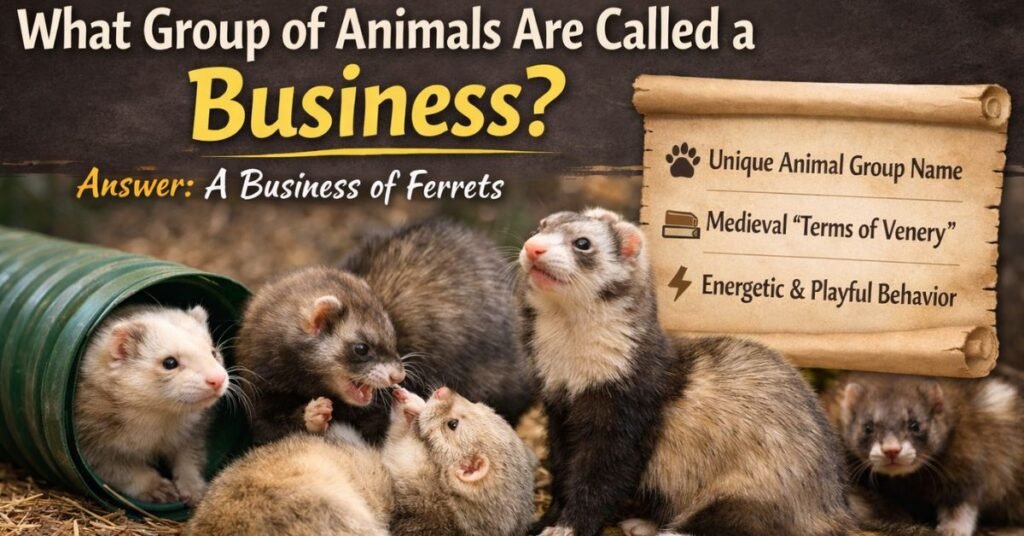
If someone asked you what group of animals are called a business, your first instinct might be to think of humans in suits sitting in a boardroom.
Surprisingly, the answer has nothing to do with corporations or entrepreneurs. In the animal kingdom, a “business” refers to a group of ferrets.
Yes, ferrets.
This unusual term belongs to a category of language known as collective nouns—special words used to describe groups of animals. Some of them are well known, like a pack of wolves or a flock of birds, while others are wonderfully strange and poetic.
A business of ferrets is one of the most intriguing examples.
But the story goes much deeper than a quirky phrase. Understanding where this term comes from opens a window into:
- The fascinating world of animal collective nouns
- The history of English language traditions
- The behavior and social structure of ferrets
- Why certain animals received unusual group names centuries ago
By the end of this guide, you’ll understand exactly what group of animals are called a business, why ferrets earned this name, and how this odd expression has survived in modern language.
Let’s dive into one of the most charming linguistic curiosities in the animal kingdom.
What Group of Animals Are Called a Business?
The short answer is simple.
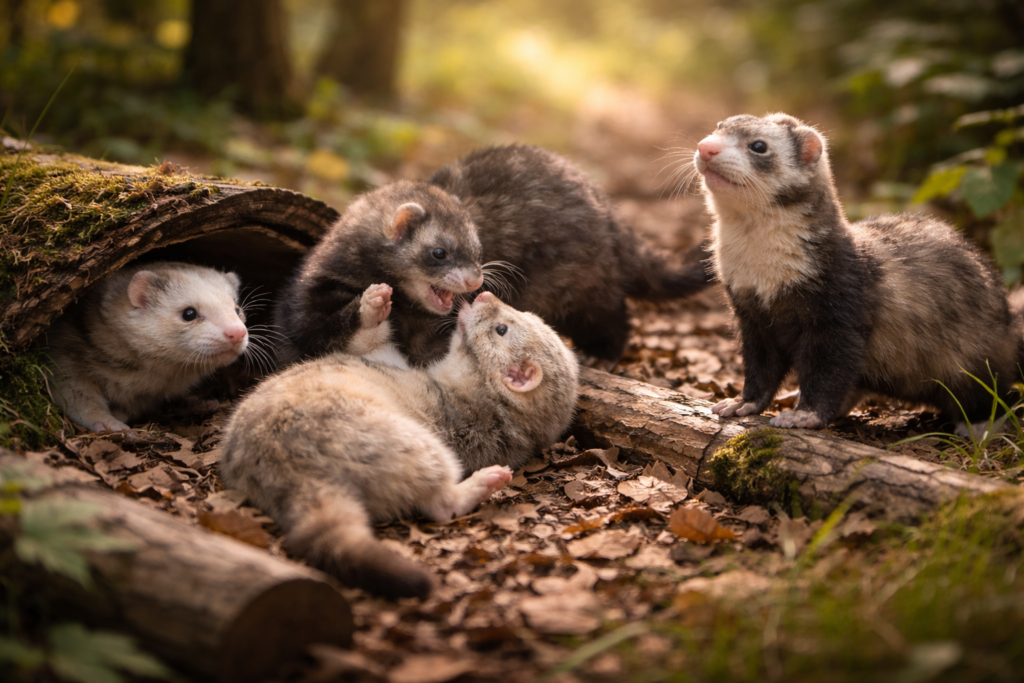
A group of ferrets is called a business.
However, like many collective nouns, the term has historical roots and cultural influences that go back hundreds of years.
Collective nouns are descriptive phrases used to refer to groups of animals, objects, or people. While many are straightforward—like a herd of cattle—others are more imaginative.
Examples include:
- A murder of crows
- A parliament of owls
- A tower of giraffes
- A crash of rhinos
- A business of ferrets
These phrases were often created during the late Middle Ages, particularly among hunting communities and aristocratic circles in England. Books about hunting and animal classification introduced elaborate terminology for groups of animals.
One of the earliest influential works was The Book of Saint Albans (1486), which included a list of collective nouns called “terms of venery.”
These terms were partly practical but also playful. Many were intentionally witty or symbolic.
The phrase “business of ferrets” likely emerged from observing the animal’s personality and behavior. Ferrets are energetic, curious, and constantly busy exploring their surroundings.
Their never-ending activity made the word business an amusing but fitting description.
Imagine several ferrets together:
- darting through tunnels
- chasing each other
- sniffing every corner
- investigating everything
It truly looks like a group constantly “busy” with activity, which likely inspired the name.
So while it might sound unusual at first, the phrase perfectly captures the personality of ferrets.
Understanding Collective Nouns for Animals
To fully appreciate the phrase a business of ferrets, it helps to understand how collective nouns work.
Collective nouns describe groups as a single entity, providing a more colorful alternative to saying “a group of animals.”
They exist across many categories.
Examples include:
Common Animal Collective Nouns
Mammals:
- Herd of elephants
- Pack of wolves
- Troop of monkeys
- Pod of dolphins
- Business of ferrets
Birds:
- Flock of birds
- Murder of crows
- Parliament of owls
- Gaggle of geese
Insects:
- Swarm of bees
- Army of ants
Fish:
- School of fish
- Shoal of fish
While some of these terms are widely used in everyday language, others remain mostly literary or historical.
Interestingly, many collective nouns were created more for entertainment and linguistic creativity than strict scientific classification.
Writers and scholars enjoyed inventing clever phrases that captured the essence of an animal’s behavior or personality.
For example:
- A parliament of owls suggests wisdom and deliberation.
- A murder of crows evokes dark, mysterious imagery.
- A business of ferrets reflects constant activity and curiosity.
These expressions turned language into something descriptive and imaginative, rather than purely functional.
Today, collective nouns remain popular in education, literature, trivia, and wildlife discussions, making them a fun way to engage with language and nature.
Why Ferrets Are Called a “Business”
The phrase business of ferrets isn’t random—it reflects the nature of the animals themselves.
Ferrets are famously energetic creatures.
Anyone who has owned or observed ferrets knows they are rarely still for long. They spend most of their time:
- Exploring small spaces
- Digging and burrowing
- Chasing each other
- Investigating objects
- Playing with surprising intensity
This nonstop activity likely inspired the idea that ferrets are always “busy.”
Ferret Behavior Explained
Ferrets belong to the mustelid family, which also includes:
- Weasels
- Otters
- Badgers
- Minks
Members of this family are known for their:
- agility
- curiosity
- intelligence
- hunting instincts
Ferrets were domesticated thousands of years ago and historically used for hunting rabbits through a method called ferreting.
During this activity, ferrets would enter rabbit burrows, chase the rabbits out, and assist hunters.
Watching multiple ferrets work together likely reinforced the impression of organized activity or “business.”
Their social play also looks remarkably busy.
Ferrets frequently engage in something called the “weasel war dance.”
This energetic display includes:
- hopping sideways
- bouncing around
- twisting their bodies
- making playful sounds
When several ferrets perform this behavior together, the scene looks chaotic, energetic, and extremely busy.
Thus, the name “business of ferrets” makes perfect sense.
The History Behind Animal Group Names
Many people assume collective nouns are modern inventions, but their history stretches back hundreds of years.
During medieval times, aristocrats and hunters developed elaborate terminology for animals as part of hunting culture.
These terms became known as “terms of venery.”
They were recorded in medieval books on hunting and animal classification.
Some well-known examples from this period include:
- A murder of crows
- A pride of lions
- A parliament of owls
- A leap of leopards
- A skulk of foxes
These terms served several purposes:
- Demonstrating education and social status
- Adding colorful language to hunting traditions
- Creating memorable descriptions of animal behavior
The medieval elite enjoyed using specialized vocabulary to show sophistication.
Over time, many of these phrases entered mainstream language and remained part of English vocabulary.
Interestingly, some collective nouns are rarely used outside trivia or educational contexts, while others have become standard.
For example:
Commonly used today:
- flock of birds
- herd of cattle
- pack of wolves
Less common but still known:
- business of ferrets
- crash of rhinos
- flamboyance of flamingos
Even though they may sound humorous today, these expressions represent a rich part of linguistic history and cultural storytelling.
Real-Life Behavior of Ferrets in Groups
Understanding how ferrets behave socially helps explain why they were assigned such an energetic collective noun.
Ferrets are naturally social animals.
In the wild—or when kept together as pets—they enjoy companionship and play.
Group Dynamics Among Ferrets
When multiple ferrets live together, they often:
- Sleep piled together for warmth
- Play wrestle and chase
- Explore their environment cooperatively
- Communicate through squeaks and body language
A group of ferrets can be extremely entertaining to watch.
They frequently engage in coordinated play that includes:
- tunneling through blankets
- chasing toys
- hopping around energetically
This activity rarely stops for long.
Ferrets typically sleep deeply for several hours, then wake up and become intensely active for short bursts.
When several ferrets wake up at the same time, the result is a whirlwind of movement.
This chaotic energy likely inspired observers to describe them collectively as a “business.”
It reflects their:
- constant motion
- curiosity
- coordinated activity
In many ways, watching a group of ferrets resembles observing a group of energetic workers constantly moving between tasks.
Benefits of Learning Animal Collective Nouns
At first glance, learning terms like “business of ferrets” might seem like simple trivia.
However, these expressions offer several surprising benefits.
Language Enrichment
Collective nouns expand vocabulary and make communication more vivid.
Instead of saying “a group of ferrets,” the phrase business of ferrets creates a more memorable image.
Writers, educators, and storytellers often use these expressions to add personality to their work.
Educational Value
Teachers frequently use collective nouns to make learning more engaging for students.
They help illustrate:
- animal behavior
- language evolution
- descriptive writing
Students often enjoy discovering unusual phrases such as a flamboyance of flamingos or a parliament of owls.
Wildlife Awareness
Learning these terms also sparks curiosity about animals themselves.
Someone who learns the phrase business of ferrets might become interested in:
- ferret domestication
- mustelid species
- animal behavior
This curiosity encourages deeper exploration of wildlife and ecosystems.
Cultural Literacy
Collective nouns represent an important part of English linguistic heritage.
Understanding them helps people appreciate how language evolved through centuries of storytelling, observation, and humor.
In short, collective nouns blend language, culture, and natural history into memorable expressions.
How to Identify and Use Animal Group Names
If you’re curious about animal collective nouns, learning how to recognize and use them correctly is surprisingly simple.
Step 1: Understand the Animal
Start by learning basic facts about the animal.
Questions to ask:
- Is the animal social?
- Does it live in herds, packs, or colonies?
- Does its behavior inspire a descriptive name?
For ferrets, their busy, energetic behavior led to the term business.
Step 2: Learn the Traditional Term
Many collective nouns come from historical traditions.
Examples:
- pride of lions
- murder of crows
- business of ferrets
These names often appear in dictionaries and educational materials.
Step 3: Use the Term Naturally
Collective nouns work best in descriptive writing.
Example sentences:
- A business of ferrets raced through the tunnels.
- The playful business of ferrets explored every corner of the room.
Using these terms adds personality to language.
Step 4: Teach Others
Sharing unusual collective nouns is a fun way to spark conversation.
People often enjoy learning surprising animal facts.
For example:
“Did you know a group of ferrets is called a business?”
It’s a perfect piece of trivia that tends to stick in people’s memory.
Tools and Resources to Learn More Animal Collective Nouns
If you’re interested in exploring more unusual animal group names, several excellent resources can help.
Books
Popular educational books include:
- animal trivia collections
- wildlife encyclopedias
- language and etymology guides
These often contain lists of hundreds of collective nouns.
Educational Websites
Several wildlife and language websites maintain updated lists of animal group names.
These resources often include:
- historical origins
- animal behavior explanations
- visual examples
Wildlife Documentaries
Nature documentaries frequently describe animal group behavior.
Watching animals in their natural habitats helps connect collective nouns with real-world behavior.
Classroom Resources
Teachers often use flashcards, posters, and quizzes featuring animal collective nouns.
These tools make learning both fun and memorable.
Common Misunderstandings About the Term “Business of Ferrets”
Because the phrase sounds unusual, people often misunderstand it.
Here are a few common misconceptions.
Mistake 1: Thinking It Refers to Humans
Some assume the phrase refers to business professionals or organizations.
In reality, the term strictly describes a group of ferrets.
Mistake 2: Assuming It’s a Scientific Term
Collective nouns are mostly linguistic traditions, not scientific classifications.
Biologists typically say group of ferrets rather than business of ferrets.
Mistake 3: Believing It’s Widely Used in Everyday Speech
While widely known in trivia and education, the phrase isn’t used frequently in daily conversation.
However, it remains a charming part of English vocabulary.
How to Avoid Confusion
Remember these key points:
- It’s a collective noun
- It refers specifically to ferrets
- It originated from historical language traditions
Once you know that, the phrase becomes easy to remember.
Conclusion
The question “what group of animals are called a business” leads to one of the most delightful quirks in the English language.
A business of ferrets perfectly captures the playful, energetic nature of these curious animals.
But the story goes beyond just one phrase.
It reveals the fascinating world of animal collective nouns, a tradition shaped by centuries of observation, creativity, and storytelling.
These expressions enrich our language by turning simple descriptions into vivid imagery.
Whether it’s a parliament of owls, a murder of crows, or a business of ferrets, each phrase reflects something unique about the animals it describes.
Next time you see ferrets darting around together, you’ll know exactly what to call them.
A busy, energetic, endlessly curious business of ferrets.
And if you enjoy learning unusual facts like this, keep exploring the strange and wonderful vocabulary hidden within the natural world.
Language, after all, is full of surprises.
FAQs
What group of animals are called a business?
A group of ferrets is called a business. This collective noun reflects the animals’ energetic and constantly active behavior.
Why are ferrets called a business?
Ferrets are extremely playful and curious animals that are always moving and exploring. Their constant activity likely inspired the term business, suggesting they are always busy.
Is “business of ferrets” a scientific term?
No. The phrase is a collective noun from linguistic tradition, not a scientific classification used by zoologists.
Are there other names for groups of ferrets?
While business is the most recognized collective noun, people sometimes simply say group of ferrets in everyday language.
What family do ferrets belong to?
Ferrets belong to the mustelid family, which includes animals like weasels, otters, minks, and badgers.

Michael Grant is a business writer with professional experience in small-business consulting and online entrepreneurship. Over the past decade, he has helped brands improve their digital strategy, customer engagement, and revenue planning. Michael simplifies business concepts and gives readers practical insights they can use immediately.