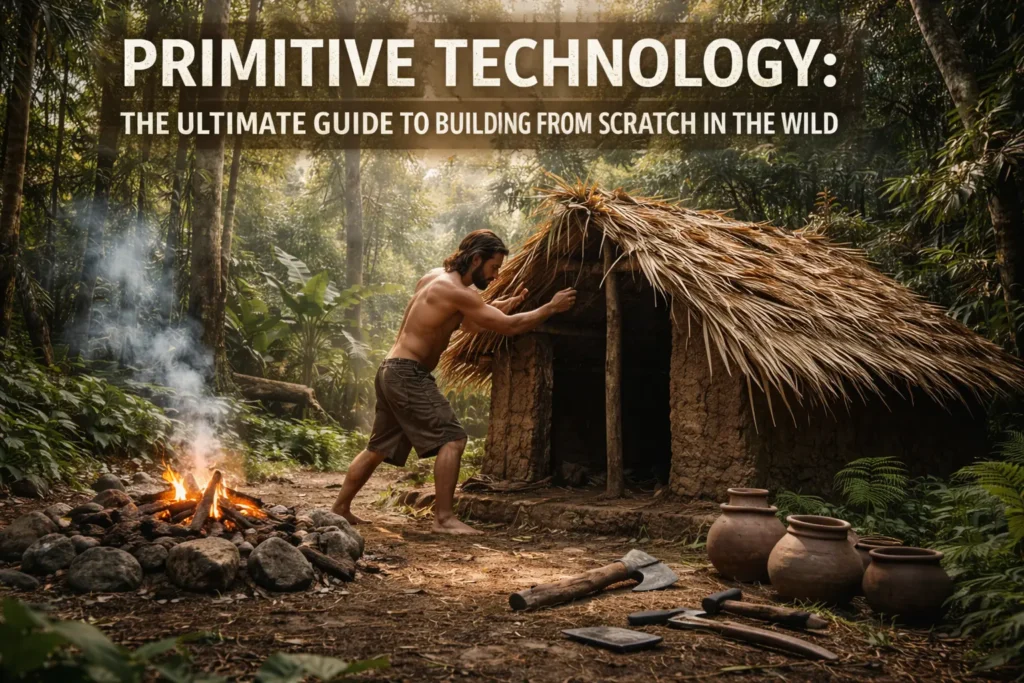
Discover the world of primitive technology — who started it, what it means, why millions are captivated, and how you can take your first steps into building from scratch with nothing but the natural world around you.
What is Primitive Technology? Definition and Core Principles
Primitive technology is the practice of building tools, shelters, and other functional objects entirely from raw, natural materials found in the wild — with zero use of modern tools or manufactured products. No metal axes, no plastic cordage, no store-bought cement. Every object, from the axe head to the thatched roof, must be created entirely from scratch using only what nature provides.
The concept sounds deceptively simple, but it is governed by a strict philosophical code. Practitioners must source, process, and fabricate every single component from the environment around them. A clay pot, for example, cannot be shaped with a metal scraper — it must be formed by hand or with a wooden tool that the practitioner themselves has fashioned. This self-imposed constraint is what separates primitive technology from ordinary bushcraft or general outdoor survival skills.
It is also important to understand what primitive technology is not. It is not survivalism, prepping, or doomsday planning. Survivalists train to endure emergencies. Primitive technology practitioners, by contrast, are engaged in a creative, intellectual, and deeply satisfying hobby — one that happens to produce remarkable results. The goal is not to “survive” in the wild, but to understand, master, and demonstrate the ingenuity of pre-modern human craftsmanship.
The core rules are few but absolute: use no modern tools, use no modern materials, build everything from scratch, and source everything from the natural environment. These constraints, far from limiting creativity, are precisely what make the practice so compelling.
Meet John Plant: The Man Behind the Phenomenon
If you have ever watched a silent video of a shirtless man in blue shorts methodically constructing a mud-brick hut in a lush Queensland forest, you have already encountered the face of primitive technology. That man is John Plant, an Australian from Far North Queensland who, almost by accident, became one of the most-watched and most-admired craftspeople on the internet.
John Plant launched his Primitive Technology YouTube channel in 2015. Within months, his videos were being watched by millions. By the late 2010s, his channel had surpassed 10 million subscribers and accumulated well over a billion views — extraordinary figures for a channel that publishes only a handful of videos per year and in which the creator never says a single word on screen.
Plant’s identity was not always public knowledge. For years, he remained anonymous, a deliberate choice that kept the focus squarely on the work rather than the personality. When his identity was eventually revealed, it added a layer of endearing normality to the whole phenomenon: here was a quiet man from rural Queensland, working a modest day job mowing lawns, who had built one of the most successful YouTube channels in the world as a creative hobby.
Plant holds a BSc degree and approaches his practice with the discipline of a scientist and the patience of a craftsman. He owns the land on which he films, a patch of Far North Queensland scrub that spans eucalyptus forest and wet tropical rainforest — home to mosquitoes, spiky plants, and apparently limitless quantities of good building clay.
His philosophy is one of knowledge exchange. In interviews and on his blog, Plant has emphasized that the goal is not personal glory but the documentation and sharing of techniques. The written posts accompanying each video break down materials, methods, and results in clear, precise language — a resource as valuable as the videos themselves.
One painful chapter in John Plant’s story deserves mention: a Facebook page that had stolen and reposted his videos reportedly earned around A$39,000 in advertising revenue — income that never reached him. It was a stark reminder of the dark side of viral content, and it underscored the importance of following and supporting official channels.
Why Are We So Fascinated by Primitive Technology?
Tens of millions of people watch videos of a silent man building things in the forest. No narration. No dramatic music. No jump cuts or fast edits. Just the methodical crack of stone on stone, the gentle hiss of a bow drill, the soft thud of mud being pressed into a wall. Why is this so captivating?
Psychologists who study motivation and behaviour have offered some compelling answers. Goal contagion is one key mechanism: when we observe someone working purposefully toward a clear goal, our own brains activate similar motivational pathways. Watching John Plant dig a foundation and lay stones triggers something in the viewer — a vicarious sense of progress and accomplishment.
Professor Art Markman of the University of Texas, commenting on the phenomenon in a BBC News feature, pointed to the appeal of watching someone demonstrate mastery of physical skills in an age when so much of modern life is abstract and digital. There is a profound satisfaction in seeing raw materials transformed into something functional through nothing but knowledge and physical effort.
There is also a deeper cultural undercurrent. In an era of institutional uncertainty, algorithmic complexity, and relentless digital noise, primitive technology offers something rare: total clarity. The rules are simple. The materials are real. The results are tangible. You either build a working fire or you do not. There is no ambiguity, no algorithm, no quarterly performance review.
The self-reliance fantasy also plays a powerful role. Deep in most people is some version of the Robinson Crusoe dream — the notion that, stripped of all modern convenience, we could somehow fend for ourselves using only our wits and the resources at hand. Primitive Technology videos feed that fantasy without requiring viewers to actually set foot in a forest.
Finally, the silence is itself a feature, not a limitation. In a world of constant noise, watching a man work in focused, wordless concentration is genuinely calming. Many viewers report watching John Plant’s videos for the same reason others watch rain fall or logs burn — it is meditative, grounding, and somehow restorative.
A Guide to Key Primitive Technology Projects and Skills
One of the most remarkable aspects of John Plant’s documented work is the way each project builds upon the last. Early videos show basic huts and fire-making. Later videos demonstrate iron smelting, under-floor heating systems, and mechanically assisted metalworking. It is, in miniature, a living documentation of human technological development across tens of thousands of years — compressed into a decade of YouTube content.
Below is a structured guide to the major categories of projects and the skills they represent.
Shelter and Architecture
The construction of shelter is the foundational project of primitive technology, and Plant has documented an extraordinary progression of architectural complexity. Early builds used simple thatched frames and timber-and-mud walls. Later structures incorporated fired terracotta roof tiles, mud-brick construction, and sophisticated water management features.
Among the most celebrated builds is the thatched workshop — a large, functional workspace with a properly engineered roof, packed earth floor, and walls robust enough to withstand heavy tropical rainfall. Even more impressive is the hut featuring an under-floor heating system (a hypocaust-style design), in which warm air from a central fire is channelled beneath the floor to heat the living space — a technique used by the Romans and various Asian civilisations for centuries.
- Wattle-and-daub huts with thatched roofing
- Fired terracotta tile roofing systems
- Mud-brick walls with clay-lime plaster
- Underfloor radiant heating channels
- Large workshop spaces with drainage and ventilation
- Raised floor platforms for dry storage
Mastering Fire: Pyrotechnology Basics
Fire is the gateway to virtually every other primitive technology skill. Without fire, there is no pottery, no metalworking, no cooking, no charcoal — the entire technological chain collapses. Mastering fire-making from first principles is therefore not merely useful; it is foundational.
The bow drill method is the most commonly demonstrated fire-starting technique in Plant’s videos. It uses a hardwood spindle rotated rapidly against a softer fireboard by a bow strung with cordage. The friction generates a glowing coal that is then carefully transferred to a tinder bundle and blown into flame. The technique requires practice but is reliably reproducible once the correct wood combinations and technique are established.
Beyond basic fire-making, pyrotechnology encompasses the use of fire in construction, ceramics, and metallurgy. Understanding how to build and manage a sustained, high-temperature fire — using specific fuel types, controlling airflow, and constructing proper fire chambers — is a skill that underpins nearly every advanced project.
- Bow drill fire starting with hardwood spindle and softwood fireboard
- Hand drill method for particularly dry environments
- Construction of efficient fire lays for sustained heat
- Charcoal production through controlled partial combustion
- Ash management and the production of wood ash lye
Tools, Weapons, and Machines
Early human technology was defined by the ability to shape stone, and Plant documents this progression with methodical care. The production of a functional stone axe — selecting the right rock, flaking it to a sharp edge, hafting it to a handle with cordage and tree resin — is a microcosm of everything that makes primitive technology remarkable. Every material must be understood, sourced, and processed correctly for the final tool to function.
As Plant’s documented skill set expanded, so did the sophistication of his machines. The centrifugal blower — a simple but ingenious device that uses a spinning paddle inside a clay housing to force air into a furnace — represents a significant leap in mechanical ingenuity. It dramatically increases the temperature achievable in a primitive furnace, enabling more advanced metalworking.
- Stone flaking and knapping for axe and adze heads
- Handle hafting with plant-fibre cordage and natural resins
- Digging sticks hardened by fire
- Slings and projectile weapons from stone and cordage
- Wooden hammers and mallets
- Centrifugal blower for furnace aeration
- Water-powered hammer (trip hammer) using stream flow
The Art of Weaving and Fibre Craft
Cordage — twisted plant fibre used as rope, string, or thread — is arguably the most universally useful product in the primitive technology toolkit. It is used in everything from tool handles and bow strings to roof lashings and carrying baskets. Plant demonstrates several methods for producing cordage from natural fibres, including bark strips, grass, and the stems of lawyer cane.
Weaving extends beyond cordage to baskets, mats, sandals, and structural wall panels. The technique of wattle — weaving flexible rods between upright stakes to create a rigid panel that can then be daubed with mud — is the basis for much of the wall construction in Plant’s hut projects. It is a beautiful example of how primitive technology transforms simple plant materials into complex, functional structures.
- Two-ply cordage twist from bark fibre and grass
- Basket weaving from lawyer cane and fan palm
- Wattle panels for wall construction
- Sandal fabrication from plant fibre
- Mat weaving for floor coverings and sleeping surfaces
Ceramics, Kilns, and Advanced Pyrotechnology
Pottery is one of the oldest technologies in human history, and John Plant’s documentation of ceramic production — from sourcing and preparing clay, to hand-building vessels, to firing them in a simple ground kiln — is among the most instructive content on the channel. Terracotta clay, found in many parts of the world, is the primary material; the red colour that characterises fired terracotta comes from the oxidation of iron compounds in the clay during firing.
Plant’s pyrotechnological work extends far beyond pottery. His bloomery furnace — a clay-lined shaft furnace that uses charcoal fuel and forced air to smelt iron ore — represents the upper reaches of documented primitive metallurgy. Using iron-rich materials including iron bacteria (a bacterially-deposited iron compound found in some waterways), Plant has demonstrated the production of iron prills (small metallic iron globules), a genuine accomplishment of remarkable complexity.
Wood ash cement, made by mixing wood ash with water and slaked lime, is another fascinating material explored in depth. The pozzolanic reaction between the silica in ash and calcium hydroxide produces a genuine hydraulic cement — one that was used by the Romans in their most enduring architectural works.
- Hand-building clay vessels by coil and pinch methods
- Open-ground kiln firing for basic terracotta
- Updraft kiln construction for higher temperatures
- Charcoal production for high-temperature fuel
- Bloomery furnace construction and iron smelting
- Wood ash cement production via pozzolanic reaction
- Finery furnace for refining iron prills
Food and Agriculture in the Wild
Plant’s agricultural experiments demonstrate that primitive technology is not limited to buildings and tools — it extends to the deliberate cultivation of food. His documentation of yam cultivation is particularly instructive: yams produce edible tubers underground as well as aerial bulbils (small propagating tubers that grow in the leaf axils), and Plant demonstrates how both can be harvested and replanted to create a sustained food production system.
Cooking in a primitive context requires vessels capable of withstanding direct flame — which is where ceramic production connects directly to food preparation. Plant has demonstrated the cooking of fu fu (a starchy staple made by pounding boiled tubers), grain processing using stone grinding tools, and various methods for preparing foraged plant materials safely and effectively.
- Yam cultivation from tubers and bulbils in prepared soil
- Rice paddy experimentation in wet ground
- Stone grinding for grain processing
- Ceramic cooking vessels for boiling and stewing
- Fu fu preparation from pounded cooked tubers
- Bamboo as a cooking vessel and structural material
Essential Natural Materials and How to Source Them
Understanding materials is as important as mastering techniques. The same method applied to the wrong material will fail every time. Here is a guide to the core natural materials used across primitive technology projects, with notes on identification and sourcing.
Stone: Not all stone is suitable for knapping or construction. Flint, chert, obsidian, and quartzite are ideal for tool-making due to their conchoidal fracture — they break in predictable curves when struck correctly. Sandstone and limestone are softer and more useful as grinding surfaces. Granite is durable for construction but very difficult to shape. Look for stone in creek beds, rocky outcrops, and eroded hillsides.
Clay: Good pottery clay is plastic (it holds its shape when pressed), free of large grit particles, and ideally has a moderate iron content for strength. Test clay by rolling it into a thin rope — if it bends without cracking, it is plastic enough for pottery. Clay is typically found in river banks, the bottoms of dry creek beds, and the sub-surface of cleared ground.
Wood: Different woods serve different purposes. Hardwoods (eucalyptus, oak, hickory) are ideal for axe handles, structural poles, and fire spindles. Softwoods (pine, willow, some palms) work better as fireboards in bow-drill sets. Green (freshly cut) wood is flexible and good for bending; dried wood is stronger and more appropriate for structural use.
Plant Fibres: Bark from certain trees (including various species of fig and lime) can be stripped in long sections and twisted into strong cordage. Grass stems, dried palm fronds, and the split stems of plants like lawyer cane are all useful weaving and binding materials. Always test fibre strength before using it in a load-bearing application.
Iron Bacteria: In areas with iron-rich waterways, a reddish-brown sludge sometimes found on stream beds or in seeps may contain iron hydroxides deposited by iron-oxidising bacteria. This material can be collected, dried, and reduced in a furnace to produce metallic iron — a remarkable naturally occurring ore source documented extensively by John Plant.
The Expanding Universe: Community and Other Creators
John Plant’s channel may have defined the genre, but it did not create it alone. The primitive technology community has grown into a rich ecosystem of practitioners, enthusiasts, and documentarians spread across multiple platforms and countries.
On Reddit, the r/PrimitiveTechnology subreddit functions as a welcoming hub for practitioners and fans alike. Users share their own experiments, ask technical questions (with impressively detailed and knowledgeable responses from the community), and discuss the finer points of technique. The community is notable for its constructive, supportive culture — a rare quality in online spaces.
Among other creators, Mr. Dong (working in Vietnam) stands out for his extremely high production quality and his documentation of impressive large-scale construction projects. His channel demonstrates that the principles of primitive technology translate across different ecosystems and material environments — a reminder that these skills are, at their root, universal human knowledge rather than any particular regional tradition.
The global spread of primitive technology content reflects something important: the appeal is not nostalgia for any particular culture’s past, but a deep, species-wide appreciation for human ingenuity applied directly to the natural world.
The Primitive Technology Book: From Screen to Page
In 2019, John Plant published Primitive Technology: A Survivalist’s Guide to Building Tools, Shelters, and More in the Wild, released through Clarkson Potter, an imprint of Penguin Random House. The book translates his most important YouTube projects into detailed written and illustrated guides, making the knowledge accessible in a portable, offline format.
The book covers approximately 50 projects, organized by theme and difficulty, with step-by-step instructions and accompanying illustrations. It is not a survival manual in the conventional sense — Plant has always been clear that his practice is a hobby, not a survival protocol — but it functions as an outstanding reference for anyone who wants to understand and replicate the techniques he has documented on screen.
For practitioners who prefer to work from a physical guide rather than pausing a video every thirty seconds, the book is an invaluable resource. It also makes an excellent gift for anyone interested in outdoor skills, craft history, or the broader philosophy of self-reliance and material culture.
The book is available from all major booksellers in hardcover format, and is also stocked by many public libraries — a fitting distribution channel for a body of knowledge that Plant has always intended to share freely.
Essential Safety and Ethical Considerations for Practitioners
Primitive technology is a deeply rewarding practice, but it is not without risk. Anyone attempting these techniques should approach safety with the same rigour they bring to their craft. Here are the essential considerations.
Fire Safety
Fire is the single greatest hazard in primitive technology practice. Always check local fire ban regulations before lighting any fire outdoors — in many regions, lighting fires during high-risk periods is illegal and can result in significant fines or criminal penalties. Keep a bucket of water and a clearing of bare earth around any fire. Never leave a fire unattended. Ensure fires are fully extinguished — not just apparently out — before leaving the area.
Tool Handling
Stone tools are extraordinarily sharp and unpredictable during knapping. Always wear eye protection when striking stone, and be aware that stone flakes can travel several metres and are capable of causing serious injury. Store finished stone tools safely and handle them with care. Wooden tools can splinter; always work away from your body when carving under load.
Ethical Foraging and Building
The natural environment is not an unlimited resource. Ethical primitive technology practice means taking only what you need, avoiding protected species, and — wherever possible — practising in areas where you have explicit permission to build and forage. Leave-No-Trace principles apply: dismantle experimental structures after use if you are practising in a public or conservation area.
- Check local regulations on fire, tree felling, and land use before starting any project
- Avoid disturbing wildlife habitats, particularly nesting sites and water sources
- Take only what you need — harvest selectively, not exhaustively
- Obtain landowner permission before building any permanent or semi-permanent structure
- Be aware of toxic plants — many common wild plants can cause skin irritation or systemic poisoning
First Aid Preparedness
Working alone in the wild with hand-made tools is inherently higher risk than working in a controlled environment. Always carry a basic first aid kit, a charged phone or emergency communication device, and — if working in remote areas — let someone know your location and expected return time.
faqs
What is primitive technology?
Primitive technology is the practice of constructing tools, shelter, and other objects entirely from raw natural materials, without the use of any modern tools or manufactured products. Every component — from the handle to the binding to the cutting edge — must be made from scratch using only what is available in the natural environment.
Who is the guy in the Primitive Technology videos?
He is John Plant, an Australian from Far North Queensland. He launched his YouTube channel in 2015 and remained largely anonymous for several years before his identity became public. He holds a BSc degree and describes primitive technology as a personal hobby.
Does the Primitive Technology guy live in the wild?
No. John Plant has been clear that he lives in a normal modern house, eats modern food, and pursues primitive technology as a creative hobby. He owns land in Far North Queensland where he films his projects, but he does not live a primitive lifestyle on a day-to-day basis.
Why is there no talking in Primitive Technology videos?
John Plant has stated that he prefers to let the work speak for itself. The absence of narration also makes the videos universally accessible — language is no barrier when the instruction is purely visual. Many viewers cite the silence as a key part of the appeal, finding the videos calming and meditative.
Is primitive technology the same as survival skills?
Not quite. Survival skills focus on staying alive in emergency situations. Primitive technology is a creative and intellectual hobby focused on understanding and replicating pre-modern craftsmanship techniques. The skills overlap in some areas, but the motivations and methods are quite different.
What is the most popular Primitive Technology video?
Several of Plant’s videos have amassed tens of millions of views. Videos featuring fire-making, large hut construction, and the more dramatic metallurgy projects consistently draw the largest audiences.
Are there other primitive technology YouTubers?
Yes. The genre has expanded considerably since Plant’s channel launched. Notable creators include Mr. Dong (Vietnam), who produces high-quality construction videos, and various other channels across Asia, Europe, and the Americas. The r/PrimitiveTechnology subreddit is a good directory of the broader community.
Where can I learn primitive technology skills as a beginner?
John Plant’s blog (accompanying his YouTube videos) provides detailed written instructions. His published book is also an excellent starting resource. Begin with simple projects: making cordage, starting a bow-drill fire, or hand-building a small pinch-pot from local clay. These foundational skills underpin every more complex technique.
Starting Your Own Journey into the Wild
The most important thing to know about primitive technology is this: you do not need to be in Far North Queensland, and you do not need to build a tiled-roof hut on your first attempt. The practice scales down beautifully to wherever you are. A quiet corner of a local forest, a handful of clay from a river bank, a couple of dry sticks, and an afternoon’s patience are all you need to take your first steps.
Start small. Make cordage from bark fibre or dried grass. Build a tiny clay pinch-pot and fire it in a small, open fire. Learn to identify the rocks in your local environment and understand which ones might be useful for tool-making. These small projects will teach you more about natural materials and physical processes than any amount of reading — and they will almost certainly hook you completely.
The broader lesson of primitive technology is not that modern tools are bad or that we should all abandon our conveniences. It is that human ingenuity, applied patiently to the natural world, is capable of extraordinary things. John Plant’s body of work is a demonstration of that principle — quiet, methodical, and profoundly inspiring.
Whether you watch from the comfort of your sofa or set out to build your own mud-brick hut, the world of primitive technology offers something genuinely rare in the modern era: the satisfaction of making something real, with your own hands, from the world around you.

Adrian Cole is a technology researcher and AI content specialist with more than seven years of experience studying automation, machine learning models, and digital innovation. He has worked with multiple tech startups as a consultant, helping them adopt smarter tools and build data-driven systems. Adrian writes simple, clear, and practical explanations of complex tech topics so readers can easily understand the future of AI.