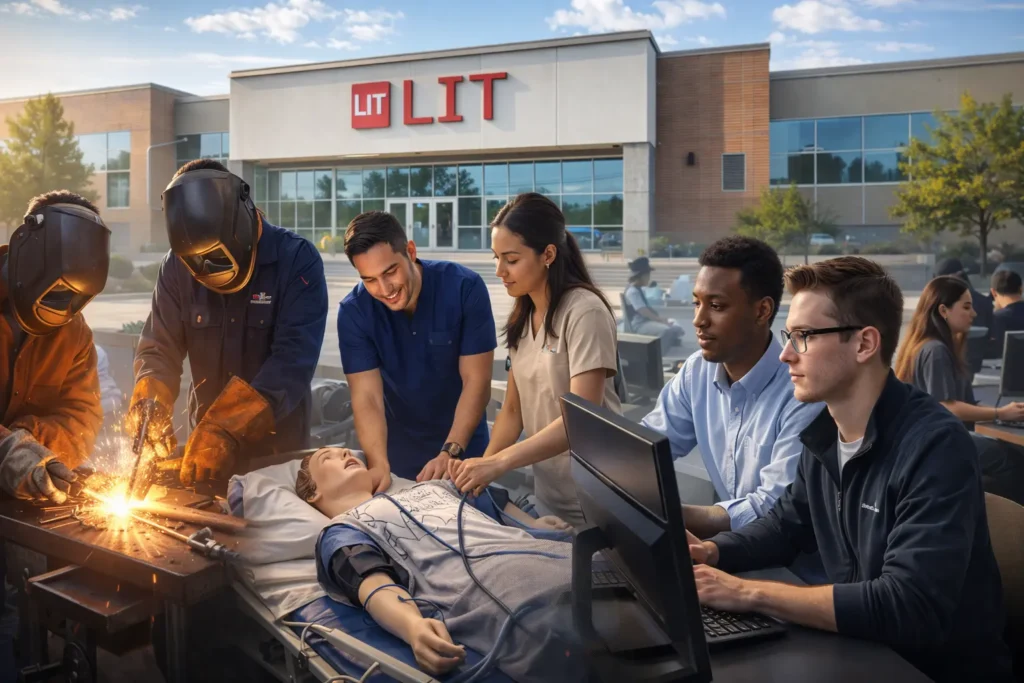
Lamar Institute of Technology — commonly known as LIT — is a public technical college located in Beaumont, TX, dedicated to one mission: helping students launch rewarding careers. Whether you are fresh out of high school, changing careers, or looking to earn a credential fast, LIT offers an affordable, accredited pathway with a proven record of graduate employment and earnings. With the motto “Get a Degree that Works,” LIT lives up to its promise.
What is Lamar Institute of Technology?
Lamar Institute of Technology is a public, open-admissions technical school that operates as part of the Texas State University System. With a semester-based academic calendar and a laser focus on workforce readiness, LIT fills a critical gap in Southeast Texas education — offering hands-on training in high-demand industries at an affordable price.
A Public Technical College with a Rich History
LIT traces its roots to 1949, when it operated as the technical division of Lamar University. In 1995, it was established as a separate, independent institution, allowing it to sharpen its focus on technical and career education. Today, under President Sidney E. Valentine, LIT serves thousands of students annually from its 855 E. Lavaca campus in Beaumont, Texas 77705.
Unlike a traditional community college, LIT is purpose-built for direct workforce entry. Every program is designed with industry outcomes in mind — not general academic transfer requirements.
Accreditation and Institutional Trust
LIT holds full regional accreditation from the Southern Association of Colleges and Schools Commission on Colleges (SACSCOC) — the gold standard for academic quality in the southern United States. This means credits and credentials from LIT are widely recognized by employers and transfer institutions alike.
In addition to institutional accreditation, key programs carry programmatic accreditations from nationally recognized bodies:
- Dental Hygiene — American Dental Association (ADA)
- Respiratory Therapy — Commission on Accreditation for Respiratory Care (CoARC)
- Diagnostic Medical Sonography — CAAHEP
- Medical Radiologic Technology — JRCERT
- Health Information Technology — AHIMA
Academic Programs: Career Training That Pays Off
LIT offers Associate of Applied Science (AAS) degrees, technical certificates, and continuing education across four major areas. Every program is designed for maximum employability — not years of prerequisite coursework.
Industrial & Engineering Technology
LIT is nationally recognized for its industrial programs, many of which directly serve the Gulf Coast’s robust petrochemical and manufacturing sector. Programs include:
- Process Technology — Prepares students for roles as process operators at refineries and chemical plants. Heavily tied to ExxonMobil and local industry partners.
- Instrumentation Technology — Covers measurement and control systems for industrial processes.
- Chemical Technology — Teaches applied chemistry in industrial production environments.
- Welding — Hands-on certification prep for structural, pipe, and specialty welding.
- HVAC (Heating, Ventilation & Air Conditioning) — Meets growing demand for skilled trades.
- Utility Line Technology — Trains students for electrical utility and power grid maintenance.
Allied Health & Nursing Pathways
Healthcare is one of the fastest-growing sectors in Southeast Texas, and LIT’s allied health programs connect students directly to local hospitals and clinical networks. Offerings include:
- Dental Hygiene (ADA-accredited)
- Diagnostic Medical Sonography (CAAHEP-accredited)
- Medical Radiologic Technology (JRCERT-accredited)
- Respiratory Therapy (CoARC-accredited)
- Health Information Technology (AHIMA-accredited)
- Laboratory Technician
Clinical placements are coordinated with regional healthcare systems, giving students real-world experience before graduation.
Public Service & Safety Programs
LIT’s public safety division trains the next generation of first responders and law enforcement professionals for Jefferson County and the surrounding region:
- Police & Criminal Science
- Paramedic / Emergency Medical Services
- Homeland Security
- Forensic Science
- Occupational Safety & Health Technician
Business, Liberal Arts & General Studies
Not every LIT student is entering the trades. The college also offers pathways in Liberal Arts, Child Care Provider, and Biology — rounding out a comprehensive suite of academic options that can lead to employment or transfer to a four-year university.
LIT Program Comparison: Duration, Credential & Industry
| Program | Credential | Est. Duration | Industry Sector |
| Process Technology | AAS Degree | 2 Years | Petrochemical / Energy |
| Dental Hygiene | AAS Degree | 2 Years | Healthcare |
| Welding | Certificate / AAS | 1–2 Years | Manufacturing / Construction |
| Instrumentation Technology | AAS Degree | 2 Years | Industrial / Energy |
| Medical Radiologic Technology | AAS Degree | 2 Years | Healthcare |
| Respiratory Therapy | AAS Degree | 2 Years | Healthcare |
| Paramedic | Certificate / AAS | 1–2 Years | Public Safety |
| HVAC | Certificate | 1 Year | Skilled Trades |
| Health Information Tech. | AAS Degree | 2 Years | Healthcare IT |
How Much Does LIT Cost? Tuition and Financial Aid
LIT is one of the most affordable technical colleges in Texas — and the cost has gotten even lower. Tuition has dropped 47% over the last three years, making LIT a standout value in higher education.
In-State vs. Out-of-State Tuition
| Cost Category | In-State (TX Resident) | Out-of-State |
| Tuition (Annual) | $2,844 | ~$12,636 – $12,924 |
| Books & Supplies | $1,800 – $2,707 | $1,800 – $2,707 |
| Application Fee | $0 | $0 |
| Average Net Price (with aid) | $8,381 | Varies |
For comparison, the national average net price for a 2-year public institution is over $12,000 per year. LIT students pay well below that — especially when financial aid is factored in.
Financial Aid, Scholarships & Grants
LIT participates in all major federal and state financial aid programs. Key figures:
- 52% of students receive Pell Grants — a reflection of LIT’s accessibility to working-class and first-generation families.
- Average financial aid award: $4,699 – $5,591 per year
- Average net price (what students actually pay after aid): $8,381
- Texas-specific programs: TEXAS Grant, Hazelwood Act (veterans), and institutional scholarships.
- No application fee — zero cost to apply.
Students should complete the FAFSA as early as possible and contact LIT’s Financial Aid Office at (409) 880-8321 for personalized guidance on available aid packages.
Is Lamar Institute of Technology Worth It? ROI and Outcomes
This is the most important question prospective students ask — and LIT’s numbers are compelling.
Graduate Earnings: $59,404 Median Salary
LIT graduates earn a median salary of $59,404 five years after graduation — which is 34% higher than the Texas state average for two-year college graduates. That salary premium reflects the industry-aligned nature of LIT’s programs, particularly in petrochemical, healthcare, and skilled trades.
Job Placement Rate: 89% Employed or Transferred
Within one year of graduation, 95% of LIT alumni are employed. Looking more broadly, 89% of graduates find a career position or successfully transfer to a four-year institution. These are not self-reported figures — they reflect outcomes tracked through state and institutional data.
Industry partnerships with companies like ExxonMobil, local hospital networks, public school districts, and municipal governments provide direct pipelines to employment for graduates in Process Technology, Allied Health, and Public Safety programs.
Graduation Rate
LIT’s graduation rate is approximately 30–32% (US News: 32%, Niche: 30%). While this is below the national average for 4-year institutions, it is important to understand the context: LIT serves a large proportion of part-time students, working adults, and students with prior college experience who complete individual certificates without always being counted in the traditional graduation cohort. Many students achieve their goals — a certificate or a job — without being captured in these metrics.
Campus Life and Student Experience at LIT
Location: Beaumont, Texas
LIT’s main campus is located at 855 E. Lavaca Street, Beaumont, TX 77705 — in the heart of Southeast Texas, near the Gulf Coast petrochemical corridor. Beaumont is a midsize city of approximately 120,000 residents, offering a cost-of-living that stretches student budgets further than Houston or Dallas.
The city’s industrial base — refineries, chemical plants, port operations, and the medical corridor — creates a ready-made job market for LIT graduates in every major program area.
Campus Facilities
LIT’s campus includes purpose-built facilities designed for hands-on education:
- Cecil Beeson Building — Administrative and academic hub
- Technology Center — Industrial technology labs
- Workforce & Allied Health Center — Healthcare simulation labs
- ExxonMobil Petrochemical Center — Industry-standard process technology training
- Eagles’ Nest — Student services and gathering space
- Szuch Multi-Purpose Center — Events and recreation
- Testing Center — Proctored exams and certification testing
- Mega Bytes Café — On-campus dining
LIT students also have access to Lamar University’s library and recreation center through a partnership agreement — expanding the amenities available beyond LIT’s own campus.
Student Support Services
Small class sizes — with a student-to-faculty ratio of 21:1 — mean students get real attention from instructors. Support services include:
- Academic Advising — Personalized guidance on program selection and course sequencing
- Tutoring Center — Free supplemental instruction in core subjects
- Career Counseling & Placement Services — Resume help, interview prep, and job fairs
- Credit for Life Experiences — Recognition of prior learning toward degree requirements
- Veteran Services — Support for Hazelwood Act and GI Bill recipients
How to Apply to Lamar Institute of Technology
Admission Requirements
LIT has an open admissions policy — which means virtually any student who applies is accepted. There is no minimum GPA requirement, no SAT/ACT threshold, and no application fee. This commitment to access is what makes LIT a true community resource.
To be admitted, you will need:
- High school diploma or GED
- Completed ApplyTexas application (free)
- Official transcripts from high school and/or prior colleges
- TSI Assessment (Texas Success Initiative) for degree-seeking students in certain programs
- Proof of meningitis vaccination (required for students under 22)
Step-by-Step Application Process
- Submit your application through ApplyTexas.org — select Lamar Institute of Technology.
- Request official high school or GED transcripts be sent directly to LIT’s Admissions Office.
- If you have prior college credits, request official transcripts from each institution.
- Complete the TSI Assessment if required for your chosen program. Exemptions apply for students with qualifying SAT, ACT, or TAKS scores.
- Meet with an Academic Advisor to select your program and courses.
- Register for classes and pay tuition. Apply for financial aid via FAFSA (studentaid.gov) using LIT’s school code.
- Attend new student orientation and begin your first semester.
Registration Dates and Semesters
LIT follows a semester-based academic calendar with three primary enrollment windows:
- May Mini — Accelerated intersession courses
- Summer Session — Full and abbreviated summer terms
- Fall Semester — Main enrollment period (largest class selection)
- Spring Semester — Second full term
Check the official LIT academic calendar at LIT.edu for exact registration open and close dates each year.
Online Learning and Dual Credit at LIT
LIT Online: Flexible Degrees and Certificates
For students who cannot attend classes in person, LIT Online offers 100% online courses leading to associate degrees and certificates. Online program highlights include:
- Medical Billing and Coding Certificate — Fully online, prepares for national CPC certification
- Health Information Technology — AAS degree available in online format
- Business and General Studies courses — Available online for scheduling flexibility
- Basic Peace Officer Course — Online components available
LIT Online uses the same accredited curriculum as on-campus programs, ensuring that online graduates are just as prepared for the workforce as their on-campus peers.
Dual Credit for High School Students
LIT partners with regional high schools to offer dual credit programs, allowing high school juniors and seniors to earn college credit while completing their secondary education. This reduces the time and cost of completing a degree or certificate after graduation.
Dual credit students take LIT courses on campus, at their high school, or online — making the program highly accessible to students across Jefferson County and surrounding areas.
faqs
Is Lamar Institute of Technology a good school?
Yes — by most measures, LIT delivers strong value for its students. Niche awards LIT an overall grade of B, with particularly strong marks in value and diversity. The 89% job placement rate and $59,404 median graduate salary speak louder than rankings. Student reviews on Niche average 4.11 out of 5, with frequent praise for supportive faculty, affordable costs, and program quality.
Does Lamar Institute of Technology have dorms?
No, LIT does not have on-campus residential housing. However, LIT students can access student housing options at nearby Lamar University, located on the same Beaumont campus corridor. LIT students also have access to Lamar University’s library and recreation center, making the two institutions complementary neighbors.
What is the acceptance rate for LIT?
LIT has a 100% acceptance rate. The college operates under an open admissions policy, meaning any applicant who meets basic eligibility requirements (high school diploma or equivalent) is admitted. There are no selective admissions processes, competitive thresholds, or waitlists.
How much is Lamar Institute of Technology tuition?
In-district (Texas resident) tuition is approximately $2,844 per year. Out-of-state tuition runs approximately $12,636 to $12,924 per year. After financial aid, the average net price paid by LIT students is $8,381. Importantly, LIT’s tuition has dropped 47% over the past three years — one of the steepest tuition reductions of any technical college in Texas.
What programs is LIT known for?
LIT is best known for Process Technology, Dental Hygiene, Welding, and Instrumentation Technology. Its allied health programs — Dental Hygiene, Respiratory Therapy, Sonography, and Radiologic Technology — hold prestigious national accreditations and place graduates into high-demand healthcare roles. Its industrial programs are closely tied to Southeast Texas’s petrochemical industry.
How do I contact the LIT Financial Aid Office?
You can reach LIT’s Financial Aid Office by phone at (409) 880-8321. The office is located on the main campus at 855 E. Lavaca, Beaumont, TX 77705. Financial aid advisors can assist with FAFSA completion, scholarship applications, and payment plan options.
Does LIT have a dental hygiene program?
Yes. LIT’s Dental Hygiene program is accredited by the Commission on Dental Accreditation (CODA) of the American Dental Association — the gold standard for dental hygiene education. Graduates are eligible to sit for the National Board Dental Hygiene Examination and state licensure exams.
Conclusion: A Technical College Built for Results
Lamar Institute of Technology is not a traditional community college — and that distinction matters. Unlike general-studies community colleges, LIT is purpose-built for direct workforce entry, evidenced by a 34% salary premium for graduates compared to the state average for two-year college alumni.
With open admissions, zero application fees, a 47% tuition reduction, and accredited programs in the highest-demand sectors of Southeast Texas’s economy — petrochemical, healthcare, and public safety — LIT represents one of the strongest returns on educational investment in the region.
Whether you are interested in welding, dental hygiene, process technology, or emergency medicine, LIT offers a direct, affordable path from the classroom to a well-paying career.

Adrian Cole is a technology researcher and AI content specialist with more than seven years of experience studying automation, machine learning models, and digital innovation. He has worked with multiple tech startups as a consultant, helping them adopt smarter tools and build data-driven systems. Adrian writes simple, clear, and practical explanations of complex tech topics so readers can easily understand the future of AI.