If you’ve ever tried to check whether a business in California is legitimate, available, or in good standing, you already know the feeling. You type a name into Google, click a few random results, and suddenly you’re drowning in outdated directories, half-filled profiles, and conflicting information. Somewhere in the back of your mind, a quiet question starts nagging you: “Is there an official, reliable way to look this up?”
That’s exactly where a california business lookup comes in—and why it matters far more than most people realize.
Whether you’re starting a company, hiring a contractor, investing, forming a partnership, or just trying to confirm who you’re dealing with, knowing how to properly search California business records can save you time, money, and serious legal headaches. In this guide, I’ll walk you through everything you need to know, step by step, in plain human language—no legal fog, no jargon soup.
You’ll learn what a California business lookup really is, how it works behind the scenes, when to use it, which tools to trust, common mistakes to avoid, and how seasoned founders and professionals use it as a quiet superpower.
What Is a California Business Lookup (and Why It Exists)
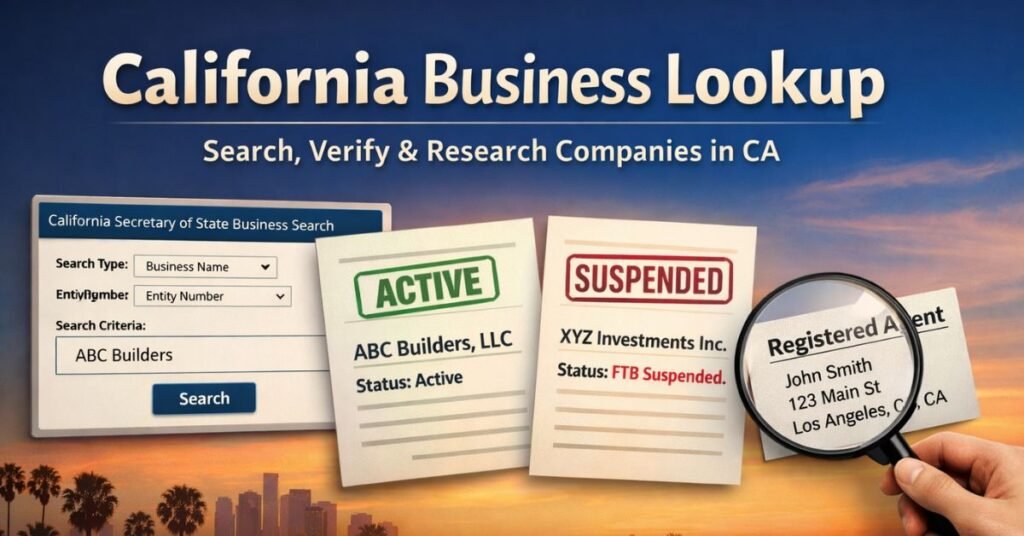
At its core, a california business lookup is a way to search the official database of businesses registered in the state of California. Think of it as the state’s master address book for companies. Every legally registered corporation, LLC, limited partnership, and many other entities have a record here.
These records are maintained by the California Secretary of State, the government body responsible for business filings, compliance, and public transparency.
A useful analogy:
If businesses were people, a California business lookup would be their birth certificate, legal name record, and status report rolled into one.
When you perform a lookup, you’re not just checking a name. You’re accessing verified, state-maintained data such as:
- Legal business name
- Entity type (LLC, corporation, LP, etc.)
- Registration number
- Status (active, suspended, dissolved)
- Date of formation
- Registered agent information
- Jurisdiction (California or out-of-state)
This system exists for one big reason: trust. California is home to millions of businesses, from Silicon Valley startups to family-owned shops. Without a central, authoritative registry, it would be nearly impossible to confirm who’s real, who’s compliant, and who’s not.
Why California Business Lookup Matters in the Real World
A california business lookup isn’t just for lawyers or accountants. In practice, it’s used daily by regular people making everyday decisions—often without realizing how critical it is.
Imagine these scenarios:
You’re about to name your new online store. The name sounds perfect, the domain is available, and Instagram isn’t taken. One quick California business lookup reveals that the name is already registered as an active LLC. That single search just saved you from a forced rebrand six months later.
Or say you’re hiring a contractor for a major renovation. They hand you a business card and a polished website. A lookup shows the business is “FTB Suspended,” meaning they’re not legally allowed to operate. That’s not just a red flag—it’s a stop sign.
Here’s who benefits most from using a California business lookup regularly:
- Entrepreneurs validating business name availability
- Investors performing due diligence
- Freelancers vetting clients
- Employers confirming vendor legitimacy
- Journalists researching companies
- Consumers avoiding scams
In a state as massive and complex as California, the lookup system is less of a convenience and more of a survival tool.
Key Benefits and Use Cases of California Business Lookup
One of the biggest advantages of a california business lookup is clarity. Instead of guessing, assuming, or trusting surface-level information, you get facts straight from the source.
1. Verifying Business Legitimacy
A business can look professional online and still be legally inactive. The lookup instantly shows whether an entity is active, suspended, or dissolved. This is crucial when signing contracts, paying invoices, or entering partnerships.
2. Checking Name Availability Before Registration
Before filing formation documents, smart founders always search existing names. California does not allow two active entities with the same or deceptively similar names in the same category. A lookup prevents rejections and delays.
3. Due Diligence for Partnerships and Investments
Investors and partners use lookup records to confirm:
- How long the business has existed
- Whether it’s compliant with filings
- Who officially represents the company
This helps assess risk before money changes hands.
4. Finding Registered Agent Information
If you need to send legal documents, notices, or formal correspondence, the lookup provides registered agent details—legally required points of contact for businesses.
5. Compliance and Monitoring
Many professionals periodically check their own listing to ensure everything remains accurate, especially after address changes or ownership updates.
In short, the california business lookup is not just informational—it’s protective.
Step-by-Step Guide: How to Perform a California Business Lookup Correctly
Let’s get practical. Here’s exactly how experienced professionals perform a california business lookup without missing key details.
Step 1: Go to the Official Search Tool
Always start with the official business search provided by the California Secretary of State. Third-party sites can be helpful, but the state database is the source of truth.
Step 2: Choose the Right Search Type
Most people default to “Business Name,” but you can also search by:
- Entity number
- Registered agent name
- Officer or manager name (for corporations and some LLCs)
Using partial names often yields better results, especially if you’re unsure of punctuation or spelling.
Step 3: Review the Entity List Carefully
Search results may show multiple similar names. Click into each relevant entry and verify:
- Entity status (Active is what you usually want)
- Entity type (LLC vs corporation matters legally)
- Jurisdiction (California vs foreign entity)
Step 4: Open the Full Record
Inside the detailed view, look for:
- Date of registration
- Principal address
- Mailing address
- Registered agent name and address
This is where you’ll spot red flags like outdated information or suspension notices.
Step 5: Save or Document the Results
For legal, business, or financial purposes, take screenshots or download records. This creates a paper trail and protects you if disputes arise later.
Tools, Comparisons, and Recommendations for California Business Lookup
While the official state tool is essential, it’s not always the most user-friendly. That’s where additional tools can help—if used wisely.
Official Free Tool (Best for Accuracy)
The California Secretary of State’s business search is:
Pros:
- 100% authoritative
- Free
- Updated directly from filings
Cons:
- Basic interface
- Limited filtering options
- No alerts or monitoring
Third-Party Business Lookup Platforms
Sites like business data aggregators and compliance tools often pull from state databases and add features.
Pros:
- Easier navigation
- Historical changes
- Compliance reminders
- Cross-state searches
Cons:
- Subscription fees
- Possible update delays
- Not always complete
When to Use Each
- Use the official lookup for legal verification and filings
- Use third-party tools for research, monitoring, and comparisons
- Cross-check important details when stakes are high
Seasoned professionals often use both: the state tool for confirmation, and a paid platform for convenience.
Common Mistakes People Make (and How to Fix Them)
Even experienced users make errors when performing a california business lookup. Here are the most common ones—and how to avoid them.
Mistake 1: Assuming “Active” Means Fully Compliant
Active status means the entity exists, not that it’s in perfect standing. Always check for FTB suspensions or missing filings.
Fix: Look for tax status indicators and recent filing dates.
Mistake 2: Ignoring Entity Type
LLCs and corporations have different legal obligations. Confusing the two can lead to contract or compliance issues.
Fix: Confirm the entity type before proceeding.
Mistake 3: Relying on Google or Yelp Instead
Online profiles are not legal records.
Fix: Use the official lookup as your primary source.
Mistake 4: Searching Exact Names Only
Small differences in spacing or punctuation can hide results.
Fix: Use partial names and multiple search attempts.
How Professionals Use California Business Lookup Strategically
Seasoned founders, attorneys, and investors don’t just “check” the lookup—they use it as a strategy tool.
They analyze formation dates to gauge experience.
They compare registered addresses to spot shell entities.
They monitor competitor registrations for new ventures.
In other words, they read between the lines.
Once you understand how to interpret the data, a california business lookup becomes more than a database—it becomes insight.
Conclusion: Why California Business Lookup Is a Skill Worth Mastering
A california business lookup may sound simple, but in practice, it’s one of the most powerful, underused tools available to anyone doing business in California.
It protects you from fraud.
It helps you make smarter decisions.
It gives you confidence backed by facts.
Whether you’re launching your first LLC or vetting your hundredth partner, mastering this lookup process puts you ahead of the curve. If there’s one habit worth building in California business life, this is it.
Take a few minutes, run a search, and get comfortable with the system. Your future self will thank you.
FAQs
What is the official California business lookup website?
The official lookup is maintained by the California Secretary of State and provides public access to business records.
Is California business lookup free?
Yes, the state-provided search tool is completely free.
Can I find owners of a California LLC?
You can see managers or members for some LLCs, but ownership disclosure varies by filing type.
How often is the database updated?
Updates occur as filings are processed, though timing can vary.
What does “FTB Suspended” mean?
It means the business failed to meet tax obligations and cannot legally operate.

Michael Grant is a business writer with professional experience in small-business consulting and online entrepreneurship. Over the past decade, he has helped brands improve their digital strategy, customer engagement, and revenue planning. Michael simplifies business concepts and gives readers practical insights they can use immediately.