1. What Is Contemporary Amperex Technology (CATL)?
1.1 Company Overview & Identity
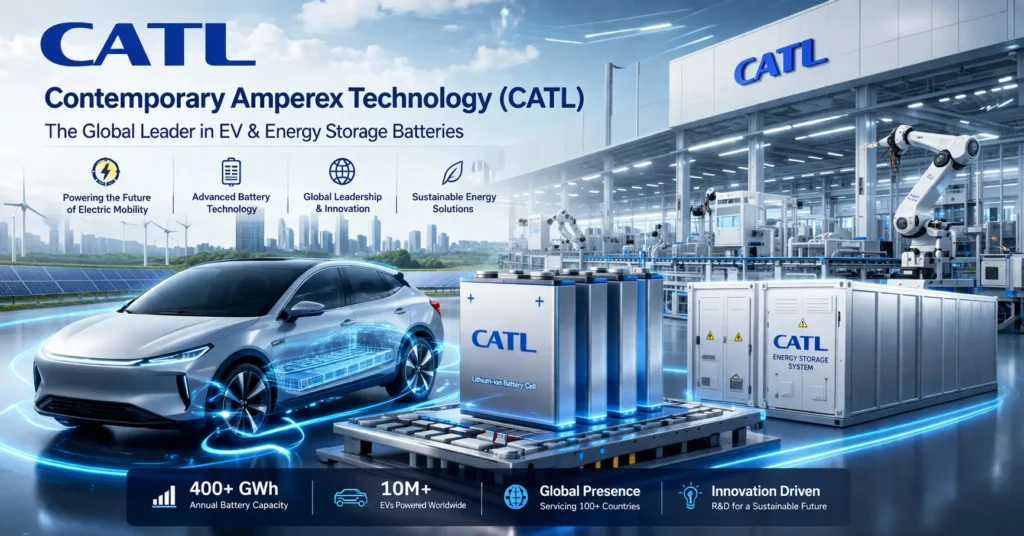
Contemporary Amperex Technology Co. Limited — widely known as CATL (Chinese: 宁德时代) — is the world’s largest manufacturer of lithium-ion batteries for electric vehicles and energy storage systems. Founded in 2011 and headquartered in Ningde, Fujian Province, China, CATL went public on the Shenzhen Stock Exchange (SZSE) in 2018 under the stock code 300750, and completed a landmark secondary listing on the Hong Kong Stock Exchange (HKEX) in 2025.
The company was established by Robin Zeng (Zeng Yuqun), an engineer-turned-entrepreneur who built CATL from a small subsidiary into a Fortune Global 500 powerhouse. With over 131,000 employees across 13 to 15 manufacturing bases worldwide and six dedicated R&D centers, CATL has fundamentally reshaped the global electrification landscape.
| Attribute | Details |
| Full Name | Contemporary Amperex Technology Co. Limited |
| Founded | 2011 |
| Headquarters | Ningde, Fujian, China |
| Founder | Robin Zeng (Zeng Yuqun) |
| Stock Code | 300750 (SZSE); also listed on HKEX (2025) |
| Employees | 131,000+ |
| Revenue (2024) | $50.29 Billion USD |
| Total Assets | $107.78 Billion USD |
| Manufacturing Bases | 13-15 globally |
| R&D Centers | 6 worldwide |
1.2 Mission & Sustainability Vision
CATL’s corporate mission is to be a global leader in new energy innovation, committed to reducing humanity’s dependence on fossil fuels while enabling a sustainable, electrified future. The company has set ambitious carbon neutrality goals: achieving net-zero carbon emissions in its core operations by 2025, and across its entire value chain by 2035.
To support this mission, CATL has constructed the world’s first zero-carbon battery factory in Yibin, Sichuan, powered entirely by renewable hydroelectric energy. This flagship facility represents CATL’s commitment to practicing what it preaches — manufacturing clean energy products through clean energy processes.
- Reduce global fossil fuel dependency through advanced battery technology
- Achieve carbon-neutral core operations by 2025
- Full value-chain carbon neutrality by 2035
- Accelerate the global transition to renewable energy storage
2. Market Leadership & Global Presence
CATL has dominated the global EV battery market for eight consecutive years, a streak that reflects its unrivaled technology, manufacturing scale, and customer relationships. In 2023, CATL commanded a 36.8% share of the global EV battery market — meaning that roughly one in every three electric vehicles on the planet uses a CATL battery. As of 2024, over 17 million electric vehicles have been powered by CATL battery systems.
The company has also led global energy storage shipments for two consecutive years, cementing its dual leadership across both mobile (EV) and stationary (grid) energy storage segments. According to SNE Research, CATL has been the top EV battery supplier globally since 2017, outpacing rivals including BYD, LG Energy Solution, Panasonic, and Samsung SDI.
| Year | Global Market Share | Key Milestone |
| 2017 | ~25% | First year as global #1 EV battery supplier |
| 2019 | ~28% | Began international factory expansion |
| 2021 | ~33% | Cell-to-pack technology introduced commercially |
| 2022 | ~37% | Shenxing fast-charge platform announced |
| 2023 | 36.8% | 8 consecutive years as global leader |
| 2024 | ~38% (est.) | HK secondary listing; Tener ESS launched globally |
2.2 Manufacturing Footprint
CATL operates a truly global production network, with 13 to 15 manufacturing bases spanning Asia, Europe, and emerging markets. The company’s flagship campus remains in Ningde, Fujian Province, which houses its headquarters, primary R&D facilities, and large-scale production lines. The Yibin plant in Sichuan is particularly notable as the world’s first battery factory to achieve carbon neutrality certification.
In Europe, CATL has made strategic investments to serve its major automaker clients on the continent. Its Arnstadt, Germany plant (Thuringia Factory, CATL THURINGIA GmbH) began operations in 2022, making it the first large-scale Chinese battery factory in Europe. The Debrecen, Hungary facility targets production for European OEMs, while the Zaragoza, Spain plant was established in collaboration with Stellantis.
| Location | Country | Status / Key Notes |
| Ningde (HQ) | China | Global HQ, primary R&D, flagship production |
| Yibin | China | World’s first zero-carbon battery factory |
| Arnstadt (Thuringia) | Germany | First large-scale Chinese battery factory in Europe |
| Debrecen | Hungary | Serves European OEMs (BMW, Stellantis, VW) |
| Zaragoza | Spain | Joint venture with Stellantis |
| Multiple Sites | China | Yibin, Liyang, Xining, Zhaoqing, Guizhou and more |
2.3 Key Subsidiaries & Global Offices
Beyond its manufacturing plants, CATL has established strategic subsidiary offices in key automotive and technology hubs. The Munich office supports its deep partnership with BMW and other German automakers. The Paris office facilitates relationships with French manufacturers and European policy engagement. The Yokohama office represents CATL’s push into the competitive Japanese market, where it works alongside Toyota and Honda. The Detroit office serves North American OEM relationships with Ford, Stellantis, and others.
CATL also operates a research center in Hong Kong, leveraging the city’s international financial and academic connections to attract global talent and strengthen its intellectual property portfolio.
3. Core Products & Breakthrough Technologies
3.1 EV Battery Systems
CATL’s product portfolio for electric vehicles spans multiple battery chemistries and form factors, designed to meet the diverse needs of passenger cars, commercial vehicles, and two-wheelers. The company’s primary battery chemistries include Lithium Iron Phosphate (LFP), Nickel Manganese Cobalt (NMC), and its proprietary M3P chemistry, while newer platforms include sodium-ion batteries.
3.1.1 Shenxing LFP Battery
Unveiled in 2023, the Shenxing (meaning ‘divine speed’) battery represents a generational leap in LFP fast-charging capability. Built around CATL’s 4C super fast-charging architecture, the Shenxing battery can charge from near-empty to 80% capacity in just 10 minutes under optimal conditions, and can add approximately 400 km of range in a single 10-minute charge session.
Key technical innovations behind Shenxing include nano-crystallization of the LFP cathode, which dramatically increases the rate at which lithium ions can insert and extract during charging, reducing internal resistance. The battery also features a superconducting electrolyte that allows ions to migrate faster through the electrolyte medium, and a full-tab electrode design that shortens the electron path and reduces heat generation during rapid charging.
Critically, Shenxing maintains performance even in cold temperatures, achieving effective charging down to -10 degrees Celsius — a key improvement over earlier LFP chemistry which suffered significant range loss in winter conditions.
- Charging speed: 10 minutes to 80% capacity (4C architecture)
- Range recovery: ~400 km added in 10 minutes
- Cold weather: Effective down to -10 degrees Celsius
- Innovation: Nano-crystallization, superconducting electrolyte, full-tab electrode
3.1.2 Qilin Battery (CTP 3.0)
The Qilin battery, introduced in 2022 as CATL’s third-generation cell-to-pack (CTP 3.0) technology, achieves an unprecedented volume utilization rate of over 72%, the highest of any mass-production EV battery system to date. By eliminating conventional module structures and integrating cells directly into the battery pack — while using the cells themselves as structural components — Qilin dramatically reduces weight and increases energy density.
The system achieves a gravimetric energy density of 255 Wh/kg for the NMC version, enabling electric vehicles to achieve over 1,000 km of range on a single charge. The LFP version achieves 160 Wh/kg, competitive with NMC packs from previous generations. Qilin also incorporates a multi-functional elastic interlayer between cells that serves simultaneously as a thermal management layer, vibration dampener, and structural support, enabling 4C fast charging at the pack level.
- Volume utilization rate: 72% (industry-leading)
- Energy density: 255 Wh/kg (NMC), 160 Wh/kg (LFP)
- Range capability: 1,000+ km per charge
- Technology: Cell-to-pack (CTP 3.0), no modules
3.1.3 M3P and Sodium-Ion Batteries
CATL’s M3P battery represents a new cathode chemistry platform that bridges the gap between LFP (safe, low-cost) and NMC (high energy density). By substituting some lithium with magnesium, zinc, and other elements, CATL claims M3P achieves higher energy density than LFP while maintaining comparable thermal stability and cycle life.
CATL also introduced the world’s first mass-production sodium-ion battery in 2021. Sodium-ion batteries use sodium instead of lithium, offering significant advantages in cost (sodium is far more abundant), low-temperature performance, and safety. While currently lower in energy density than lithium-based systems, sodium-ion batteries are positioned for entry-level electric vehicles and stationary storage applications where cost is paramount.
3.2 Energy Storage Systems (ESS)
CATL’s energy storage business has grown explosively to match its EV battery dominance. The company has led global energy storage system shipments for two consecutive years, with products deployed across utility-scale grids, commercial facilities, and industrial applications on every major continent.
3.2.1 Tener ESS
Launched in 2024, the Tener energy storage system is CATL’s flagship utility-scale storage product, and represents the most technologically advanced battery energy storage system commercially available. The Tener delivers an impressive 6.25 MWh of storage capacity in a single 20-foot container, making it one of the densest energy storage products on the market.
Most remarkably, Tener is the first ESS product in history to achieve zero capacity degradation over its first five years of operation, backed by CATL’s engineering guarantee. This is achieved through a combination of a biomimetic solid electrolyte interface (SEI) layer — modeled on biological membranes — that suppresses side reactions during cycling, advanced electrolyte formulation, and intelligent battery management algorithms.
- Capacity: 6.25 MWh per 20-foot container
- Degradation: Zero capacity loss guaranteed for 5 years
- Innovation: Biomimetic SEI layer, advanced electrolyte
- Lifetime: 20-year operational design life
3.3 Emerging Technologies & Platforms
Beyond batteries, CATL is expanding into integrated vehicle platforms and infrastructure. The company’s skateboard chassis platform integrates the battery pack as a structural component of the vehicle frame, offering automakers a ready-made electric vehicle foundation that reduces development time and cost. CATL has licensed and collaborated with multiple automakers on this platform.
CATL is also developing battery swapping networks under the EVOGO brand, deploying urban battery replacement stations that allow EV drivers to swap a depleted battery block for a fully charged one in approximately 60 seconds. This addresses charging time concerns without requiring ultra-fast charging infrastructure and is particularly relevant for ride-hailing and commercial fleet operators.
4. Key Partnerships & Automotive Clients
4.1 Strategic Global Collaborations
CATL’s customer base reads like a who’s who of the global automotive industry. The company has supply agreements with virtually every major automaker worldwide, positioning it as an indispensable link in the global EV supply chain. This breadth of relationships provides CATL with both revenue stability and invaluable co-development opportunities that feed back into its technology roadmap.
| Automaker | Region | Key Models / Notes |
| BMW | Germany/Europe | BMW i-series, iX, i4, i7, MINI Electric; long-term supply partner |
| Tesla | USA/Global | Model 3, Model Y; CATL supplies LFP Standard Range packs |
| Ford | USA/Europe | Mustang Mach-E, F-150 Lightning; LFP supply deal |
| Volkswagen Group | Germany | ID. series across VW, Audi, Skoda; major European supply |
| Toyota | Japan/Global | bZ4X and future BEV platforms; joint development agreements |
| Honda | Japan/Global | Honda e:N series; supply and technology collaboration |
| Hyundai/Kia | South Korea | IONIQ series, EV6, GV70e; significant volume contracts |
| Stellantis | Multi-national | Spain plant joint venture; Fiat, Peugeot, Jeep EVs |
| Volvo/Geely | Sweden/China | C40, EX30, EX90; Geely is a strategic CATL shareholder |
| Mercedes-Benz | Germany | EQS, EQE, and upcoming platforms |
| VinFast | Vietnam | Primary battery supplier for Vietnamese EV startup |
| NIO | China | Battery-as-a-Service (BaaS) model; swappable packs |
4.2 Chinese OEM Partnerships
Within China — still the world’s largest EV market — CATL supplies batteries to virtually every major domestic automaker. NIO uses CATL batteries in conjunction with its unique Battery-as-a-Service (BaaS) subscription model, separating the battery from the vehicle purchase price. Li Auto’s extended-range EVs rely on CATL’s LFP packs for their electric drive systems. XPeng’s intelligent EVs use CATL’s high-energy-density packs to maximize range.
It is worth noting that BYD — CATL’s closest domestic rival — manufactures its own batteries (Blade Battery) and does not purchase from CATL. BYD held approximately 15% global market share in 2023, making it the clear second-place competitor. However, CATL’s market share of 36.8% is more than double BYD’s, reflecting CATL’s broader customer base across international markets.
4.3 Joint Ventures
CATL has established formal joint ventures with select partners in strategic markets. Its partnership with FAW Jiefang (First Auto Works) targets commercial vehicle electrification in China. The Valmet Automotive partnership in Finland focuses on European manufacturing and assembly. Most significantly, the Stellantis joint venture for the Zaragoza, Spain plant represents CATL’s deepest commitment to European localized production and is expected to supply cells for a range of European-market EVs.
5. Sustainability & Circular Economy
5.1 Carbon Neutrality Roadmap
CATL has made sustainability a central pillar of its corporate strategy, not merely a compliance exercise. The company has committed to two key milestones: achieving carbon neutrality in all core manufacturing operations by 2025, and extending that commitment to cover its entire supply chain and value chain by 2035.
The Yibin factory in Sichuan Province is the crown jewel of this sustainability effort. Powered predominantly by renewable hydroelectric power, this facility became the world’s first carbon-neutral battery manufacturing plant, verified by internationally recognized third-party auditors. CATL is rolling out the Yibin model to other manufacturing sites globally, prioritizing renewable energy procurement and energy efficiency upgrades.
- 2025 target: Carbon-neutral core manufacturing operations
- 2035 target: Full value-chain carbon neutrality
- Yibin plant: First carbon-neutral battery factory globally
- Renewable energy: Priority hydroelectric and solar procurement
- Energy efficiency: Continuous process optimization at all sites
5.2 Battery Recycling & Circular Economy
CATL recognizes that sustainable EV adoption depends not only on clean manufacturing but also on responsible end-of-life battery management. The company has invested heavily in closed-loop battery recycling infrastructure, with a flagship recycling facility representing over $5 billion in investment.
CATL’s recycling process recovers critical materials including lithium, cobalt, nickel, and manganese from retired battery cells, re-processing them into battery-grade materials suitable for re-use in new cells. This closed-loop approach reduces dependence on virgin mining, lowers the environmental footprint of battery production, and creates a more stable supply chain for critical minerals.
The company also practices cascade utilization — repurposing retired EV battery packs that still retain 70-80% of their original capacity as stationary energy storage systems before eventual recycling. This extends the useful life of batteries and maximizes the energy and economic value extracted from each manufactured cell.
6. Corporate Affairs & Financial Performance
6.1 Financial Highlights
CATL’s financial performance reflects its market dominance and pricing power. For fiscal year 2024, the company reported revenues of approximately $50.29 billion USD, with total assets reaching $107.78 billion USD. These figures place CATL firmly among the world’s largest industrial companies and on the Fortune Global 500 list.
After its 2018 IPO on the Shenzhen Stock Exchange (SZSE: 300750), CATL’s market capitalization surged dramatically, at times exceeding $200 billion USD, making it one of the most valuable companies in China. In 2025, CATL completed a significant secondary listing on the Hong Kong Stock Exchange (HKEX), broadening its investor base to include international institutional investors and making it more accessible to non-mainland Chinese investors.
| Financial Metric | Value |
| Revenue (FY2024) | $50.29 Billion USD |
| Total Assets | $107.78 Billion USD |
| IPO Date | June 2018 (SZSE: 300750) |
| HK Secondary Listing | 2025 (HKEX) |
| Fortune Global 500 | Listed (2023, 2024) |
| R&D Spend | ~6% of annual revenue |
| Patent Applications (2023) | 1,799 (WIPO Rank #8) |
6.2 R&D Investment & Intellectual Property
CATL allocates approximately 6% of its annual revenue to research and development — a remarkable commitment for a manufacturing company of its scale. With six global R&D centers (in Ningde, Shanghai, Munich, Paris, Yokohama, and Hong Kong) and an R&D workforce numbering in the tens of thousands, CATL is one of the most research-intensive battery companies in the world.
In 2023, CATL filed 1,799 patent applications with the World Intellectual Property Organization (WIPO), ranking eighth globally across all industries and second among Chinese corporations. CATL’s intellectual property portfolio spans battery cell chemistry, thermal management, battery management systems (BMS), manufacturing processes, and recycling technologies — creating deep competitive moats that are difficult for rivals to circumvent.
7. Challenges, Controversies & Geopolitics
7.1 US Restrictions & Security Concerns
CATL’s global expansion has not been without friction. In 2023 and 2024, the US Department of Defense added CATL to its list of companies allegedly working with China’s military, commonly known as the ‘Pentagon blacklist.’ This designation carries significant reputational and potential operational consequences, including complicating CATL’s ability to participate in US government-funded projects and creating uncertainty for American utility and corporate clients.
In a notable incident, Duke Energy — one of the largest US electric utilities — announced the disconnection of CATL battery storage systems from its facilities following the Pentagon designation. This decision highlighted the commercial risks that geopolitical designations can pose, even when the underlying technology is already installed and operational. The US National Defense Authorization Act (NDAA) contains provisions that restrict the procurement of batteries from certain Chinese manufacturers, including CATL, by US federal agencies.
Republican legislators in the US Congress have also debated removing CATL-supplied batteries from eligibility for the Inflation Reduction Act (IRA) electric vehicle tax credits, though the complex international joint venture structures CATL has established make the application of such restrictions legally intricate.
7.2 Rebuttals & CATL’s Response
CATL has consistently and forcefully denied all allegations related to military connections and forced labor. The company has described reports linking it to the Chinese military as ‘groundless and completely false,’ emphasizing that it is a commercial enterprise with no involvement in military production or research. CATL has engaged international law firms and public affairs advisors to contest its designations and communicate its position to US and European policymakers.
Regarding forced labor allegations connected to the Uyghur Forced Labor Prevention Act (UFLPA), CATL has stated that its supply chains undergo rigorous third-party audits and that it is fully compliant with international labor standards. The company points to its adoption of supply chain traceability tools and participation in international industry initiatives as evidence of its commitment to ethical sourcing.
7.3 Trade, Tariffs & the US-China Technology War
The broader US-China geopolitical rivalry has created structural headwinds for CATL’s North American ambitions. US tariffs on Chinese battery imports, technology transfer restrictions, and the IRA’s domestic content requirements have collectively constrained CATL’s ability to directly supply the US market from China-based factories. CATL’s response has been to pursue joint ventures and licensing arrangements with American companies — most notably the Ford Motor Company licensing deal announced in 2023, under which CATL licensed its LFP technology to a Ford-operated plant in Michigan.
In Europe, CATL faces increasing scrutiny from the EU’s anti-subsidy investigation into Chinese EV manufacturers, though as a battery supplier rather than a vehicle maker, CATL’s direct exposure to vehicle tariffs is limited. Nevertheless, pressure on European OEM customers could reduce their volume purchases.
8. Competitive Landscape
8.1 CATL vs. Key Competitors
While CATL commands a commanding lead in global EV battery market share, it operates in a competitive landscape populated by formidable rivals. Understanding where CATL stands relative to its primary competitors helps contextualize its achievements and strategic priorities.
| Company | Country | 2023 Market Share | Key Strength | Key Chemistry |
| CATL | China | 36.8% | Scale, technology breadth, global OEM base | LFP, NMC, M3P, Na-ion |
| BYD | China | ~15% | Vertical integration, own vehicles | LFP (Blade Battery) |
| LG Energy Solution | South Korea | ~14% | Western partnerships, cylindrical cells | NMC, LFP |
| Panasonic | Japan | ~7% | Tesla exclusivity, cylindrical cells | NCA, NMC |
| Samsung SDI | South Korea | ~5% | Premium OEM relationships | NMC |
| SK On | South Korea | ~5% | US manufacturing, Ford/Hyundai partner | NMC |
8.2 Technology Differentiation
CATL’s competitive advantage is built on several reinforcing pillars. Its cell-to-pack (CTP) technology — which eliminates modules and integrates cells directly into structurally reinforced packs — achieves higher energy density and lower cost per kWh than modular designs. This innovation has been widely copied but CATL continues to iterate, with CTP 3.0 (Qilin) setting the current industry benchmark.
CATL is also the only major battery maker currently supplying mass-production vehicles with all three primary cell formats: prismatic (dominant in China), pouch (popular in Korea), and cylindrical (Tesla’s preferred format). This multi-format capability allows CATL to serve any OEM’s design preferences without requiring the customer to adapt to CATL’s format preferences.
9. Careers at CATL
9.1 Global Workforce & Culture
With over 131,000 employees across 13 production sites and six R&D centers globally, CATL is one of the largest employers in the clean energy sector. The company recruits aggressively from top universities worldwide, particularly for its R&D divisions in electrochemistry, materials science, manufacturing engineering, and software/AI.
CATL’s research centers in Hong Kong, Munich, Paris, and Yokohama are specifically designed to attract international talent in markets where CATL competes for the same engineers sought by BMW, Tesla, LG, and Samsung. Competitive compensation, access to cutting-edge research infrastructure, and the opportunity to work on technologies that will power hundreds of millions of vehicles are key recruiting propositions.
- R&D roles: Battery chemistry, BMS software, manufacturing process engineering
- Engineering: Cell design, pack design, thermal management, testing
- Business: Sales, market development, supply chain, finance
- Support: Legal, HR, communications, sustainability
9.2 Talent Community
CATL actively maintains a global talent community through its careers portal, allowing prospective candidates to register their interest and receive updates on relevant openings across all global locations. The company particularly emphasizes recruitment for its R&D center in Hong Kong, which focuses on next-generation battery materials research in collaboration with local universities.
For students and recent graduates, CATL operates internship and graduate programs across its manufacturing and research facilities. These programs provide structured development paths in a rapidly growing industry segment with long-term career potential.
10. CATL Company Timeline
| Year | Milestone |
| 2011 | CATL founded in Ningde, Fujian, by Robin Zeng as a spin-off from ATL (Amperex Technology Limited) |
| 2012 | First supply agreements with domestic Chinese automakers; began LFP and NMC cell development |
| 2015 | Launched first-generation cell-to-pack (CTP) concept; rapid capacity expansion begins |
| 2017 | Became the #1 global EV battery supplier by volume, overtaking Panasonic |
| 2018 | Successful IPO on Shenzhen Stock Exchange (SZSE: 300750); raised approximately $900M |
| 2019 | Announced Thuringia, Germany factory — first large-scale Chinese battery plant in Europe |
| 2020 | Expanded Tesla supply agreement; began sodium-ion battery development program |
| 2021 | Unveiled world’s first mass-production sodium-ion battery; CTP 2.0 announced |
| 2022 | Qilin Battery (CTP 3.0) unveiled; Arnstadt Germany factory begins production |
| 2023 | Shenxing ultra-fast-charge LFP battery launched; Ford licensing deal announced; Pentagon list designation |
| 2024 | Tener ESS launched with zero-degradation guarantee; revenue reaches $50.29B |
| 2025 | Secondary listing on Hong Kong Stock Exchange (HKEX); continued global expansion |
11. FAQ
General Questions
What does Contemporary Amperex Technology Co. Limited (CATL) do?
CATL is the world’s largest manufacturer of lithium-ion batteries for electric vehicles and energy storage systems. It supplies battery cells and complete battery pack systems to virtually every major global automaker, and its energy storage products power utility-scale grids on every continent.
Is CATL a Chinese company? Where is its headquarters?
Yes. CATL is a Chinese company headquartered in Ningde, Fujian Province, China. While it operates factories and offices globally, its legal domicile, primary R&D operations, and controlling ownership are all China-based.
Who is the founder of CATL?
CATL was founded in 2011 by Robin Zeng (Zeng Yuqun), an engineer who previously worked at Sony’s battery division and ATL (Amperex Technology Limited) before establishing CATL as a standalone entity. Zeng remains the company’s chairman and controlling shareholder.
In 2023, CATL held a 36.8% share of the global EV battery market, making it the clear market leader. This represents eight consecutive years at the top of global rankings, more than double the share of its nearest competitor, BYD.
Technology Questions
What is the Shenxing battery?
The Shenxing battery is CATL’s ultra-fast-charging LFP (lithium iron phosphate) battery platform, introduced in 2023. It charges from near-empty to 80% in approximately 10 minutes using a 4C charging architecture, and adds approximately 400 km of driving range in that time. It uses nano-crystallization cathode technology and a superconducting electrolyte to achieve this speed.
What is the Qilin battery?
The Qilin battery is CATL’s third-generation cell-to-pack (CTP 3.0) system, achieving a volume utilization rate of over 72% — the highest in mass-production EVs. It delivers energy density of up to 255 Wh/kg (NMC version), enabling 1,000+ km range on a single charge.
Does CATL make LFP or NMC batteries?
Both. CATL manufactures Lithium Iron Phosphate (LFP), Nickel Manganese Cobalt (NMC), and its proprietary M3P chemistry batteries, as well as sodium-ion cells. The choice of chemistry depends on the application: LFP offers safety and longevity at lower cost; NMC offers higher energy density for premium vehicles.
How does CATL’s cell-to-pack technology work?
Cell-to-pack (CTP) technology eliminates the traditional ‘module’ layer between individual cells and the battery pack. Instead, cells are arranged directly inside a structurally reinforced pack housing, with the cells themselves contributing to the pack’s structural integrity. This reduces weight, increases the proportion of the pack volume occupied by active cells, and lowers manufacturing complexity. CATL’s CTP 3.0 (Qilin) takes this further by using a multi-functional interlayer between cells for thermal management and vibration damping.
Investment & Corporate Questions
What is CATL’s stock symbol? Is it publicly traded?
CATL is publicly traded on the Shenzhen Stock Exchange (SZSE) under the ticker symbol 300750. In 2025, it completed a secondary listing on the Hong Kong Stock Exchange (HKEX), making it more accessible to international investors. US investors cannot directly purchase SZSE-listed shares through most US brokerage accounts but may access HKEX-listed shares through international brokers.
Why is CATL on the Pentagon blacklist?
The US Department of Defense added CATL to its list of companies alleged to support China’s military in 2023-2024. CATL denies any military connections, calling the designation ‘groundless and completely false.’ The listing does not prohibit commercial activity but creates reputational and procurement risks, particularly for US government-funded projects.
Does CATL use forced labor?
CATL has denied all allegations of forced labor in its supply chain, stating it fully complies with international labor standards and undergoes regular third-party supply chain audits. The company has contested its characterization under the US Uyghur Forced Labor Prevention Act (UFLPA).
Why did Duke Energy disconnect CATL batteries?
Following CATL’s addition to the Pentagon’s list of alleged military-linked companies, Duke Energy, a major US utility, announced it was removing CATL battery systems from its facilities as a precautionary measure related to national security concerns. This was a business decision by Duke Energy, not a government order, though it reflected heightened scrutiny of Chinese technology in US energy infrastructure.
Conclusion
Contemporary Amperex Technology (CATL) stands as one of the defining industrial success stories of the 21st century. From a startup founded in 2011 in a mid-sized Chinese coastal city, CATL has risen in just over a decade to become the undisputed global leader in EV and energy storage batteries — supplying power to one in three electric vehicles worldwide and commanding nearly 37% of the global market.
CATL’s competitive moat rests on a combination of massive scale, relentless R&D investment, breakthrough technologies (Shenxing, Qilin, Tener), deep relationships with virtually every major global automaker, and a rapidly globalizing manufacturing footprint spanning China, Europe, and beyond. Its sustainability ambitions, including zero-carbon manufacturing and closed-loop battery recycling, position it for relevance in an increasingly ESG-conscious world.
The challenges are real: US geopolitical restrictions, the Pentagon blacklist, tariff pressures, and intensifying competition from Korean and Chinese rivals will test CATL’s ability to maintain its dominant position. Yet the company’s trajectory, financial strength, and technology leadership suggest that Contemporary Amperex Technology will remain the backbone of the global electric vehicle revolution for the foreseeable future.

Adrian Cole is a technology researcher and AI content specialist with more than seven years of experience studying automation, machine learning models, and digital innovation. He has worked with multiple tech startups as a consultant, helping them adopt smarter tools and build data-driven systems. Adrian writes simple, clear, and practical explanations of complex tech topics so readers can easily understand the future of AI.