The proliferation of small unmanned aerial systems — commonly known as drones — has fundamentally altered the threat landscape for military units, law enforcement agencies, and critical infrastructure operators. What was once an expensive technology reserved for nation-state militaries is now accessible to adversaries, criminals, and hostile actors at a cost measured in hundreds of dollars.
The consequences are severe. Weaponized drones have been used on military battlefields, deployed near airports, and flown over critical infrastructure — creating life-safety risks that existing defenses were not designed to address. Traditional kinetic responses (shooting drones down with projectiles) carry unacceptable collateral damage risks in populated environments. Radio-frequency jamming systems can interfere with civil communications infrastructure. Neither solution is adequate for the range of operational environments where the threat is most acute.
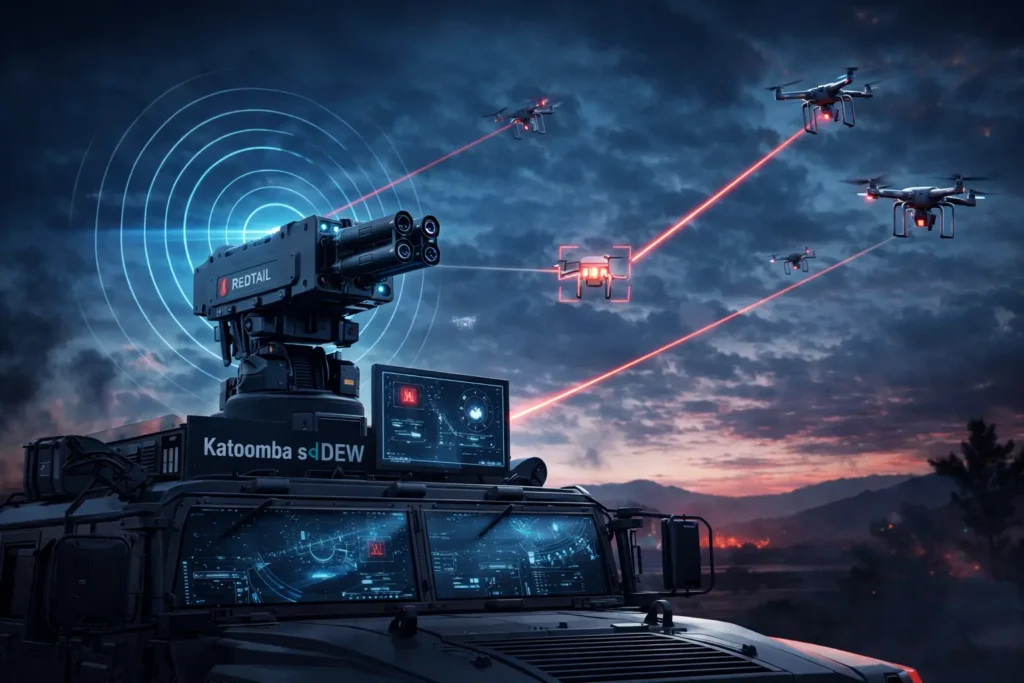
RedTail Technology has developed the Katoomba sDEW — a small directed energy weapon system — to fill this critical capability gap. The Katoomba platform provides dismounted warfighters, law enforcement officers, and security teams with a precise, non-kinetic, and AI-assisted tool for detecting, tracking, and defeating hostile drones at operationally relevant ranges, with minimal collateral risk to people and infrastructure nearby.
| Capability | Specification |
| System Type | Small Directed Energy Weapon (sDEW) — Electro-Optical |
| Primary Function | Counter-small Unmanned Aerial Systems (c-UAS / C-UAS) |
| Defeat Modes | Dazzle, Blind, Defeat |
| AI Assistance | Autonomous electro-optical tracking with AI aim-assist |
| Configurations | Rifle attachment, standalone, turret-mounted |
| Regulatory Status | NDAA Compliant |
| Power System | Interchangeable energy magazines — simplified logistics |
| Development Stage | Active development; demo and procurement inquiries open |
What Is the Katoomba sDEW?
A New Class of Small Directed Energy Weapon
The Katoomba sDEW belongs to an emerging category of counter-drone technology: small directed energy weapons that deliver sufficient optical energy to disrupt, disable, or defeat drone sensors and flight systems without firing a projectile. This non-kinetic approach eliminates the risk of falling debris in populated environments — one of the most significant limitations of conventional counter-drone solutions.
The ‘small’ designation reflects the system’s mission-specific design philosophy. Rather than a large, vehicle-mounted directed energy platform requiring significant logistical support, the Katoomba is engineered for portability and rapid deployment. It is designed to be carried and operated by a single person — a dismounted warfighter, a law enforcement officer, or a security professional — without specialized training or a dedicated support team.
Autonomous Electro-Optical Systems Explained
The Katoomba’s core technology is an autonomous electro-optical (EO) system. Electro-optical systems use light — in this case, directed laser energy — rather than radio waves, projectiles, or physical nets to engage a target. The system’s autonomous tracking capability means that once a drone is identified and engaged, the Katoomba’s AI system continuously tracks the target and maintains aim-point alignment without requiring the operator to manually track a fast-moving aerial object.
This is a critical capability in high-stress operational environments. Research and military field experience consistently demonstrate that operator performance degrades significantly under cognitive load — particularly when required to manually track fast-moving, erratically-flying objects while simultaneously managing the tactical situation around them. The Katoomba’s AI aim-assist compensates for this human performance limitation, dramatically improving engagement accuracy under real-world operational conditions.
The system is also engineered to be jam-proof — unlike radio-frequency (RF) jamming systems that can be countered by adversaries using frequency-hopping communications protocols, the Katoomba’s electro-optical defeat mechanism cannot be defeated by electronic countermeasures. This makes it particularly valuable against sophisticated drone operators who may anticipate and counter RF-based defenses.
The platform is NDAA compliant, ensuring it meets U.S. National Defense Authorization Act requirements for defense procurement, including restrictions on components from certain foreign sources.
Key Capabilities: Dazzle, Blind, Defeat
The Katoomba sDEW offers three distinct engagement modes, each calibrated for a different operational scenario and threat level. This tiered approach allows operators to apply the minimum force necessary to neutralize a threat — a critical consideration in law enforcement and civilian security contexts.
Dazzle: Sensor Disruption with Minimum Collateral Risk
In Dazzle mode, the Katoomba delivers a precisely aimed optical energy pulse that disrupts the drone’s camera sensors and any optical navigation systems it relies on. This mode does not damage the drone’s flight systems — it temporarily blinds the drone’s optical sensors, causing it to lose orientation and often triggering automated return-to-home protocols.
Dazzle is the preferred engagement mode in populated environments where the risk of a falling drone poses a safety hazard to people and property below. By disrupting the drone’s navigation rather than its flight systems, Dazzle creates drone operator confusion and forces mission abort while minimizing the risk of uncontrolled descent.
Blind: Extended Sensor Defeat
In Blind mode, the Katoomba delivers sustained optical energy sufficient to permanently damage the drone’s electro-optical sensors. This mode is used when Dazzle has been ineffective or when the tactical situation requires a more definitive sensor defeat. The drone remains airborne but loses all visual and optical navigation capability, rendering it inoperable for the mission at hand.
Defeat Mode for Critical Threats
In Defeat mode, the Katoomba delivers maximum energy sufficient to disable the drone’s core flight systems — effectively bringing it down. This mode is reserved for situations where the drone poses an imminent threat to life or critical infrastructure and where the operational environment permits a controlled descent.
AI Aim-Assist for High Cognitive Load Situations
The thread connecting all three engagement modes is the Katoomba’s AI aim-assist system. Modern small drones are fast, agile, and increasingly programmed to fly evasive flight paths when they detect attempts to counter them. Manually tracking and maintaining an aim-point on such a target — particularly for an operator who is simultaneously managing a complex tactical situation — is extraordinarily difficult.
RedTail’s autonomous EO tracking system uses computer vision and AI-driven target tracking to acquire a detected drone and maintain a stable aim-point throughout the engagement sequence. The operator’s role is reduced to target identification and engagement authorization — the system handles the precision aiming. This dramatically reduces the skill level required for effective operation and ensures consistent performance even when the operator is fatigued, in motion, or under fire.
Technical Specifications
The table below provides available technical specification data for the Katoomba sDEW system. As with all defense products, certain specification parameters may be subject to export control restrictions or may not be publicly disclosed. Contact RedTail Technology directly for a complete specification sheet and NDA-protected technical data package.
| Parameter | Specification |
| System Classification | Small Directed Energy Weapon (sDEW) — Electro-Optical |
| Engagement Technology | Directed laser energy — electro-optical (non-RF) |
| Engagement Modes | Dazzle / Blind / Defeat (tiered non-kinetic to kinetic-effect) |
| Target Class | Small UAS / Drone (sUAS — Group 1 and Group 2 targets) |
| Operator Configuration | Single operator; no dedicated support personnel required |
| Physical Form Factor | Rifle attachment, standalone handheld, turret-mounted |
| Power System | Interchangeable energy magazines (modular, hot-swappable) |
| Target Acquisition | Autonomous electro-optical with AI tracking and aim-assist |
| Countermeasure Resistance | Jam-proof (optical, not RF — not susceptible to RF ECM) |
| Regulatory Compliance | NDAA Compliant |
| Portability | Man-portable; single-operator deployment |
| Training Requirement | Accelerated training curriculum; simplified operation under cognitive load |
| Development Status | Active; contact RedTail for current production and delivery timelines |
Note: Power output (watts), effective engagement range by mode, system weight, cooling specifications, and battery endurance data are available upon request under NDA. Contact RedTail Technology for a full technical data package.
Operational Configurations & Use Cases
The Katoomba sDEW is designed for operational flexibility. Three distinct hardware configurations allow the system to be deployed across the full spectrum of potential threat environments — from forward-deployed military units to urban law enforcement and fixed critical infrastructure protection.
Dismounted Warfighter: Rifle Attachment Configuration
The rifle attachment configuration integrates the Katoomba directly onto a standard military rifle platform, allowing a dismounted warfighter to carry and deploy the system as part of their standard loadout. No additional personnel, vehicles, or support equipment are required.
This configuration is designed for rapid deployment in dynamic combat environments where drone threats may emerge suddenly and without warning. The rifle-mounted form factor allows the operator to transition between conventional small-arms engagement and directed energy drone defeat with minimal reconfiguration time — a critical requirement in the fluid tactical environments of modern combined-arms warfare.
Law Enforcement & Public Safety: Standalone Configuration
The standalone handheld configuration is designed for law enforcement and public safety applications where the rifle attachment form factor may be inappropriate or impractical. This version provides all the same detection, tracking, and defeat capabilities in a standalone device that can be operated by a single officer without modification to existing weapons.
Use cases in this configuration include airspace security at public events, response to unsafe drone operations near airports or crowded venues, counter-drone protection for dignitary visits, and support to SWAT and tactical operations where drone intelligence-gathering poses a threat to operational security.
Fixed Site Defense: Turret-Mounted Configuration
The turret-mounted configuration provides persistent, automated protection for fixed sites requiring continuous counter-drone coverage. This version integrates the Katoomba’s electro-optical system into a stabilized turret that can be remotely operated or configured for fully autonomous operation within a defined engagement envelope.
Critical Infrastructure Protection Applications
The turret-mounted Katoomba is particularly well-suited for protecting critical infrastructure sites — power generation facilities, water treatment plants, data centers, communications nodes, and transportation hubs — where the continuous drone threat requires a persistent, automated response capability that does not require continuous human operator attention.
- Airport and airspace security: prevent unauthorized drone incursions into controlled airspace
- Power grid protection: neutralize surveillance and attack drones targeting electrical infrastructure
- Event security: protect large public gatherings from weaponized or disruptive drone operations
- Border security: detect and defeat reconnaissance drones used to support smuggling or infiltration operations
- Maritime security: protect vessels and port facilities from aerial reconnaissance and attack
How Katoomba Compares to Traditional C-UAS Solutions
The counter-drone market currently offers a range of solutions, each with distinct operational strengths and limitations. Understanding how the Katoomba sDEW compares to these alternatives is essential for procurement decision-makers evaluating their options.
| Criterion | Katoomba sDEW | RF Jammers | Net Guns | Kinetic (Projectile) |
| Defeat Mechanism | Directed optical energy | Radio frequency disruption | Physical net entanglement | Projectile impact |
| Collateral Risk (Populated Areas) | Low — no falling debris, no RF interference | Medium — can disrupt civil comms | Medium — net deployment unpredictable | High — falling debris, ricochet |
| Countermeasure Resistance | High — jam-proof optical system | Low — defeated by freq. hopping | Low — evadable by fast drones | Medium — requires accurate aim |
| Effective vs. Swarms | Moderate — sequential engagement | High — area effect | Low — one target per shot | Low — limited magazine |
| Operator Skill Required | Low — AI aim-assist | Low — area denial | High — manual aiming | High — precision marksmanship |
| Training Time | Accelerated (hours) | Minimal | Moderate | Extensive |
| NDAA Compliance | Yes | Varies by manufacturer | Typically yes | Yes (standard weapons) |
| Cost per Engagement | Very low (energy) | None (after purchase) | High (per net) | Moderate (per round) |
| Form Factor | Man-portable, rifle/standalone/turret | Vehicle or handheld | Handheld/launcher | Standard weapon |
The Katoomba sDEW occupies a unique position in this landscape: it provides the precision targeting and tiered engagement modes of a kinetic weapon, the operational simplicity of a jammer, and the low collateral-risk profile required for use in populated environments. No other currently available solution combines all three of these attributes in a man-portable form factor.
Accelerated Training & Simplified Operation
One of the most significant operational advantages of the Katoomba sDEW is its exceptionally short operator training timeline. Advanced counter-drone systems often require days or weeks of specialized training before operators can employ them effectively in the field. Redtail has designed the Katoomba to be operable with competence after an accelerated training program measurable in hours, not days.
Operator Training Curriculum
The Katoomba operator training curriculum covers:
- System familiarization: hardware, software interface, engagement modes, and safety procedures
- Threat recognition: identifying drone types, flight patterns, and behaviors indicative of hostile intent
- Engagement procedures: target acquisition, mode selection, engagement, and post-engagement assessment
- Maintenance and pre-mission checks: battery management, system calibration, and basic fault diagnosis
- Rules of engagement: legal framework for drone engagement in military and civilian law enforcement contexts
Simplified Logistics: Interchangeable Energy Magazines
A significant operational challenge for directed energy systems in field deployment has historically been power logistics. High-power laser systems require substantial, heavy power sources that are incompatible with dismounted operations.
RedTail has addressed this challenge with a modular, interchangeable energy magazine system. Operators carry multiple pre-charged energy magazines — analogous to ammunition magazines for conventional weapons — and can swap them rapidly in the field to restore full system capability. This approach integrates naturally with existing military logistics frameworks for ammunition and battery management, eliminating the need for specialized power generation equipment at the point of use.
Company & Development Background
Leadership Team
RedTail Technology was founded by Richard Pahlavani, a physicist-entrepreneur with deep expertise in electro-optical systems and directed energy technology. As CEO, Pahlavani leads the company’s technical and business development strategy with a focus on delivering operationally practical solutions for the c-UAS mission.
Michael Bauer serves as Chief Technology Officer, overseeing the engineering and development of the Katoomba system and RedTail’s broader autonomous electro-optical platform architecture.
Backed by UNSW Founders
RedTail Technology has been supported by the UNSW Founders program — the commercialization and startup acceleration initiative of the University of New South Wales, Australia. UNSW Founders provides early-stage companies with mentorship, funding access, facilities, and a global network of advisors and investors with deep expertise in deep-tech and defense technology commercialization.
This affiliation reflects RedTail’s origins as a physics-driven, research-informed technology company with the technical credibility and academic rigor that defense procurement processes demand.
faqs
What is the effective range of the Katoomba sDEW?
Specific engagement range data — including dazzle range, blind range, and defeat range — is available in RedTail’s technical data package, which is provided to qualified defense and law enforcement customers under NDA. Contact RedTail directly for access to full range performance data. Note that effective range varies by mode, operating conditions (atmospheric, lighting), and target characteristics.
Is it legal for law enforcement to use directed energy drone dazzlers?
Specific engagement range data — including dazzle range, blind range, and defeat range — is available in RedTail’s technical data package, which is provided to qualified defense and law enforcement customers under NDA. Contact RedTail directly for access to full range performance data. Note that effective range varies by mode, operating conditions (atmospheric, lighting), and target characteristics.
How does Katoomba differ from a drone jammer?
Radio frequency jammers work by broadcasting electromagnetic interference that overwhelms the radio signals used to control the drone and transmit its video feed. They are effective against many current consumer and commercial drones, but they also interfere with other communications systems operating on the same frequencies — which can create problems in dense urban environments or near critical communications infrastructure.
The Katoomba sDEW operates on an entirely different physical principle: it uses precisely directed optical energy (laser light) to affect the drone’s sensors and/or flight systems. It does not emit RF energy, does not interfere with communications infrastructure, and cannot be countered by frequency-hopping or other RF electronic countermeasures. This makes it fundamentally more capable against sophisticated drone adversaries and safer to use in communications-sensitive environments.
What makes it jam-proof?
Because the Katoomba’s defeat mechanism is electro-optical (light-based) rather than radio frequency (RF), it is immune to the electronic countermeasures that can defeat RF jammers. An adversary cannot ‘hop’ to a different frequency to avoid an optical engagement. The physical laws governing electro-optical interactions with drone sensor materials do not have an analogous workaround.
Is the Katoomba a lethal weapon?
In its primary operating modes (Dazzle and Blind), the Katoomba is a non-lethal, non-kinetic directed energy system that affects drone sensors rather than flight systems or structural components. The Defeat mode, which delivers sufficient energy to disable flight systems, is designed to bring a drone down in a controlled manner and is not characterized as a lethal weapon. The system is not designed, and is not intended, for use against human targets.
How do I request a demonstration or procurement information?
Defense, law enforcement, and critical infrastructure security organizations interested in evaluating the Katoomba sDEW are encouraged to contact RedTail Technology directly via the website (redtailtech.ai) to request a technical briefing, system demonstration, or procurement specification package. RedTail’s team will work with qualified customers to determine the appropriate evaluation pathway, including field demonstrations for military and law enforcement customers.
Request Information or Book a Demo
RedTail Technology is currently working with defense organizations, law enforcement agencies, and critical infrastructure security teams to evaluate and deploy the Katoomba sDEW. If your organization is facing small drone threats that current solutions are failing to address adequately, RedTail’s team wants to hear from you.
- Request a full technical specification package (NDA-protected for sensitive parameters)
- Schedule a briefing with RedTail’s technical and business development team
- Arrange a field demonstration of the Katoomba sDEW’s engagement capabilities
- Discuss procurement pathways including direct purchase, government contracting vehicles, and pilot program options
- Explore integration with your existing force protection and physical security architecture
Visit redtailtech.ai to contact RedTail Technology and begin the procurement evaluation process.
── APPENDIX ──
SEO Implementation Guide & Recommendations
This appendix consolidates actionable SEO recommendations for both Redtail Technology web presences. Implement these alongside the content articles above to maximize search visibility and competitive positioning.
Universal SEO Recommendations (Both Sites)
Word Count & Content Depth
Both articles in this document exceed the 2,000-word minimum required to outrank thin competitor pages (LinkedIn profiles, Crunchbase listings, basic startup profiles). Target the full content depth as published; do not truncate for brevity.
Heading Structure
Maintain the H1 > H2 > H3 > H4 heading hierarchy exactly as structured in these articles. Each H2 targets a distinct user intent cluster. Do not consolidate or reorder headings without conducting fresh keyword intent analysis.
FAQ Schema Markup
Implement FAQ schema (JSON-LD or microdata) for all FAQ sections in both articles. FAQ schema is one of the highest-ROI structured data implementations available for commercial and product-research intent pages, enabling rich snippet display in Google’s SERPs.
Internal Linking Architecture
For the CRM site: Create dedicated pages for Pricing, Security, Integrations, and Onboarding and link to them from the anchor text in this article. For the Defense site: Create dedicated pages for Specifications, Technology Deep Dive, Use Cases, and Training Curriculum and link accordingly.
Multimedia Embedding
Embed the Redtail CRM YouTube channel videos (239+ videos available) on relevant feature sections. For the Defense site, create or embed a product video or animated diagram showing the three engagement modes (Dazzle, Blind, Defeat). Both actions improve dwell time and reduce bounce rate — important behavioral signals in Google’s ranking algorithm.
Site Disambiguation Strategy
Because two separate entities share a similar name, both websites should include a clear disambiguation note in a visible location (header banner, sidebar, or footer):
- CRM site: ‘Redtail Technology, Inc. provides CRM software for financial advisors. For the counter-drone defense system, visit redtailtech.ai’
- Defense site: ‘RedTail Technology builds autonomous counter-drone directed energy systems. For Redtail CRM software for financial advisors, visit redtailtechnology.com’
This cross-linking serves both users (reducing confusion) and SEO (establishing entity disambiguation and context for Google’s Knowledge Graph).
| Item | CRM (FinTech) | Defense (c-UAS) |
| Recommended Title Tag | Redtail Technology | CRM for Financial Advisors | Features & Pricing | Katoomba sDEW | Counter-Drone System | RedTail Technology |
| Meta Description | Redtail Technology is the leading web-based CRM for financial advisors and wealth management firms. Manage clients, automate workflows, and stay compliant. | RedTail Technology’s Katoomba sDEW delivers AI-assisted, non-kinetic counter-drone defeat for warfighters, law enforcement, and critical infrastructure. |
| Primary Keyword | CRM for financial advisors | counter drone system c-UAS |
| Secondary Keywords | wealth management CRM, RIA CRM, Redtail CRM pricing | Katoomba sDEW, directed energy weapon, drone dazzler law enforcement |
| External Links | FINRA, SEC, NIST cybersecurity | DOD c-UAS strategy, NDAA text, FAA drone regulations |
| Target Audience | Financial advisors, RIA owners, compliance officers | Defense procurement, law enforcement commanders, security directors |
| Conversion Goal | Book CRM demo / request pricing | Request technical briefing / procurement inquiry |

Adrian Cole is a technology researcher and AI content specialist with more than seven years of experience studying automation, machine learning models, and digital innovation. He has worked with multiple tech startups as a consultant, helping them adopt smarter tools and build data-driven systems. Adrian writes simple, clear, and practical explanations of complex tech topics so readers can easily understand the future of AI.