It started with a power outage—at least for me.
One spring afternoon, I was halfway through drafting an article when my lights flickered, my laptop shut off, and my unsaved work vanished. Frustrated, I reached for my phone and opened an early-access AI writing tool powered by a brand-new model I had barely heard whispers about: GPT-5.
I typed, “Help me re-create the article I was writing.”
What came back wasn’t just a reconstruction. It was clearer, friendlier, and somehow more me than what I’d written before my power cut out.
That’s when I realized: something fundamentally new had arrived.
Welcome to The Birth of GPT-5.
What Is GPT-5? (And Why Was Everyone Waiting for It?)
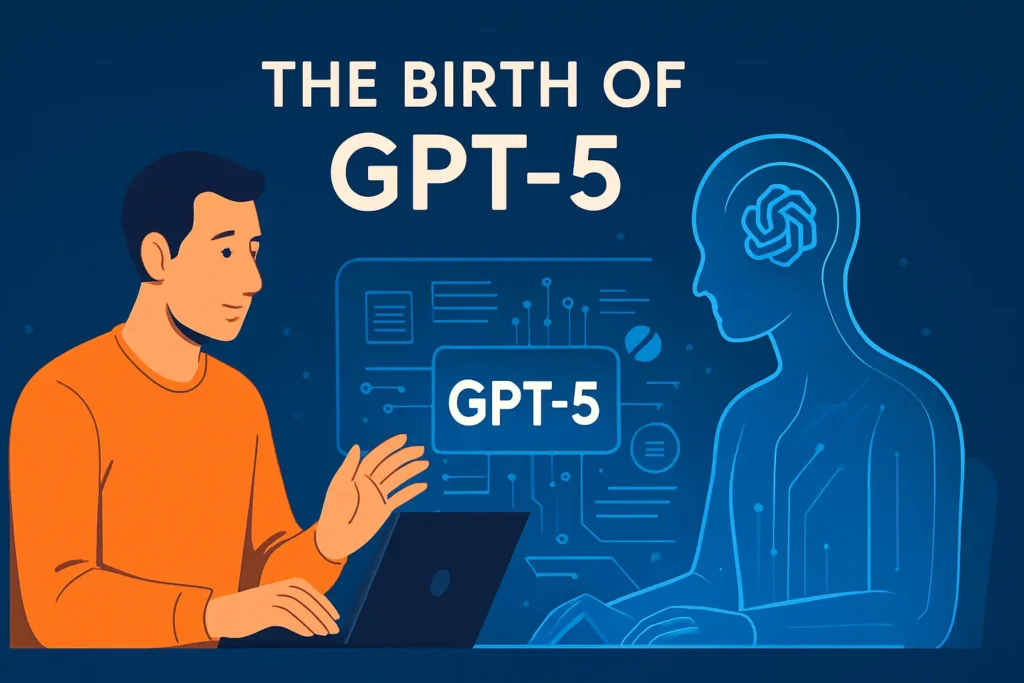
GPT-5 is the next major evolution in OpenAI’s Generative Pre-trained Transformer series—models designed to understand language, reason through complex tasks, and generate human-like responses.
But what makes GPT-5 special isn’t just that it’s “better” at writing, coding, or answering questions. It’s that it feels more:
- Context-aware
- Emotionally intelligent
- Reliable in long conversations
- Capable of multi-step reasoning
- Useful across real-world workflows
If GPT-4 was a brilliant assistant, GPT-5 feels closer to a thoughtful collaborator.
How GPT-5 Was Born: The Breakthroughs Behind the Model
While OpenAI hasn’t published every detail publicly, several major advancements shaped GPT-5’s development:
1. Larger and More Efficient Training
GPT-5 was trained on more diverse datasets with improved filtering, reducing hallucinations and increasing factual accuracy.
2. Better Long-Context Understanding
It can maintain coherence across long documents—think 100+ pages—making it ideal for editing books, research papers, and legal or technical docs.
3. Improved Reasoning and Planning
GPT-5 is significantly better at:
- Multi-step problem solving
- Coding complex systems
- Breaking down ambiguous instructions
- Detecting errors in its own output
4. Native Multimodal Intelligence
While earlier models added vision and audio as extensions, GPT-5 was built with multimodality in mind. It can understand images, audio, and even complex PDFs more fluidly.
5. Safety and Alignment Improvements
GPT-5 was trained with reinforced human feedback and more robust guardrails to reduce misinformation and misuse.
What Can GPT-5 Actually Do? Real-World Use Cases
Here are some examples that show how GPT-5’s birth impacts everyday users.
Content Creation & Marketing
- Drafts full editorial calendars
- Generates humanlike blog posts (like this one!)
- Rewrites content while preserving tone and intent
- Brainstorms unique angles with minimal prompting
Business Productivity
- Builds workflows and automation steps
- Summarizes meetings or long reports
- Assists with hiring tasks, job descriptions, and onboarding
Software Development
- Writes production-ready code
- Explains unfamiliar libraries or frameworks
- Debugs complex issues with step-by-step logic
Education & Research
- Breaks down advanced concepts
- Helps design lessons and study plans
- Reviews research papers for clarity and structure
Creative Work
- Storyboarding
- Songwriting
- Worldbuilding and character development
How to Make the Most of GPT-5: Step-by-Step Guide
Step 1: Start with Clear Intent
Before prompting GPT-5, decide:
- What outcome do you want?
- Who is the audience?
- What tone should it use?
Step 2: Give Context (Even If Short)
GPT-5 thrives on context:
- “I’m writing a blog for small-business owners…”
- “I’m a beginner coder working on…”
Step 3: Use Conversations, Not Commands
Instead of:
“Fix this.”
Try:
“This paragraph feels choppy. Can you smooth it out and keep my voice?”
Step 4: Iterate Like You Would With a Teammate
Ask follow-up questions. Provide feedback. GPT-5 adapts quickly.
Step 5: Integrate It Into Your Workflow
Use GPT-5 to support—not replace—your natural strengths.
Recommended Tools to Use With GPT-5
You don’t need anything fancy, but these tools amplify what the model can do:
- Notion or Obsidian for organized long-form work
- Zapier or Make.com for workflow automation
- Figma for multimodal design collaboration
- VS Code for coding with GPT-powered debugging
- Google Workspace or Microsoft 365 for business tasks
Common Mistakes to Avoid
Expecting perfection on the first try
GPT-5 excels with iteration.
Giving no context or vague instructions
“Write something good” yields generic results.
Not verifying complex facts
It’s more accurate—but still worth fact-checking.
Copying outputs verbatim
Treat it as a collaborator, not a replacement for your voice.
GPT-5 vs. Previous Generations: What’s Better Now?
| Feature | GPT-4 | GPT-5 |
|---|---|---|
| Reasoning | Strong | Much stronger, deeper logic |
| Speed | Moderate | Faster + more efficient |
| Long-context | Up to ~128k tokens | Much higher and more stable |
| Multimodal | Good add-on | Native & seamless |
| Personalization | Limited | Learns your style more intuitively |
GPT-5 isn’t just newer—it’s noticeably more capable in real workflows.
Final Takeaway: The Birth of GPT-5
The birth of GPT-5 isn’t about replacing humans. It’s about amplifying what we can create, learn, and accomplish with a tool that feels more intuitive and collaborative than ever before.
Like that moment during my power outage, GPT-5 often shines in unexpected ways—stepping in not to do the work for us, but to help us do our best work with it.
FAQs
Is GPT-5 available to the public?
Yes—though access may vary by platform or subscription tier.
Can GPT-5 replace human writers or workers?
No. It’s powerful, but its best use is as a partner in creativity, research, or tasks—not a replacement.
What’s the biggest improvement in GPT-5?
Long-context reasoning and multimodal capabilities.
Do I need technical skills to use GPT-5?
Not at all. Clear instructions and curiosity are enough.
Can GPT-5 generate full books or large projects?
Yes—with proper structure, prompts, and iteration.

Adrian Cole is a technology researcher and AI content specialist with more than seven years of experience studying automation, machine learning models, and digital innovation. He has worked with multiple tech startups as a consultant, helping them adopt smarter tools and build data-driven systems. Adrian writes simple, clear, and practical explanations of complex tech topics so readers can easily understand the future of AI.