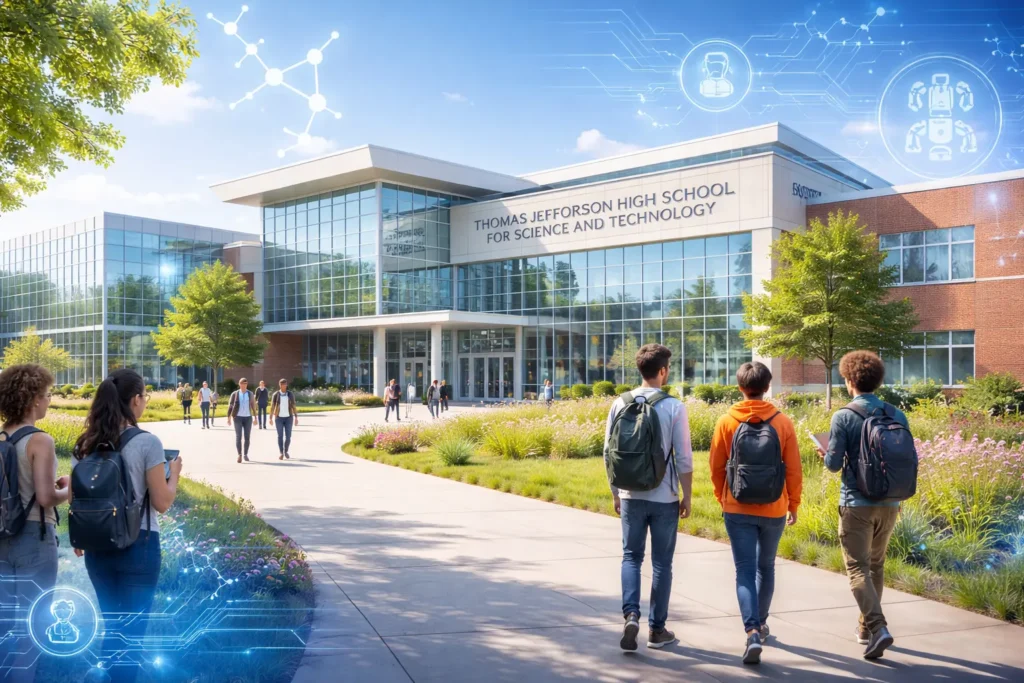
Thomas Jefferson High School for Science and Technology (TJHSST, commonly called “TJ”) is one of the most prestigious public high schools in the United States. Located in Alexandria, Virginia, TJ consistently ranks among the top high schools in the nation and is widely regarded as the gold standard for STEM-focused secondary education. Whether you’re a prospective student, a parent researching your options, or simply curious about what makes this school extraordinary, this complete guide covers everything you need to know — from the competitive admissions process to the satellite-building curriculum inside.
What is Thomas Jefferson High School for Science and Technology? An Overview of a Top-Ranked STEM Magnet School
Core Identity: A Governor’s School for Science & Technology
Thomas Jefferson High School for Science and Technology is a public magnet high school operated by Fairfax County Public Schools (FCPS). It was founded in 1985 under Virginia Governor Charles S. Robb, making it an official Virginia Governor’s School — a designation reserved for specialized public schools that serve academically advanced students across multiple jurisdictions.
TJ’s founding mission was to create a world-class environment for students passionate about science, technology, engineering, and mathematics. From the beginning, the school attracted corporate sponsorship from major technology firms including Honeywell and AT&T, cementing its identity as a bridge between rigorous academics and real-world STEM innovation. The school underwent a major renovation and expansion between 2013 and 2017, modernizing its facilities while preserving its unique academic culture.
TJ is a member of the National Consortium for Specialized Secondary Schools of Mathematics, Science and Technology (NCSSSMST), placing it alongside elite institutions across the country that share its mission of advanced STEM education.
Quick Facts: Location, Leadership, and Demographics
| Detail | Information |
|---|---|
| Full Name | Thomas Jefferson High School for Science and Technology |
| Common Name | TJHSST, TJ |
| Address | 6560 Braddock Road, Alexandria, Virginia 22312 |
| Phone | (703) 750-8300 |
| Principal | Michael Mukai |
| Grades | 9–12 |
| Enrollment | ~2,133 students |
| Student-Teacher Ratio | 17:1 |
| School Colors | Red, White, and Navy |
| Team Name | Colonials |
| Website | tjhsst.fcps.edu |
Student Demographics: TJ’s student body reflects intense academic competition across Northern Virginia. Approximately 63% of students identify as Asian American and 19% as White, with the remainder representing Black, Hispanic, and multiracial students. About 13% of the student population is economically disadvantaged — a figure that reflects ongoing efforts to broaden access to the school’s selective program.
How to Get In: A Step-by-Step Guide to TJHSST Admissions
Eligibility: Who Can Apply?
TJ draws students from six jurisdictions in Northern Virginia:
- Fairfax County
- Arlington County
- Loudoun County
- Prince William County
- City of Fairfax
- City of Falls Church
Applicants must also meet two baseline academic requirements: a minimum GPA of 3.5 (based on 7th and 8th grade coursework) and completion of Algebra I by the end of 8th grade. Meeting the minimum does not guarantee admission — TJ receives thousands of applications annually for roughly 550 seats.
The Application Process: From Portrait to Problem-Solving
Since 2020, TJ has replaced its standardized entrance exam with a holistic review process built around four components:
1. Student Portrait Sheet — Four short essays asking students to describe experiences, skills, and personal qualities. Reviewers assess problem-solving experiences, personal challenges, and demonstrated character.
2. Problem-Solving Essay — A timed written response to a math or science-based problem. The reasoning process matters as much as the final answer.
3. GPA (7th & 8th Grade) — Academic performance across both years, accounting for coursework rigor and consistency.
4. Experience Factors — Formally considered contextual factors including socio-economic status (economically disadvantaged), English Language Learner (ELL) status, and special education status. These recognize achievement relative to opportunity.
Applications are reviewed anonymously — by number rather than name — to reduce potential bias during scoring.
Understanding the Selection Process
Seats are allocated in two stages. The 1.5% Rule guarantees a minimum of 1.5% of available seats to students from each eligible middle school, preventing any single feeder school from dominating admissions. Remaining seats are filled from a broader at-large pool of the highest-scoring applicants across all jurisdictions.
Acceptance Rates & Demographic Trends
Under the current holistic model, the acceptance rate has settled at approximately 19–22%. The admissions process has been the subject of significant legal debate. The Coalition for TJ and the Pacific Legal Foundation filed a lawsuit challenging the holistic process as discriminatory, attracting national attention. Prospective families should consult the latest FCPS communications for the current policy status.
Inside the Classroom: The Rigorous TJHSST Curriculum
The First Year: Building Foundations with IBEST
Every incoming 9th grader enters the IBEST program — an integrated curriculum combining Biology, English, Statistics, and Technology into a unified first-year experience. Rather than treating these as isolated courses, IBEST weaves them together so students learn to analyze data, communicate findings, understand living systems, and apply digital tools in a cohesive way. IBEST sets the tone for the cross-disciplinary, rigorous thinking that defines all four years at TJ.
Advanced Labs & Coursework: Beyond AP
TJ’s collection of 15+ specialized research laboratories is one of its most defining features — facilities that many universities would be proud to house. Students pursue deeply specialized coursework in areas including Neuroscience, Oceanography, Astrophysics, Quantum Physics, Biotechnology, Advanced Marine Biology, DNA Science, Automation and Robotics, and Computer Systems.
These labs are genuine research environments, not classroom add-ons. In terms of AP coursework, 100% of TJ students participate in AP exams, with a pass rate of 94–100% — figures that consistently rank TJ at the top of national AP performance lists.
The Capstone Experience: Senior Research & The TJSTAR Symposium
Every TJ student must complete a mandatory senior research project — a year-long independent investigation that is the academic culmination of their TJ experience. Students choose between conducting research in one of TJ’s on-campus labs or pursuing an external mentorship with a professional researcher at a university, government agency, or technology company.
Projects are presented at the annual tjSTAR Symposium (Thomas Jefferson Student Research Symposium), a professional-style conference where students defend their work before peers, faculty, and community members.
Beyond Earth: The TJ3Sat & TJREVERB Satellite Projects
TJHSST built and launched TJ3Sat, which became the first satellite ever built by a high school. Students in the Systems Engineering Course designed and constructed this CubeSat through a multi-year engineering process. The follow-up mission, TJREVERB, continued this tradition. These are not models or simulations — they are fully functional spacecraft designed, assembled, and deployed by high school students.
Computing Power: The Supercomputer Lab
TJ has housed multiple generations of supercomputing hardware, including the ETA-10P and later the Cray SV1. The Computer Systems Lab gives students access to infrastructure that supports advanced simulations and machine learning research — resources typically reserved for university or government facilities.
Life at TJ: Student Activities and Culture
Athletics: The TJ Colonials
TJ fields competitive sports teams as the Colonials across a wide range of sports in Northern Virginia regional athletics. Current schedules, rosters, and offerings are available at tjsports.org.
Clubs, Publications, and the Arts
TJ’s extracurricular life is diverse and active. Key programs include tjTODAY (the student newspaper), Teknos (the student science and technology research journal where students publish original work), Techniques (the yearbook), a celebrated Orchestra program, and the beloved Swing Dance Club. Students also run competitive math and science clubs, robotics teams, debate organizations, cultural groups, and community service programs.
TJHSST Rankings and Recognition: The Numbers Don’t Lie
National and State Rankings (US News & World Report)
- #5 in the Nation
- #1 in Virginia
- Overall Score: 99.97 / 100
- College Readiness Index: 100%
- AP Exam Participation Rate: 100%
- AP Pass Rate: 94–100%
- Graduation Rate: 100%
Academic Performance: SOL Proficiency Rates
| Subject | TJ Proficiency | State Average (approx.) |
|---|---|---|
| Mathematics | 99% | ~70% |
| Reading | 98% | ~75% |
| Science | 100% | ~75% |
TJ outperforms both the Fairfax County district average and the Virginia state average by 20–30 percentage points across all three core subjects.
faqs
What GPA is required for TJHSST?
A minimum of 3.5 on a 4.0 scale, based on 7th and 8th grade coursework. The competitive applicant pool typically skews significantly higher.
Is there an entrance exam?
No. TJ eliminated its entrance exam in 2020 in favor of the holistic review process.
Can I apply from outside Fairfax County?
Yes — students from Arlington County, Loudoun County, Prince William County, the City of Fairfax, and the City of Falls Church are all eligible.
What is the acceptance rate?
Approximately 19–22% under the current admissions model.
Is there an application fee?
No. The previous $100 fee was eliminated to improve access for economically disadvantaged students.
Is TJ a public or private school?
TJ is a free public magnet school operated by Fairfax County Public Schools — there is no tuition.
Do students have to do a research project?
Yes. A senior research project is a mandatory graduation requirement for all students.
What is TJ most known for?
Its intensive STEM curriculum, professional-grade specialized research labs, mandatory senior research program, student-built satellites (TJ3Sat and TJREVERB), and its consistent ranking as one of the top five high schools in the United States.
Final Thoughts: Is TJHSST Right for You?
Thomas Jefferson High School for Science and Technology is not designed for every student — and that is by design. TJ is built for students who thrive under academic pressure, are genuinely passionate about science and technology, and are ready to engage in authentic research from day one.
For the right student, TJ offers something rare: the chance to build a satellite, publish original research, collaborate with professional scientists, and graduate with real-world scientific experience that goes far beyond college readiness. Its #5 national ranking reflects decades of institutional commitment to a model that treats high school students as the scientists, engineers, and innovators they are capable of becoming.
If you are considering applying, start early, understand the holistic process fully, and remember that the goal isn’t simply to get in — it’s to be the kind of student who will genuinely thrive there.
Statistics and rankings sourced from US News & World Report, FCPS official data, and public records. For the most current application deadlines and admissions requirements, visit tjhsst.fcps.edu.

Adrian Cole is a technology researcher and AI content specialist with more than seven years of experience studying automation, machine learning models, and digital innovation. He has worked with multiple tech startups as a consultant, helping them adopt smarter tools and build data-driven systems. Adrian writes simple, clear, and practical explanations of complex tech topics so readers can easily understand the future of AI.