If you’ve spent any time in corporate meetings, scrolling LinkedIn, or reading annual reports, you’ve probably seen the acronym everywhere. But what does DEI stand for in business — and why has it become such a central conversation in boardrooms, HR departments, and startup Slack channels alike?
DEI stands for Diversity, Equity, and Inclusion. On paper, it’s three simple words. In practice, it’s a strategic framework that shapes how organizations hire, promote, lead, market, innovate, and grow.
Yet here’s the uncomfortable truth: many companies talk about DEI without truly understanding it. They launch initiatives, publish statements, and add the acronym to their careers page — but struggle to translate it into meaningful action.
In this comprehensive guide, I’ll break down:
- What DEI really means in business terms
- Why it matters beyond optics and PR
- How companies implement DEI strategically
- The real benefits (and real challenges)
- Common mistakes businesses make
- Tools, metrics, and frameworks you can actually use
- Frequently asked questions leaders and founders ask
Whether you’re a founder, HR leader, executive, or employee trying to understand workplace culture, this article will give you practical clarity — not buzzwords.
Let’s start at the beginning.
What Does DEI Stand for in Business? A Clear Breakdown
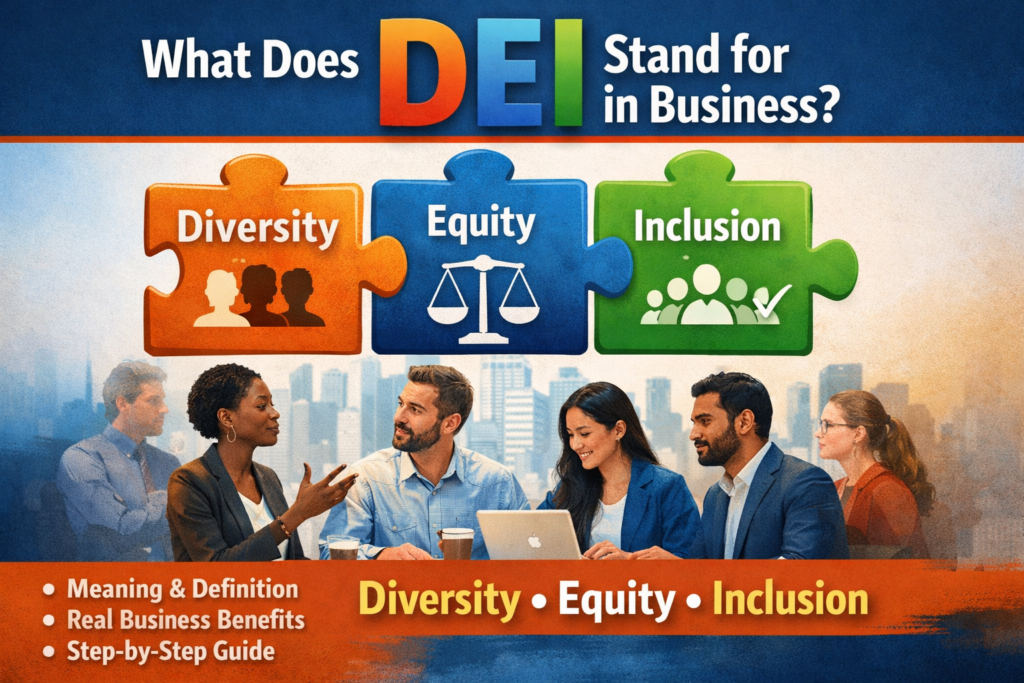
At its core, DEI in business stands for:
- Diversity – Who is in the room
- Equity – How fair the systems are
- Inclusion – Whether everyone feels valued and heard
That’s the simplified version. Now let’s unpack what each word actually means in real business settings.
Diversity: Representation Across Differences
Diversity refers to the presence of differences within a workplace. These differences may include:
- Race and ethnicity
- Gender identity
- Age
- Disability
- Sexual orientation
- Religion
- Socioeconomic background
- Educational pathways
- Cognitive styles
- Cultural experiences
In business, diversity is about representation — especially in leadership and decision-making roles.
Imagine a marketing team made up of five people who all grew up in similar neighborhoods, attended similar universities, and share similar life experiences. Their ideas may be polished — but narrow.
Now imagine that same team includes people from different cultures, age groups, educational paths, and lived experiences. Suddenly, blind spots shrink. Campaigns resonate more broadly. Innovation increases.
Diversity expands perspective.
Equity: Fair Systems, Not Equal Treatment
This is where confusion often starts.
Equity is not the same as equality.
Equality means giving everyone the same resources.
Equity means giving people what they need to succeed.
In business terms, equity asks:
- Are promotion processes truly fair?
- Do compensation systems contain hidden bias?
- Are advancement opportunities equally accessible?
- Do performance evaluations favor certain communication styles?
For example, if leadership networking events always happen after 6 PM, parents or caregivers may be disadvantaged. That’s not equitable.
Equity requires businesses to examine systems, policies, and structures — not just intentions.
Inclusion: Belonging and Psychological Safety
You can hire diverse talent. You can adjust policies for equity. But if employees don’t feel safe, respected, or heard, they won’t stay.
Inclusion is about culture.
It’s asking:
- Do employees feel comfortable speaking up?
- Are different viewpoints welcomed?
- Are people invited into decision-making?
- Do employees feel they belong?
An inclusive company doesn’t just “have diversity.” It activates it.
When employees feel included, engagement rises. Retention improves. Innovation accelerates.
Why DEI Matters in Business (Beyond Public Image)
Let’s move past surface-level arguments.
DEI is not just about corporate reputation. It’s a business strategy.
Here’s why.
1. Diverse Teams Outperform Homogeneous Ones
Multiple research studies over the past decade have found that diverse teams:
- Make better decisions
- Generate more creative solutions
- Identify risks earlier
- Adapt faster to change
When different perspectives collide (respectfully), better thinking happens.
In rapidly shifting markets, this matters.
2. Customers Are Diverse — Your Team Should Reflect That
If your customer base spans cultures, generations, and geographies, but your internal team doesn’t, you risk missing insight.
Consider global brands. Marketing missteps often happen when decision-makers lack cultural awareness.
DEI helps companies:
- Avoid tone-deaf campaigns
- Design accessible products
- Understand new markets
- Build authentic brand trust
3. Talent Attraction and Retention
Younger generations prioritize workplace culture heavily. They research company values before applying.
A company with strong DEI practices often experiences:
- Higher employee satisfaction
- Lower turnover
- Stronger employer brand
- Wider candidate pools
Retention saves money. Recruitment is expensive.
4. Risk Management and Compliance
Equitable policies reduce the risk of:
- Discrimination claims
- Workplace conflicts
- Bias-driven decisions
DEI, when done properly, supports legal compliance and ethical leadership.
5. Innovation and Long-Term Growth
Homogeneous teams can fall into groupthink. Diverse teams challenge assumptions.
And in business, challenging assumptions often leads to breakthroughs.
The Real-World Benefits of DEI in Action
Let’s make this practical.
Here are examples of how DEI translates into business results.
Hiring and Recruitment
Companies implementing inclusive hiring practices often:
- Expand candidate sourcing beyond traditional networks
- Remove biased language from job descriptions
- Use structured interviews
- Introduce blind resume reviews
Result: Access to broader talent pools.
Leadership Development
Equitable promotion systems:
- Create transparent advancement criteria
- Provide mentorship programs
- Identify high-potential employees from underrepresented groups
Result: Stronger leadership pipelines.
Product Development
Diverse teams designing products can:
- Identify accessibility improvements
- Avoid cultural blind spots
- Spot emerging market needs
Result: Products that resonate more broadly.
Workplace Culture
Inclusive workplaces:
- Encourage open dialogue
- Provide employee resource groups (ERGs)
- Offer flexible policies
Result: Higher engagement and morale.
Step-by-Step Guide: How to Implement DEI in Business
Let’s talk execution.
Implementing DEI is not a one-off workshop. It’s a structured, ongoing process.
Step 1: Conduct a DEI Assessment
Start with data.
Review:
- Workforce demographics
- Leadership representation
- Pay equity reports
- Promotion rates
- Employee engagement surveys
Ask: Where are the gaps?
Without data, DEI becomes guesswork.
Step 2: Define Clear DEI Goals
Set measurable objectives:
- Increase leadership diversity by X%
- Close pay gaps within 12 months
- Improve employee inclusion survey scores
Vague goals lead to vague outcomes.
Step 3: Build Leadership Accountability
DEI cannot live solely in HR.
Senior leaders must:
- Champion initiatives
- Tie DEI goals to performance reviews
- Model inclusive behavior
Accountability changes outcomes.
Step 4: Revise Policies and Systems
Look at:
- Hiring practices
- Compensation structures
- Performance evaluation methods
- Promotion criteria
Ask: Where might bias exist?
Step 5: Invest in Training and Education
But do it thoughtfully.
Effective DEI training:
- Is ongoing, not one-time
- Focuses on skill-building
- Encourages discussion
- Avoids blame-based messaging
Training should build competence, not defensiveness.
Step 6: Create Feedback Channels
Encourage:
- Anonymous surveys
- Open forums
- Inclusion audits
Employees must feel safe giving feedback.
Step 7: Measure and Adjust
DEI is iterative.
Track progress quarterly.
Adjust strategy as needed.
Communicate transparently.
Tools, Frameworks, and DEI Resources
Here’s where practicality matters.
Free Options
- Internal Surveys (Google Forms or Microsoft Forms)
- Basic demographic analysis in HR software
- Free bias-check tools for job descriptions
Pros:
- Cost-effective
- Easy to implement
Cons:
- Limited depth
- No expert guidance
Paid Tools and Platforms
- DEI analytics platforms
- Pay equity audit software
- Learning management systems with DEI modules
Pros:
- Advanced data insights
- Structured frameworks
- Expert-backed design
Cons:
- Budget investment required
- Requires internal buy-in
Consulting Support
For mid-to-large organizations, external DEI consultants can:
- Conduct audits
- Facilitate workshops
- Develop long-term strategies
Choose carefully. Look for proven experience and measurable outcomes.
Common Mistakes Businesses Make with DEI (And How to Fix Them)
Even well-intentioned companies stumble.
Mistake 1: Treating DEI as a PR Strategy
Posting statements without structural change erodes trust.
Fix: Tie DEI to measurable actions and publish progress.
Mistake 2: One-Time Training
A single workshop won’t shift culture.
Fix: Integrate ongoing education and leadership modeling.
Mistake 3: Ignoring Equity
Hiring diverse talent without fixing systemic bias leads to churn.
Fix: Review promotion and compensation systems.
Mistake 4: Lack of Leadership Involvement
When DEI is isolated in HR, impact stalls.
Fix: Make leaders accountable for outcomes.
Mistake 5: Overpromising, Underdelivering
Grand goals without realistic roadmaps create skepticism.
Fix: Set phased, achievable milestones.
How to Measure DEI Success
If you can’t measure it, you can’t improve it.
Key metrics include:
- Workforce diversity percentages
- Leadership representation
- Pay equity ratios
- Promotion rates by demographic
- Employee inclusion scores
- Retention rates
Qualitative metrics matter too:
- Employee feedback
- Psychological safety indicators
- Cultural climate assessments
Numbers tell one part of the story. Experiences tell the rest.
The Future of DEI in Business
DEI continues to evolve.
Today, the conversation includes:
- Belonging (DEIB)
- Accessibility
- Neurodiversity
- Global cultural inclusion
- Remote work equity
As workplaces become more global and digital, inclusion strategies must adapt.
Companies that view DEI as a long-term strategy — not a trend — are better positioned for resilience and growth.
Conclusion: What DEI Really Means for Your Business
So, what does DEI stand for in business?
It stands for Diversity, Equity, and Inclusion.
But more importantly, it stands for:
- Smarter decision-making
- Fairer systems
- Stronger cultures
- Sustainable growth
DEI is not about perfection. It’s about progress.
The companies that succeed are not the ones with the most polished mission statements — but the ones willing to examine their systems, listen to their employees, and evolve.
If you’re a leader, start with data.
If you’re an employee, start with dialogue.
If you’re a founder, start with intention.
DEI is not a checkbox. It’s a continuous commitment.
And when done right, it strengthens both people and profit.
FAQs
What does DEI stand for in business?
DEI stands for Diversity, Equity, and Inclusion. It refers to workplace strategies designed to improve representation, fairness, and belonging.
Is DEI legally required for businesses?
Some elements related to anti-discrimination are legally required. However, broader DEI strategies are voluntary but often aligned with compliance and risk management.
What is the difference between diversity and inclusion?
Diversity is about representation. Inclusion is about creating a culture where diverse individuals feel valued and heard.
How can small businesses implement DEI?
Start with fair hiring practices, transparent policies, inclusive language, and open communication. Even small teams can adopt equitable systems.
How do you measure DEI success?
Through workforce data, pay equity audits, promotion tracking, retention metrics, and employee feedback surveys.

Michael Grant is a business writer with professional experience in small-business consulting and online entrepreneurship. Over the past decade, he has helped brands improve their digital strategy, customer engagement, and revenue planning. Michael simplifies business concepts and gives readers practical insights they can use immediately.