If you’ve ever sat in on a leadership meeting or scrolled through LinkedIn job titles and wondered, what does CMO stand for in business? — you’re not alone.
It’s one of those acronyms that sounds powerful (and it is), but unless you’ve worked closely with executive teams, the real meaning can feel a bit fuzzy.
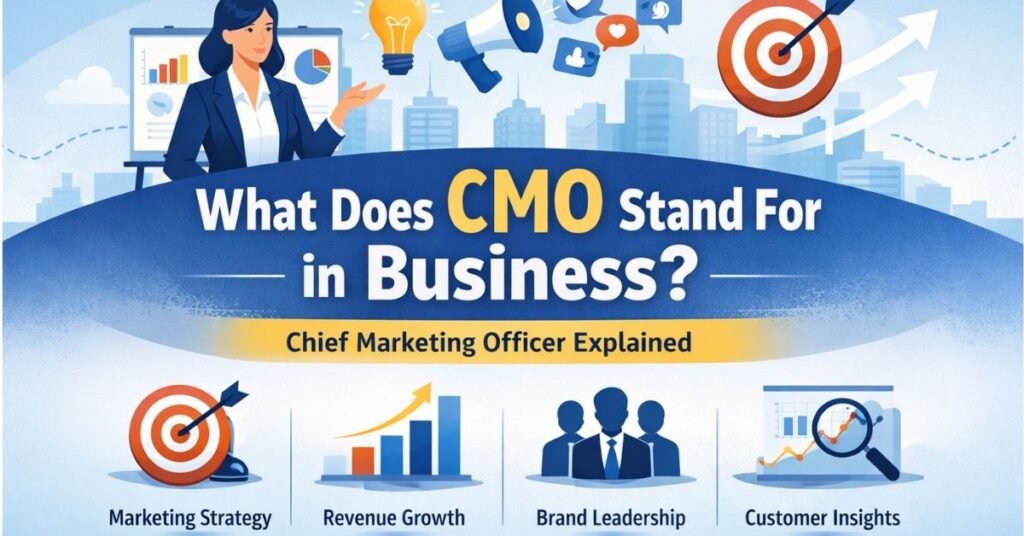
CMO stands for Chief Marketing Officer — the executive responsible for overseeing a company’s marketing strategy, brand positioning, customer acquisition, and overall growth initiatives.
But that short definition barely scratches the surface.
In today’s business world — where attention is currency and customer loyalty is fragile — the CMO isn’t just “the marketing person.” They are the architect of brand perception. The bridge between product and customer. The growth strategist sitting at the same table as the CEO and CFO.
In this comprehensive guide, you’ll learn:
- Exactly what a CMO does (beyond the buzzwords)
- How the role has evolved in the digital age
- The real benefits of having a strong Chief Marketing Officer
- How to become a CMO step by step
- Tools, structures, and comparisons
- Common mistakes companies make when hiring or empowering a CMO
- FAQs people actually search for
Let’s break it down properly.
What Does CMO Stand for in Business? A Beginner-Friendly Explanation
At its simplest level:
CMO = Chief Marketing Officer.
They are part of the C-suite — the executive leadership team — alongside roles like:
- CEO (Chief Executive Officer)
- CFO (Chief Financial Officer)
- COO (Chief Operating Officer)
- CTO (Chief Technology Officer)
If the CEO sets the vision and direction for the company, the CMO makes sure the world understands, desires, and buys into that vision.
Think of it this way:
- The CEO decides where the company is going.
- The CFO manages the money.
- The COO ensures operations run smoothly.
- The CMO ensures customers care enough to pay attention — and convert.
In many companies, the CMO leads departments such as:
- Branding
- Advertising
- Content marketing
- Digital marketing
- Social media
- Public relations
- Customer research
- Performance marketing
- Marketing analytics
In short: the CMO owns the company’s relationship with its audience.
And in modern business, that relationship is everything.
The Real Role of a Chief Marketing Officer in Today’s Business Environment
Years ago, marketing was mostly about TV ads, print campaigns, billboards, and trade shows. The CMO’s job was heavily creative and campaign-driven.
Today? It’s a hybrid of creativity, analytics, psychology, and technology.
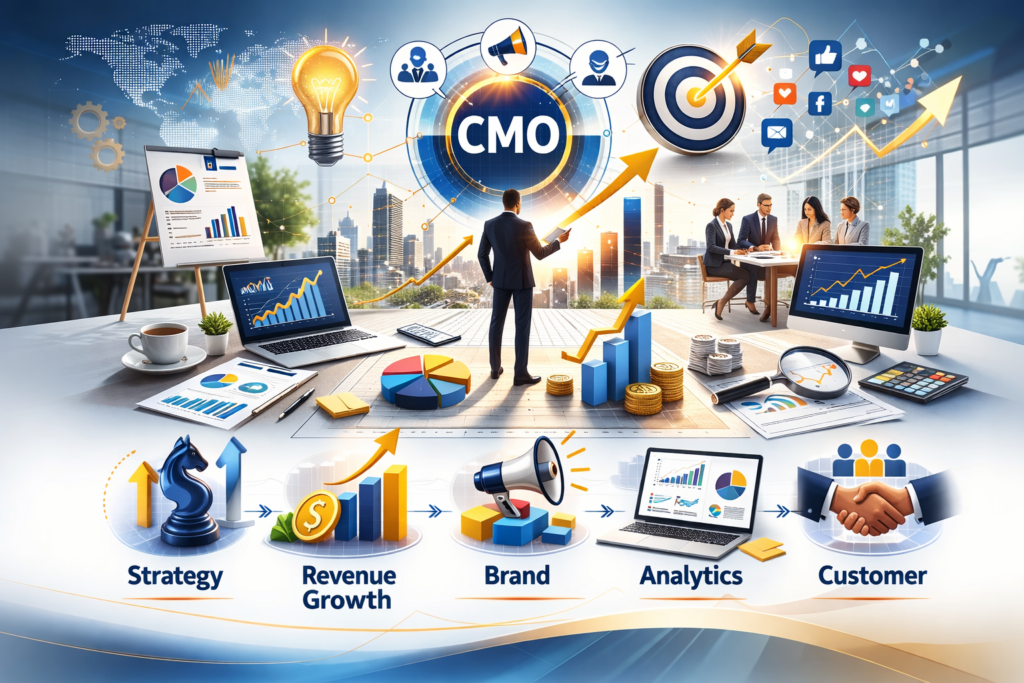
Modern CMOs are responsible for:
Strategic Growth Planning
They align marketing goals with business revenue targets. This includes:
- Setting customer acquisition strategies
- Defining market positioning
- Planning product launches
- Entering new markets
Marketing is no longer just awareness — it’s revenue-driven.
Brand Strategy & Reputation Management
A strong CMO defines:
- Brand voice
- Messaging frameworks
- Core value propositions
- Visual identity consistency
They protect brand equity and ensure the company’s image aligns with its long-term goals.
Data-Driven Decision Making
Today’s CMO must understand:
- Customer data
- Conversion rates
- Customer lifetime value (CLV)
- Return on ad spend (ROAS)
- Attribution models
Marketing without data is guesswork. A strong Chief Marketing Officer builds dashboards and makes evidence-based decisions.
Cross-Department Collaboration
The CMO works closely with:
- Sales teams (for alignment on messaging and lead quality)
- Product teams (for feature positioning)
- Finance (for budget allocation and ROI analysis)
- HR (for employer branding)
Marketing is no longer isolated. It’s integrated.
Why the CMO Role Matters More Than Ever
If you think about it, we live in a time where customers are overloaded with choices.
Every industry is crowded. Every brand is shouting.
So what separates companies that grow from those that disappear?
Clarity. Positioning. Customer connection.
And that’s where the CMO comes in.
1. They Drive Revenue, Not Just Awareness
Modern marketing is performance-based. A CMO ensures campaigns are tied to:
- Lead generation
- Sales growth
- Market share expansion
- Customer retention
Marketing is no longer a cost center — it’s a growth engine.
2. They Create Competitive Advantage
A product alone isn’t enough anymore.
Two companies may sell nearly identical services. The one with:
- Better messaging
- Clearer positioning
- Stronger storytelling
- Smarter distribution
… wins.
That strategic differentiation comes from the CMO.
3. They Build Long-Term Brand Equity
Short-term campaigns bring sales.
Long-term branding builds:
- Trust
- Authority
- Customer loyalty
- Pricing power
Companies like Apple, Nike, and Coca-Cola didn’t win on features alone. They won on brand strategy — led by visionary marketing leadership.
What Does a CMO Actually Do Day to Day?
Let’s make this practical.
A Chief Marketing Officer’s daily reality isn’t just brainstorming taglines.
It includes:
- Reviewing campaign performance reports
- Approving budgets
- Meeting with advertising agencies
- Aligning with the sales director
- Overseeing product launch plans
- Managing marketing teams
- Analyzing customer behavior data
- Presenting growth forecasts to the CEO
In smaller companies, the CMO may still be hands-on.
In larger enterprises, they operate at a strategic level — managing directors and VPs beneath them.
But regardless of company size, their core responsibility remains:
Ensure marketing drives measurable business growth.
Benefits of Hiring a Chief Marketing Officer
Many startups try to operate without a CMO to save costs.
It often backfires.
Here’s why having a strong CMO creates tangible business advantages.
Clear Brand Positioning
Without a CMO, messaging becomes inconsistent.
Different teams say different things.
A Chief Marketing Officer creates:
- Unified messaging frameworks
- Brand guidelines
- Tone-of-voice consistency
This improves trust and recognition.
Better Customer Understanding
A CMO invests in:
- Market research
- Surveys
- Customer interviews
- Competitor analysis
They turn assumptions into insights.
Stronger Marketing ROI
Instead of random campaigns, a CMO builds:
- Structured funnels
- Budget forecasting
- KPI-driven initiatives
- Attribution models
Marketing becomes predictable.
Scalability
As companies grow, marketing complexity increases.
A CMO builds systems — not just campaigns.
Step-by-Step: How to Become a CMO
If you’re reading this from a career perspective, here’s the realistic roadmap.
Step 1: Build Marketing Foundations
Most CMOs start in roles like:
- Marketing coordinator
- Content marketer
- Performance marketer
- Brand strategist
You need deep understanding of:
- Digital channels
- Customer psychology
- Analytics
- Conversion optimization
Step 2: Gain Cross-Functional Experience
Future CMOs learn:
- Sales processes
- Product development cycles
- Budget planning
- Data analysis
Marketing leadership requires business fluency.
Step 3: Develop Leadership Skills
You must manage:
- Teams
- Agencies
- Budgets
- Stakeholders
Communication becomes as important as technical skill.
Step 4: Think in Revenue Terms
A CMO doesn’t say:
“We increased traffic.”
They say:
“We increased revenue by 18% through improved acquisition efficiency.”
That shift in mindset is critical.
Step 5: Build Strategic Vision
Eventually, you move from executing marketing to designing strategy.
That’s when you become CMO material.
Tools Every Modern CMO Relies On
A strong Chief Marketing Officer isn’t guessing.
They use tools.
Here are core categories:
Analytics & Data
- Google Analytics
- Looker
- Tableau
- HubSpot dashboards
Purpose: Track performance, attribution, and growth metrics.
CRM Systems
- Salesforce
- HubSpot CRM
- Zoho
Purpose: Align marketing with sales pipelines.
Advertising Platforms
- Google Ads
- Meta Ads
- LinkedIn Ads
Purpose: Customer acquisition.
Marketing Automation
- Marketo
- HubSpot
- ActiveCampaign
Purpose: Lead nurturing and lifecycle marketing.
Social & Content Tools
- SEMrush
- Ahrefs
- Sprout Social
- Hootsuite
Purpose: Content strategy and brand monitoring.
Free vs Paid?
Free tools are useful for startups.
Paid platforms become essential at scale.
A serious CMO treats software as an investment — not an expense.
CMO vs Marketing Director vs VP of Marketing
This is where many people get confused.
CMO
- Executive-level
- Sets company-wide marketing strategy
- Reports directly to CEO
- Oversees revenue alignment
VP of Marketing
- Senior leadership
- Executes strategic initiatives
- Manages department heads
Marketing Director
- Focuses on specific channels or teams
- Tactical execution role
In simple terms:
The CMO defines the battlefield.
The VP organizes the troops.
The Director leads the charge.
Common Mistakes Companies Make with CMOs
Even smart companies get this wrong.
Mistake 1: Hiring Too Late
Startups often wait until marketing chaos begins.
A CMO works best proactively — not reactively.
Mistake 2: Expecting Miracles Without Budget
You cannot demand exponential growth without investment.
A CMO needs resources.
Mistake 3: Misalignment with CEO
If the CEO wants brand building and the CMO focuses only on performance ads — conflict arises.
Strategic alignment is essential.
Mistake 4: Measuring Vanity Metrics
Likes, impressions, and traffic mean nothing without revenue.
A serious Chief Marketing Officer focuses on impact.
The Evolution of the CMO Role in the Digital Era
The role has shifted dramatically.
Old-school CMOs focused on:
- TV campaigns
- Print ads
- Trade shows
Modern CMOs focus on:
- Omnichannel digital strategy
- Performance marketing
- Customer journey optimization
- Personalization
- AI-driven analytics
They must understand technology almost as much as creativity.
The modern CMO is part strategist, part data scientist, part storyteller.
Conclusion: Why Understanding What CMO Stands for in Business Really Matters
So, what does CMO stand for in business?
Chief Marketing Officer.
But more importantly:
It represents leadership over growth, brand, customer connection, and market influence.
A strong CMO transforms:
- Scattered marketing into strategic systems
- Campaigns into revenue engines
- Messaging into market dominance
Whether you’re a business owner considering your first executive hire or a marketer aiming for the C-suite, understanding this role changes how you see marketing forever.
Marketing isn’t decoration.
It’s direction.
And the CMO leads it.
FAQs
What does CMO stand for in business?
CMO stands for Chief Marketing Officer — the executive responsible for leading a company’s marketing strategy and growth initiatives.
Is a CMO higher than a Marketing Director?
Yes. A CMO is a C-suite executive and typically oversees the entire marketing department, including directors and VPs.
Does every company need a CMO?
Not every small business needs one immediately, but growth-focused companies benefit significantly from strategic marketing leadership.
What skills are required to become a CMO?
Strategic thinking, data analysis, leadership, communication, revenue understanding, and deep marketing expertise.
What is the average salary of a CMO?
It varies by country and company size but is typically one of the highest-paid executive roles after CEO and CFO.

Michael Grant is a business writer with professional experience in small-business consulting and online entrepreneurship. Over the past decade, he has helped brands improve their digital strategy, customer engagement, and revenue planning. Michael simplifies business concepts and gives readers practical insights they can use immediately.