Introduction: The Dual Identity of Sharif University of Technology
Sharif University of Technology (SUT) stands as Iran’s most prestigious technical institution and one of the most recognized engineering universities in the Middle East and Central Asia. Founded in 1966 in Tehran, it has long been dubbed “Iran’s MIT” — a reputation earned through decades of producing world-class scientists, engineers, and Nobel- and Fields Medal-caliber alumni who have gone on to lead global technology companies and academic institutions.
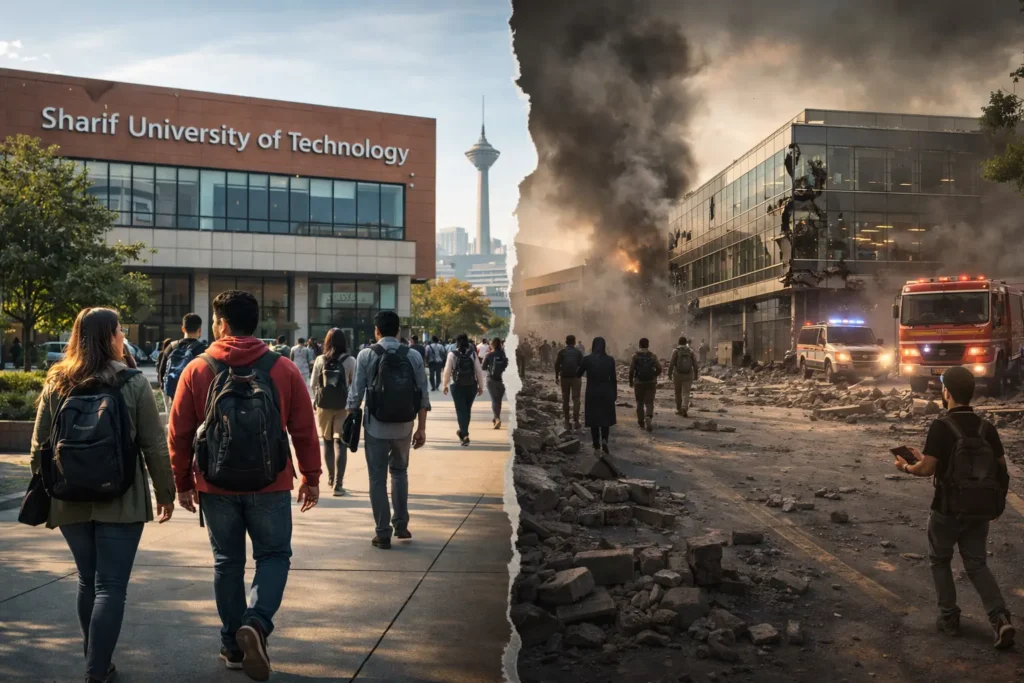
Yet on April 6, 2026, Sharif University entered a different kind of global spotlight: US-Israel airstrikes struck infrastructure in and around the Sharif neighborhood of Tehran, disrupting gas supplies, forcing the university to shift to online instruction, and igniting an intense international debate about the targeting of civilian academic institutions.
This article serves as the single authoritative resource covering both dimensions of Sharif University’s identity — its extraordinary academic legacy and its place at the heart of Iran’s geopolitical crisis. Whether you are a prospective student, researcher, journalist, or policymaker, the information below provides the most comprehensive and current account available.
At a Glance: Key Facts About Sharif University of Technology
Quick Statistics
- Official Name: Sharif University of Technology (SUT)
- Former Name: Aryamehr University of Technology (pre-1980)
- Founded: 1966, Tehran, Iran
- Type: Public Research University
- Location: Azadi Square, Tehran (Main Campus); Kish Island (International Campus)
- Enrollment: Approximately 10,000–12,000 students
- Undergraduate Students: 5,659
- Postgraduate Students: 3,390
- Doctoral Students: 989
- Full-time Faculty: 300–460 professors
- Part-time Faculty: ~430
- Endowment: US$0.5 billion (2021)
- President (2023–present): Abbas Mousavi
- Official Website: sharif.ir
- Institutional Colors: Dark Blue
- GPS Coordinates: 35°42′6.47″N, 51°20′39.35″E
Official Identity & Naming History
The university was originally established as Aryamehr University of Technology, named after the title of the last Shah of Iran. Following the 1979 Islamic Revolution and the subsequent cultural transformation of Iranian institutions, it was renamed Sharif University of Technology in 1980, honoring Majid Sharif Vaghefi, a revolutionary figure. Despite the political changes, its academic mission remained intact: to produce engineers and scientists of the highest caliber, modeled explicitly on the Massachusetts Institute of Technology (MIT).
2026 Airstrike Crisis: Israel Bombs Sharif University — Latest Updates
| ⚠️ IMPORTANT NOTICE: This section reports verified facts based on available sources as of April 6, 2026. The situation is evolving. Readers are advised to consult official Iranian state media and international wire services for the latest updates. |
What Happened on April 6, 2026?
On the morning of April 6, 2026, a wave of US-Israel airstrikes targeted multiple sites across Tehran and surrounding provinces, including the Qom region. Within Tehran, strikes impacted the Sharif neighborhood — the district in which Sharif University of Technology is located — triggering significant disruptions to civilian infrastructure.
According to reporting from IRIB (Islamic Republic of Iran Broadcasting), Tehran’s District 9 municipal head confirmed that a natural gas distribution site near the university’s campus was struck, causing a temporary gas outage across a substantial portion of the surrounding residential area. Video footage circulating on social media showed smoke rising from areas adjacent to the main campus, though the extent of direct damage to academic buildings remained unconfirmed at time of writing.
In response to the disruption, university administrators announced the immediate suspension of in-person classes and the shift to online instruction — a logistical decision that affects the approximately 12,000 students enrolled across the institution’s undergraduate, graduate, and doctoral programs.
Timeline of Events
- Early morning: Airstrikes reported across Tehran and Qom provinces
- Sharif neighborhood struck; gas infrastructure hit near campus
- District 9 head confirms gas outage to surrounding residential area
- Sharif University of Technology announces shift to online classes
- Video footage of aftermath begins circulating on social media (X.com)
- International political reactions begin emerging from US Congress members and civil society
- Iranian state media (IRIB) issues official confirmation of infrastructure damage
Damage to Campus and Gas Infrastructure
The confirmed damage as of April 6, 2026 includes a natural gas distribution station or pipeline in the vicinity of the main university campus. The strike on this infrastructure led to a gas outage affecting not just the university itself, but the broader Tarasht neighborhood — the residential zone in which many faculty and staff members live.
Whether any academic research facilities, laboratories, libraries, or administrative buildings were directly struck remains a point of contested reporting. The university’s central library, its various engineering research centers, and the main physics and chemistry laboratories represent decades of accumulated scientific infrastructure — the possible destruction of any such facilities would represent a significant loss to Iranian scientific capacity.
Unverified social media footage showed what appeared to be damage to structures consistent with residential and light industrial buildings near the campus perimeter. Official damage assessments from Iranian authorities were pending as of publication.
Political Reactions and International Response
The strike on or near a globally recognized university campus drew immediate political condemnation from multiple quarters. US Congresswoman Yassamin Ansari, one of the most prominent voices of the Iranian-American community in the US legislature, issued a sharp rebuke, stating publicly: “Why are we bombing a university?” — a question that rapidly gained traction on social media and in international news cycles.
Iranian-American journalist and commentator Omid Memarian also amplified the story, drawing attention to the university’s civilian academic nature and the international reputation of its alumni. The incident prompted broader questions about the rules of engagement when military operations intersect with civilian academic and scientific infrastructure.
On social media platform X (formerly Twitter), multiple viral posts documented the aftermath, with hashtags related to Sharif University trending globally within hours of the strike. The combination of the university’s elite reputation — routinely described as “Iran’s MIT” — and the dramatic imagery of a university campus affected by military operations generated exceptional international media attention.
Military Allegations, Sanctions, and Context
It is important to present a complete and factually grounded picture of the context in which this strike occurred. Sharif University of Technology has been subject to international sanctions — including from the European Union and the United States — based on allegations linking certain research programs at the institution to Iran’s ballistic missile development program and, by extension, to elements of the Islamic Revolutionary Guard Corps (IRGC).
These sanctions, which are tracked and documented by the EU Sanctions Tracker, reflect Western government assessments that certain SUT research activities have dual-use potential — applicable to both civilian scientific development and military applications. The Iranian government, the university’s administration, and a significant portion of the international academic community contest these characterizations, arguing that the vast majority of SUT’s research is civilian, open, and academically oriented.
The case of Omid Kokabee, an SUT-affiliated physicist who was imprisoned in Iran and later released, is frequently cited by human rights organizations as evidence of the complex intersection of academic freedom, geopolitics, and institutional identity that defines Sharif University’s place in the international discourse.
Whether the 2026 airstrike was specifically intended to target dual-use research infrastructure or represents collateral damage to civilian academic property is a determination that independent international observers, journalists, and legal experts will be examining in the weeks and months ahead.
World Rankings & Academic Reputation (2025–2026)
Overall Rankings Summary
Despite the political turbulence that has surrounded it for decades, Sharif University of Technology has consistently maintained a position among the world’s top universities across multiple authoritative ranking systems. Its standing reflects genuine research output, citation impact, and employer regard — not national favoritism.
| Ranking System | Position | Overall Score | Year |
| QS World Rankings | #=375 | 39.9/100 | 2026 |
| US News & World Report | #598 | N/A | 2025–26 |
| Times Higher Education | #401–500 | N/A | 2025–26 |
| Shanghai (ARWU) | #501–600 | N/A | 2025–26 |
QS World University Rankings 2026: Detailed Metrics
The QS (Quacquarelli Symonds) World University Rankings represent one of the most granular and globally recognized university assessment systems. In the 2026 edition, Sharif University of Technology achieved a position of #=375 with an overall score of 39.9 out of 100. The breakdown of its six core metrics reveals both its exceptional strengths and areas for development:
| QS Metric | Score |
| Academic Reputation | 17.8 / 100 |
| Employer Reputation | 48.2 / 100 |
| Citations per Faculty | 99.2 / 100 (strongest metric) |
| Faculty/Student Ratio | 8.2 / 100 |
| International Faculty | Low |
| International Students | Low |
The standout metric is Citations per Faculty, where SUT scores 99.2 out of 100 — placing it in the very highest tier globally for research output relative to faculty size. This reflects the extraordinary productivity of SUT’s research community, which continues to publish high-impact work despite the constraints imposed by international sanctions and geopolitical isolation.
The relatively lower scores for Academic Reputation (17.8) and International Faculty/Student ratios reflect the structural challenges of operating as an Iranian institution in an era of strict sanctions and restricted international mobility. These scores are not indicators of academic quality, but rather of geopolitical circumstance.
Why Is Sharif University Called “Iran’s MIT”?
The MIT comparison is not a casual nickname — it is rooted in the deliberate design philosophy of the institution from its earliest days. When Sharif University (then Aryamehr University) was established in 1966, its founding vision was explicitly modeled on the Massachusetts Institute of Technology. The Iranian scholar and philosopher Seyyed Hossein Nasr, who served as an early president of the institution, championed a curriculum and research culture explicitly designed to replicate MIT’s rigorous, STEM-focused, research-intensive model — while embedding it within Iranian cultural and linguistic traditions.
Decades later, that vision has produced results that validate the comparison. SUT alumni include a Fields Medal winner (the mathematical equivalent of a Nobel Prize), numerous successful founders of Silicon Valley technology companies, and a disproportionate share of Iran’s top scientists and engineers. The university’s admission process — requiring applicants to rank in the top tier of the national Konkour examination — ensures that only the most academically exceptional students in Iran gain entry.
Academic Structure: Departments, Programs & Degrees
Schools and Departments
Sharif University of Technology is organized into approximately 15 to 16 academic departments covering the full spectrum of engineering, pure science, and management disciplines. The institution has no law or medical school — it is resolutely focused on technical and scientific education, true to its founding mission.
- Department of Electrical Engineering
- Department of Mechanical Engineering
- Department of Chemical and Petroleum Engineering
- Department of Civil Engineering
- Department of Metallurgy and Materials Engineering
- Department of Computer Engineering and Information Technology
- Department of Physics
- Department of Chemistry
- Department of Mathematics
- Department of Industrial Engineering
- Department of Management and Economics
- Department of Aerospace Engineering
- Department of Energy Engineering
- Department of Philosophy of Science
- Department of Biomedical Engineering
Degrees Offered
SUT offers the full range of academic credentials across its departments, from undergraduate through doctoral level:
- Bachelor of Science (B.S.) — Undergraduate programs across all departments
- Master of Science (M.S.) — Graduate research and coursework programs
- Doctor of Philosophy (Ph.D.) — Doctoral research programs with approximately 989 enrolled students
International Campus: Kish Island
One of the most distinctive and strategically significant components of the Sharif University system is its international campus, located on Kish Island in the Persian Gulf. Kish Island operates as a free trade zone under Iranian law, which means it is subject to a different — and generally more permissive — regulatory framework than the Iranian mainland.
The Kish Island campus offers programs in English, making it accessible to international students who might otherwise be unable to enroll in Iranian higher education due to language barriers or visa complications. Faculties at the international campus include Management, Engineering, and Science. For international students interested in accessing SUT’s academic environment without the full complexity of enrolling on the Tehran main campus, the Kish Island campus represents an important alternative pathway.
Crucially, the international campus has not been directly affected by the April 2026 airstrike events, which were concentrated in Tehran. Its operational status as of April 6, 2026 is believed to be normal.
Admissions: How to Get Into Sharif University of Technology
The Konkour Examination
Admission to Sharif University of Technology for Iranian domestic students is among the most competitive academic gatekeeping processes in the world. Entry is determined through Iran’s national university entrance examination, known as the Konkour (or Concours). Each year, approximately 500,000 or more Iranian high school graduates sit the Konkour examination. To be admitted to Sharif University’s flagship engineering and science programs, a student must typically rank within the top 800 of those half-million test-takers — placing the admission threshold in roughly the top 0.16% of all candidates.
This extraordinary selectivity explains why Sharif University graduates are regarded with exceptional esteem by employers internationally, and why the university’s alumni network — particularly in Silicon Valley — is so concentrated and influential. Every graduate of SUT has, by definition, passed through one of the world’s most rigorous academic selection processes.
International Student Admissions
International students seeking admission to Sharif University of Technology have two primary pathways. The first is direct enrollment on the Tehran main campus, which is governed by Iran’s Ministry of Science, Research and Technology and is subject to all applicable visa and immigration requirements. The second — and often more practical — pathway for students from outside Iran is enrollment at the Kish Island International Campus, where English-medium programs are available and the free trade zone regulatory environment simplifies certain bureaucratic processes.
Prospective international students should note that sanctions imposed by the EU and US on Iranian academic institutions may complicate certain aspects of international study, including financial transfers, credential recognition in some Western countries, and access to certain research databases and software platforms. These are practical considerations that candidates should research thoroughly before committing to enrollment.
Notable Alumni & The Global SUT Network
Maryam Mirzakhani: Fields Medal Winner
The most globally celebrated alumna of Sharif University of Technology is unquestionably Maryam Mirzakhani, who completed her undergraduate degree at SUT before going on to a Ph.D. at Harvard University and a tenured professorship at Stanford University. In 2014, Mirzakhani became the first woman — and the first Iranian — to win the Fields Medal, the most prestigious award in mathematics, often described as the mathematical equivalent of the Nobel Prize.
Mirzakhani’s work on the dynamics and geometry of Riemann surfaces was described by the mathematical community as groundbreaking. Her trajectory — from the Konkour examination to the Fields Medal — remains the most powerful single testament to what Sharif University’s academic environment can produce. Mirzakhani passed away in 2017 following a battle with cancer, but her legacy continues to inspire Iranian students and the global mathematical community alike.
The Silicon Valley Connection
Beyond individual academic achievements, Sharif University of Technology has produced one of the most remarkable diaspora communities in the history of global technology. A substantial cohort of SUT alumni — particularly those who graduated during the 1980s and 1990s and subsequently emigrated from Iran — have gone on to found, co-found, or lead major technology companies in Silicon Valley and other US technology hubs.
The concentration of SUT alumni in senior roles at major US technology companies is well-documented and frequently remarked upon by technology industry observers. This diaspora reflects not only the individual talent of SUT graduates but also the gap between Iran’s extraordinary scientific human capital and its ability to absorb that talent domestically given decades of economic sanctions and political instability.
Sports and Media Alumni
Sharif University’s alumni are not limited to engineering and science. The university has also produced prominent figures in Iranian sports and media culture, including:
- Ali Daei: Former captain of the Iranian national football team and, until recently, the world record holder for international goals scored — a globally recognized footballing legend
- Adel Ferdosipour: Iran’s most famous sports journalist and television presenter, widely regarded as the defining voice of Iranian sports broadcasting
- Elshan Moradi: Prominent Iranian media personality
Campus Life, Political History & Student Activism
The Main Campus in Tehran
The main campus of Sharif University of Technology occupies a site of approximately 20 to 74 acres (sources vary significantly on the total footprint, which may reflect the inclusion or exclusion of peripheral facilities) in the Tarasht neighborhood of Tehran, adjacent to Azadi (Freedom) Square — one of the most symbolically charged locations in Iranian public life.
The campus infrastructure includes a central library with extensive scientific and technical holdings, dedicated research centers for each major department, engineering workshops and fabrication facilities, a physical education complex, and student accommodation. The research centers in particular represent significant scientific investment, including facilities relevant to materials science, computational research, and advanced physics experimentation.
Political History at Sharif University
The intersection of academic life and political activism at Sharif University has been a defining feature of the institution throughout its post-revolutionary history. Two major student organizations have historically competed for influence on campus:
- Basij Student Organization: The university-affiliated wing of the Islamic Revolutionary Guard Corps’ Basij paramilitary, which has historically maintained a significant presence on Iranian campuses and serves as a formal link between academic institutions and the Islamic Republic’s security apparatus
- Anjoman Islami (Association of Muslim Students): A student association that, despite its religiously inflected name, has historically included reform-minded and politically heterodox elements that have sometimes placed it in tension with the more hardline Basij
The tension between these factions has periodically erupted into significant campus incidents. Perhaps most notably, during the nationwide protests following the death of Mahsa Amini in custody in September 2022 — the largest mass protests in Iran since 1979 — Sharif University of Technology became one of the most dramatic flashpoints in the country.
Video footage from the Sharif campus in October 2022 showed security forces pursuing students across the campus grounds, with students trapped in parking structures as riot police moved in. The images, which circulated globally and were verified by multiple international news organizations, drew particular international attention because they occurred at Iran’s most internationally recognized university — making them extraordinarily resonant for the Iranian diaspora and for human rights observers worldwide.
A number of Sharif University students were arrested during the 2022 protest period. The episode reinforced the university’s status as not merely an academic institution but a barometer of broader Iranian civil society tensions.
Sharif University of Technology Association (SUTA)
The Sharif University of Technology Association (SUTA) is a non-profit alumni and community organization based in California that maintains chapters globally. SUTA serves as an important institutional bridge between the Sharif alumni diaspora — concentrated heavily in the United States — and the university’s ongoing academic and research activities. The organization supports alumni networking, facilitates mentorship connections between established professionals and current students, and advocates on issues relevant to the Iranian academic and scientific community internationally.
Sanctions, International Relations & Academic Freedom
EU and US Sanctions Against Sharif University
Sharif University of Technology is formally listed on the EU Sanctions Tracker, meaning that it is subject to European Union restrictive measures. Similar restrictions apply under US sanctions frameworks. These measures are based on Western government assessments that certain SUT research activities have contributed, or potentially contributed, to Iran’s ballistic missile development program.
The practical consequences of these sanctions are significant. They restrict certain categories of financial transactions with the university, limit technology transfers, and complicate the ability of SUT-affiliated researchers to collaborate with counterparts at Western institutions. For students considering enrollment at SUT’s international campuses or seeking recognition of SUT degrees in Western countries, the sanctions environment is an important practical consideration.
The Omid Kokabee Case
The case of Omid Kokabee, a physicist who trained at Sharif University before pursuing advanced studies abroad, became a cause célèbre in the international scientific community. Kokabee was imprisoned in Iran for several years on charges related to alleged communication with a foreign government — charges widely interpreted by international scientific organizations as politically motivated. His case was taken up by the American Physical Society and other international scientific bodies, which advocated for his release. Kokabee was eventually released and was later diagnosed with cancer, with advocacy organizations suggesting his medical care in prison had been inadequate. His case illustrates the complex personal stakes involved in the intersection of academic life, Iranian politics, and international scientific networks.
Impact of Sanctions on Scientific Output
Despite the significant constraints imposed by international sanctions, Sharif University has maintained remarkable scientific productivity — as evidenced by its extraordinary Citations per Faculty score in the QS rankings (99.2/100). Iranian researchers affiliated with SUT have found creative ways to maintain international scientific connections, including collaboration through third-country institutions, open-access publication strategies, and the maintenance of informal networks through the diaspora community.
The 2026 airstrike represents a qualitatively different order of disruption. Physical destruction of research infrastructure cannot be offset by network creativity or open-access publishing. The international scientific community will be watching closely to assess the extent of damage to SUT’s research capacity in the months following the April 2026 events.
Current Status: Sharif University After the April 2026 Airstrike
| 📡 LIVE SITUATION: This section will be updated as new verified information becomes available. The situation as of April 6, 2026 remains fluid. |
Is Sharif University of Technology Currently Open?
As of April 6, 2026, Sharif University of Technology has suspended all in-person instruction. University administrators have directed students and faculty to shift to online platforms for the continuation of academic activities. This decision reflects both the direct disruption caused by the airstrike on surrounding infrastructure and the general security situation in Tehran.
It is important to note that the shift to online instruction does not imply that the university’s academic programs have been suspended — rather, it represents a pragmatic continuity-of-education response under emergency conditions. Iranian universities have demonstrated significant capacity for online instruction since the COVID-19 pandemic period, meaning that the infrastructure for remote learning is substantially in place.
Status of the Kish Island International Campus
The international campus on Kish Island, located in the Persian Gulf far from Tehran, is not believed to have been directly affected by the April 2026 airstrike events. Prospective and current international students at the Kish campus should contact the institution directly for confirmation of their specific program status.
Official University Response
An official statement from University President Abbas Mousavi or from Iran’s Ministry of Science, Research and Technology addressing the impact of the airstrike on academic operations, research facilities, and the student community had not been released at the time of this article’s initial publication. This article will be updated when official statements become available.
Reconstruction and Recovery Outlook
The speed and scope of any reconstruction effort will depend on the extent of physical damage — which requires on-the-ground assessment that was not yet available at the time of writing. Iranian universities have historically demonstrated significant institutional resilience in the face of political and security disruptions. However, the physical destruction of specialized research equipment, laboratory infrastructure, or library holdings represents a category of loss that cannot be quickly or cheaply recovered.
FAQ
Is Sharif University of Technology the MIT of Iran?
Yes. This nickname is not merely colloquial — it reflects the institution’s founding philosophy. When established in 1966, SUT was explicitly modeled on the Massachusetts Institute of Technology, with a curriculum, research culture, and institutional ambition designed to replicate MIT’s STEM-focused, research-intensive model within an Iranian cultural context. Decades of exceptional scientific output and world-class alumni have validated this comparison.
What is the QS World University Ranking of Sharif University of Technology in 2026?
In the QS World University Rankings 2026, Sharif University of Technology is ranked #=375 globally, with an overall score of 39.9 out of 100. Its strongest individual metric is Citations per Faculty, where it scores 99.2/100 — placing it among the world’s elite research institutions by this measure.
Did Israel bomb Sharif University of Technology in 2026?
On April 6, 2026, US-Israel airstrikes struck infrastructure in and around the Sharif neighborhood of Tehran, where the university is located. A natural gas distribution site near the campus was confirmed struck, causing a gas outage in surrounding areas. The university shifted to online classes. The exact extent of damage to academic buildings and research facilities was under assessment at time of writing.
Who are the most notable alumni of Sharif University?
The most globally celebrated alumna is Maryam Mirzakhani, who won the Fields Medal in 2014 — the first woman and first Iranian to do so. Other notable alumni include Ali Daei (Iranian football legend), Adel Ferdosipour (Iran’s most famous sports broadcaster), and a substantial cohort of Silicon Valley technology company founders and senior executives.
How can international students get admission to Sharif University?
Iranian domestic students gain admission via the national Konkour examination, where SUT admits only the top ~0.16% of test-takers. International students can apply to the Tehran main campus through Iran’s Ministry of Science, or — more practically — enroll at the English-medium Kish Island International Campus, which operates under a more permissive regulatory framework as part of Iran’s free trade zone system.
Is Sharif University sanctioned by the EU or the United States?
Yes. Sharif University of Technology is listed on the EU Sanctions Tracker and is subject to US sanctions measures, based on Western government assessments linking certain research activities to Iran’s ballistic missile program. These sanctions have practical implications for financial transactions, technology transfers, and international academic collaboration.
What happened during the Mahsa Amini protests at Sharif University in 2022?
During the nationwide protests that erupted in Iran following the death of Mahsa Amini in September 2022, Sharif University of Technology became one of the most dramatic flashpoints. Security forces pursued students across the campus, with video footage showing students trapped in parking structures as riot police moved in. Multiple students were arrested. The images drew extraordinary international attention.
What was the former name of Sharif University of Technology?
The university was originally named Aryamehr University of Technology, a title that referenced the last Shah of Iran. Following the 1979 Islamic Revolution, it was renamed Sharif University of Technology in 1980, in honor of Majid Sharif Vaghefi.
Is Sharif University still open after the April 2026 airstrike?
As of April 6, 2026, the university has suspended in-person instruction and shifted to online classes. Academic programs are continuing remotely. The Kish Island International Campus is believed to be operating normally. Official statements from university leadership are pending.
Who is the current president of Sharif University of Technology?
As of 2023, the president of Sharif University of Technology is Abbas Mousavi.
Conclusion: The Resilience of Iran’s Premier Technical University
Sharif University of Technology occupies a singular position in the landscape of global higher education. It is simultaneously one of the most productive research institutions in the developing world, the aspirational home of Iran’s scientific elite, a flashpoint for political tensions between the Iranian state and its student body, and — as of April 2026 — a symbol of the catastrophic human cost of armed conflict that makes no distinction between military infrastructure and the accumulated intellectual capital of a nation.
The QS ranking that places it at #=375 globally, the Citations per Faculty score that puts it among the world’s elite by research output, and the Fields Medal that its most famous alumna won are not statistics about a geopolitical abstraction. They are measurements of the scientific capacity of real human beings — students, researchers, professors — who have built careers and dedicated lives to expanding human knowledge from within one of the world’s most politically complex environments.
Whatever the outcome of the current crisis, the story of Sharif University of Technology is ultimately a story about the enduring human impulse toward knowledge — and its remarkable persistence in the face of sanctions, political repression, military conflict, and geopolitical isolation. This institution has survived the Shah, the Revolution, eight years of war with Iraq, four decades of sanctions, and regular cycles of student unrest. Its capacity for resilience has been tested repeatedly, and repeatedly it has endured.
Whether it will continue to endure the events of April 2026 — and what form that endurance will take — remains to be seen. This article will continue to be updated as the situation develops.

Adrian Cole is a technology researcher and AI content specialist with more than seven years of experience studying automation, machine learning models, and digital innovation. He has worked with multiple tech startups as a consultant, helping them adopt smarter tools and build data-driven systems. Adrian writes simple, clear, and practical explanations of complex tech topics so readers can easily understand the future of AI.