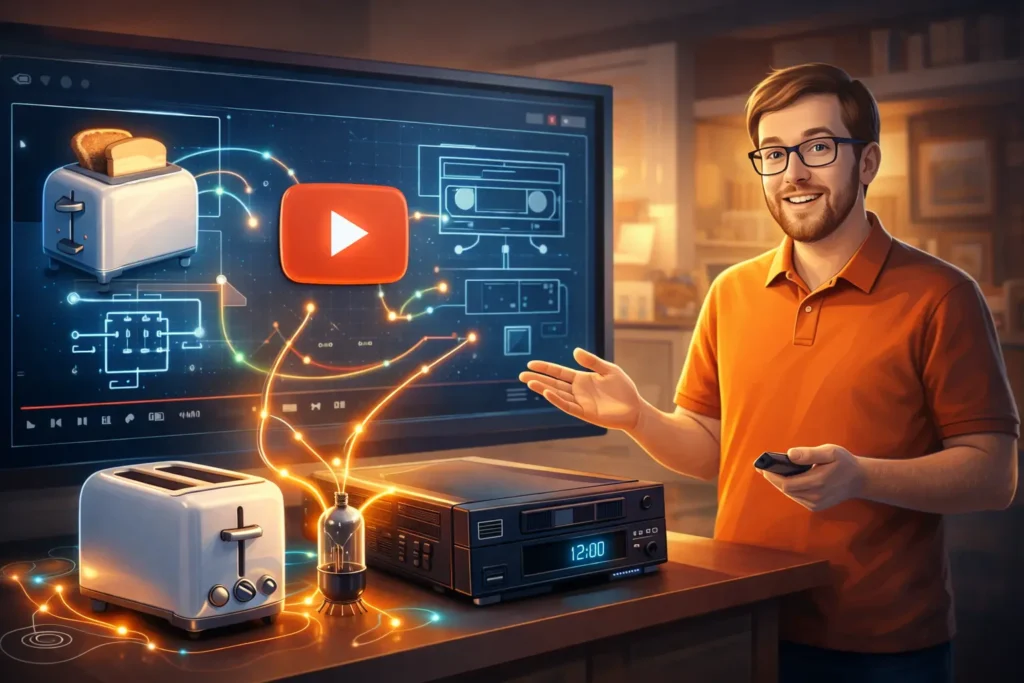
If you have ever found yourself watching a 30-minute deep-dive about why your dishwasher detergent drawer exists — and genuinely enjoying every second of it — then you have almost certainly already stumbled upon Technology Connections. The YouTube channel, created and hosted by Alec Watson, has earned a devoted audience of over three million subscribers by doing something deceptively simple: explaining the engineering, history, and occasional spectacular failure behind the everyday objects most of us never think twice about.
From heat pumps to VHS tapes, from the orientation of your electrical outlet to the reason the popcorn button on your microwave is basically a lie, Technology Connections takes the mundane and makes it riveting. This guide covers everything you need to know — who runs the channel, what it covers, why people find it almost impossible to stop watching, and what the passionate fan community is currently debating.
Who Is Behind Technology Connections?
Meet Alec Watson — Creator and Host
Alec Watson is the sole host, writer, researcher, and editor behind Technology Connections. Based in the Chicago metro area, Watson’s background is not in engineering or computer science — he holds a degree in hotel management and previously worked in the hospitality industry. This outsider perspective is arguably a large part of the channel’s appeal: Watson approaches technical subjects the way a genuinely curious layperson would, but then researches them with the rigour of an academic.
He is also a known electric-vehicle enthusiast and owns an EV, which partly explains why several of his most-discussed episodes deal with regenerative braking, brake light regulations, and the engineering trade-offs in modern electrified vehicles. His dry wit, willingness to admit when he has gotten something wrong, and ability to find genuine drama in a toaster have made him one of the most respected independent educational creators on the platform.
Channel Stats and Critical Recognition
Technology Connections has quietly grown into one of YouTube’s most respected educational channels. At the time of writing, the channel boasts over three million subscribers and has accumulated more than 424 million total views. It carries a TV-PG content rating and holds an 8.8 out of 10 score on IMDb — a remarkable figure for a non-fiction YouTube channel.
The channel’s quality has been recognised far beyond its subscriber base. Major publications that have praised or featured it include:
- Boing Boing
- Lifehacker
- The Verge
- Consumer Reports
- Popular Mechanics
Academic recognition has also followed. Physics professor Dr. Dan MacIsaac has cited Watson’s work as a reliable educational resource, and media scholar Marek Jancovic has referenced the channel in his work on what he calls ‘media epigraphy’ — the study of how old media formats are explained and preserved in the digital age.
Watson also runs a secondary channel called Technology Connextras, where he posts supplemental content, outtakes, corrections, and community-facing discussions that do not fit the more polished format of the main channel.
What Topics Does Technology Connections Cover?
The channel does not follow a strict editorial brief, but several broad themes recur across its library of episodes. Watson gravitates toward subjects where a small amount of engineering knowledge completely changes how you understand something you use every single day — and where the gap between public understanding and reality is amusingly wide.
Home Appliances You Have Been Using Wrong
Perhaps the most viral corner of Watson’s catalogue involves household appliances that most people operate in a fundamentally suboptimal way. His famous episode on dishwashers — often summarised as ‘you have been loading it wrong’ — walks through the chemistry of detergent, the mechanics of the spray arm, and why pre-rinsing your dishes actually makes the machine less effective (the detergent enzymes need food particles to bond to).
The Sunbeam Radiant Control Toaster is another fan favourite. This 1940s and 1950s appliance used a bimetallic strip and a system of levers to lower bread automatically and adjust heat based on the bread’s starting temperature — no timer needed. Watson presents it as a genuine example of elegant mid-century engineering that modern toasters have never surpassed.
Other appliance episodes that have drawn significant attention include:
- Why the microwave popcorn button is almost universally wrong — and how to actually pop microwave popcorn properly
- The counterintuitive physics of refrigerator efficiency
- Why washing machine cycles have grown dramatically longer over the past two decades
HVAC, Heat Pumps, and Energy Efficiency
Watson’s episodes on heating, ventilation, and air conditioning represent some of his most technically detailed work — and some of his most controversial. His videos on heat pump technology have introduced the concept to hundreds of thousands of viewers who had never heard of it, explaining how a heat pump can move thermal energy from outside air even when it is cold, and why it is dramatically more efficient than a resistance-based electric furnace.
Key HVAC concepts covered across his episodes include heat pump operation in cold climates, auxiliary heat strips and when they activate, the dual-fuel heat pump configuration (pairing a heat pump with a gas furnace as a backup), furnace and air conditioner sizing calculations, the problem of oversized HVAC systems in residential construction, and the concept of load calculation and why it matters more than rule-of-thumb sizing.
One community post on his YouTube channel triggered a notable debate about whether his HVAC sizing guidance applied equally to townhouses and semi-detached homes, where shared walls dramatically reduce heat loss and can make even smaller systems oversized. Watson acknowledged the complexity and has returned to the topic in subsequent content.
| Heating System | Efficiency (COP) | Best Climate | Notes |
| Resistance Electric Furnace | 1.0 (100%) | All climates | Simple but expensive to run |
| Gas Furnace | 0.8–0.98 AFUE | Cold climates | Cheaper fuel costs in many regions |
| Air-Source Heat Pump | 2.0–4.0+ COP | Mild to cold | Most efficient in moderate cold |
| Heat Pump + Gas (Dual-Fuel) | 2.0–4.0 / 0.96 | Very cold climates | Best of both worlds |
| Ground-Source Heat Pump | 3.0–5.0 COP | All climates | Highest efficiency, high upfront cost |
Automotive Technology — EVs and Brake Lights
Watson’s interest in electric vehicles has produced some of his most impactful journalism-adjacent work. His detailed examination of the Hyundai Ioniq 5’s brake light behaviour under regenerative braking attracted significant attention — and an eventual follow-up from Consumer Reports — because it identified what Watson argued was a genuine safety gap.
The issue: when a driver of the Ioniq 5 lifts off the throttle and the car decelerates via regenerative braking (harvesting energy back into the battery), the brake lights do not illuminate in the same way they would during conventional braking. Drivers behind the EV have no visual warning that the car ahead is slowing down. Watson traced this to the lack of a clear regulatory standard for what triggers brake light activation in EVs, an area where legislators have lagged behind the technology.
His earlier work on the Chevrolet Volt’s regenerative braking system drew similar analysis. These episodes sit at the intersection of engineering critique, consumer safety, and policy — territory Watson navigates with unusual care for a YouTube channel.
Audio, Video, and Forgotten Formats
A large portion of the channel’s catalogue is devoted to audio and video technology from the 20th century — formats that have mostly vanished but whose engineering decisions tell fascinating stories about the constraints and priorities of their era.
The Capacitance Electronic Disc (CED) — a short-lived format from RCA that stored video on a grooved vinyl disc played by a stylus, competing directly with Laserdisc and VHS — gets the kind of detailed treatment it receives almost nowhere else on the internet. Watson explains why it was technically ingenious, commercially disastrous, and almost entirely forgotten.
Other covered formats and topics include Compact Disc error correction and why CDs skip, the audio engineering of vinyl stereo records, the electron gun technology inside CRT televisions and what analogue television signals actually look like, VHS tape mechanics and why picture quality degraded, and Laserdisc’s surprising advantages over both VHS and early DVD.
Watson has also explored still photography and film history, including the engineering of the Magicube flashbulb (a mechanically triggered flash that required no battery), Kodak and Sylvania’s competition in the consumer flash market, and an episode using a high-speed camera to capture events invisible to the naked eye — produced in collaboration with The Slow Mo Guys channel.
Electrical Wiring, Plugs, and Telephony
Watson brings the same forensic attention to the mundane world of household electrical infrastructure. His episode on why North American electrical plugs are designed the way they are — including the history of the ground pin, the asymmetry of the two flat blades, and why outlet orientation matters — is a masterclass in making a rectangular piece of plastic feel genuinely interesting.
Extension cord safety, the hidden dangers of daisy-chaining power strips, and the physics of why wire gauge matters are covered with the kind of practical clarity that safety information rarely achieves.
On the telephony side, Watson’s deep dive into the Western Electric Model 500 telephone — the iconic mid-century desk phone — covers not just the industrial design history but the acoustic engineering of its ringer and receiver, and the role of Bell System standardisation in shaping what a telephone ‘should’ sound and feel like for generations of Americans.
Why Do Viewers Find Technology Connections So Addictive?
The ‘Dishwasher Loading’ Effect
The core hook of Technology Connections is the revelation moment — the point in an episode where a viewer realises that something they have done thousands of times is based on a misunderstanding, or that a device they dismissed as primitive is actually extraordinarily clever. Watson engineers these moments with genuine skill. The dishwasher loading episode is the archetypal example: most viewers begin it mildly curious and end it feeling they have been genuinely wrong about something simple for their entire adult life.
This ‘I had no idea’ feeling is powerfully shareable. It explains why Technology Connections episodes regularly find second audiences on Reddit, Hacker News, and social media long after their original upload — the content rewards being passed on because the revelations feel personal.
Witty, Satirical Scriptwriting
Watson’s scripts are carefully written to be informative without being dry. His humour is deadpan and observational — what many fans describe as ‘dad joke energy’ deployed with precise comic timing. He is not afraid to editorialize: if he thinks a design decision was stupid, he will say so, and the satirical framing of ‘here is the dumb thing engineers decided to do and here is why it persists’ gives many episodes a conspiratorial pleasure that pure explainer content lacks.
The contrast between his mild, measured delivery and the mild outrage of his commentary has become something of a signature. He will spend twenty minutes building a careful technical case that a particular standard is badly designed and then deliver the conclusion as if he is mildly disappointed in humanity — which, on the evidence, he may be.
Deep Research and Cinematic Production
Watson’s research standards are unusually high for independent YouTube. He cites primary sources, acknowledges uncertainty, and issues corrections — sometimes as dedicated episodes on Technology Connextras. His collaboration with The Slow Mo Guys to capture high-speed footage of the Magicube flash and other mechanisms demonstrates a commitment to showing rather than just telling that distinguishes the channel from most educational content.
The production style is deliberately unhurried. Episodes average 20 to 35 minutes and do not chase the hyper-edited tempo of viral content. This pacing suits an audience that arrives wanting to understand something thoroughly, not just encounter a neat fact and move on.
What the Community Is Talking About
Technology Connections has cultivated an unusually engaged viewer community. Hacker News, Reddit’s r/videos and r/educationalvideos, and Watson’s own YouTube community tab regularly host substantive technical discussions sparked by his episodes. A few recurring themes stand out.
Awnings vs Curtains vs Window Tinting: The Passive Cooling Debate
A Hacker News thread sparked by Watson’s episode on passive cooling generated hundreds of comments debating the relative merits of exterior awnings, interior curtains, exterior shutters, and window film as tools for reducing cooling loads. Key points from that discussion:
- Exterior awnings block solar gain before it enters the glass and are highly effective in direct sun, but fabric requires regular maintenance and retractable models add mechanical complexity
- Slat-style awnings and louvred overhangs offer better airflow than solid fabric designs
- Interior white curtains reflect some IR radiation back out but are far less effective than exterior shading because the heat has already entered the room
- Low-emissivity (low-E) window coatings address the same problem at the glass level and require no maintenance, though retrofitting is expensive
- Window tinting film varies enormously in effectiveness depending on whether it targets visible light or near-infrared radiation — cheap tinting often does little to reduce heat gain
- The historical decline of awnings correlates almost precisely with the mass adoption of central air conditioning in the 1950s and 1960s: once cooling was cheap and reliable, the motivation to invest in passive shading disappeared
| Solution | Solar Gain Reduction | Cost Range | Maintenance | Retrofittable? |
| Exterior fabric awning | Up to 77% | $200–$800 per window | Moderate (fabric, mechanism) | Yes |
| Exterior roller shutter | Up to 90% | $300–$1,200 per window | Low | Yes |
| Interior white curtain | ~20–30% | $30–$150 per window | Very low | Yes |
| Low-E window coating (factory) | 30–70% | $200–$700 per window | None | Replacement only |
| Reflective window film | 20–60% | $8–$25 per sq ft | Low | Yes |
| Deciduous tree planting | Up to 75% in summer | $100–$500 per tree | Annual (pruning) | Yes |
Heat Pumps, Auxiliary Heat, and the Cold-Climate Debate
Watson’s heat pump content has generated ongoing community discussion, particularly around the question of auxiliary electric resistance strips — the backup heating elements that engage when a heat pump cannot keep up with demand in very cold weather. Critics in his comment sections and on Hacker News have argued that:
- Auxiliary heat strips are so energy-intensive that they negate the efficiency advantage of the heat pump during the coldest periods when they are most needed
- The dual-fuel configuration (heat pump down to a set outdoor temperature, then gas furnace takes over) is more efficient in climates with genuinely cold winters, but requires maintaining two separate systems
- Cold-climate heat pumps rated for operation down to -15°C or lower have substantially changed the calculus — these units can maintain COP values above 2.0 in temperatures that would have defeated older heat pump designs
- Watson’s townhouse critics raised a valid point: a well-insulated, semi-detached home in a moderate climate may have a heating load so small that almost any system is technically adequate, making efficiency differences negligible in practice
Controversies and Corrections
The HVAC Sizing Townhome Debate
In a YouTube community post, Watson addressed pushback he received from viewers in attached and semi-detached housing who argued that his HVAC sizing guidance — which emphasised the importance of accurate load calculation and warned against oversized equipment — did not account for the dramatically different heat transfer profile of homes with shared walls.
A townhouse in a row of four units loses heat through only two exterior walls and a roof rather than four walls and a roof. In moderate climates, this can reduce the heating load to a level where even a conservatively sized system runs in long, efficient cycles — but where Watson’s broader point about avoiding oversizing remains valid. The controversy highlighted something Watson himself acknowledges: general guidance about residential HVAC becomes much more complex when applied to the enormous variety of housing types and climates that his viewers actually live in.
EV Brake Lights and the Hyundai Response
The Ioniq 5 brake light episode sparked enough attention that Consumer Reports independently investigated and published their own findings, corroborating Watson’s core concern: that regenerative deceleration in some EVs does not reliably trigger brake light activation, creating a potential rear-end collision risk. Hyundai subsequently issued a software update for the Ioniq 5 in some markets that adjusted brake light behaviour during regenerative braking. Watson covered the update on Technology Connextras, noting the improvement while flagging that the broader regulatory question — at what deceleration rate should brake lights be mandated? — remained unresolved across the EV industry.
A Beginner’s Episode Guide
New viewers often ask where to start. The following table suggests entry points organised by topic interest, based on community recommendations and view counts.
| If you are interested in… | Start with this episode | Why it works as an entry point |
| Home appliances | The Dishwasher: You’re Doing It Wrong | Immediate ‘aha’ moment; no prior knowledge needed |
| Retro technology | The Sunbeam Radiant Control Toaster | Beautiful engineering story; nostalgic and accessible |
| Energy & HVAC | Heat Pumps: The Future of Home Heating | Best overview of the technology; well-paced for beginners |
| Electric vehicles | Why EV Brake Lights Are a Problem | Concrete safety angle; easy to share with non-enthusiasts |
| Audio/video formats | The Failure of the CED | Fascinating commercial history; no technical background required |
| Electrical basics | Why Do Outlets Look the Way They Do? | Everyday object explained perfectly; very rewatchable |
| Photography/film history | The Magicube | Spectacular visuals (high-speed footage); historically rich |
faqs
Is Technology Connections available on Netflix or Amazon Prime?
No. Technology Connections is a YouTube-exclusive channel. All episodes are free to watch on YouTube at @technologyconnections. Watson also maintains a presence on Nebula, the creator-owned streaming platform, where some content is available to subscribers.
What is Alec Watson’s educational background?
Watson holds a degree in hotel management and previously worked in the hospitality sector. He does not have a formal engineering or computer science qualification. Much of his technical knowledge is self-taught, developed through research and, by his own account, a lifelong obsession with understanding how things work.
Which episode should I watch first?
The dishwasher episode is the most commonly recommended starting point, as it requires no prior knowledge, delivers its ‘revelation’ moment quickly, and is representative of Watson’s style. The toaster episode is a close second for viewers more interested in historical engineering. See the Beginner’s Episode Guide table above for topic-specific recommendations.
Did Hyundai fix the Ioniq 5 brake light problem?
Hyundai issued a software update addressing brake light behaviour during regenerative braking in some markets following coverage by Watson and subsequent independent investigation by Consumer Reports. Watson confirmed the improvement in a Technology Connextras post but noted that the underlying regulatory gap — the absence of clear federal standards governing brake light activation thresholds for EVs — had not been addressed.
Are awnings better than air conditioning for cooling?
Awnings and air conditioning serve different functions and are most effective in combination. A well-placed exterior awning can reduce solar heat gain through a window by up to 77 percent, significantly reducing the workload on an air conditioning system. In moderate climates with high sun exposure, effective exterior shading can reduce cooling costs meaningfully. However, awnings do not cool air — they prevent heat from entering. In hot and humid climates, mechanical cooling remains necessary.
Why did Technology Connections get demonetised?
Watson has discussed demonetisation issues on Technology Connextras. Like many educational channels, some episodes have been flagged or demonetised by YouTube’s automated systems due to subject matter (for example, episodes discussing electrical safety or vehicle safety issues can be flagged). Watson uses channel memberships and a Patreon as supplementary revenue sources.
Does the Technology Connections host have a day job?
As of the channel’s substantial growth past one million subscribers, Watson has indicated that the channel is his primary professional focus. His earlier career in hotel management was the source of financial stability while the channel grew.
How does a heat pump work in cold climates?
A heat pump extracts thermal energy from outdoor air and moves it indoors using refrigerant and a compressor — the same process as an air conditioner running in reverse. Even when outdoor temperatures are below freezing, there is still thermal energy in the air; the heat pump simply has to work harder to extract it. Modern cold-climate heat pumps are rated for efficient operation down to -15°C (-5°F) or lower. At extreme temperatures, auxiliary electric resistance heating or a dual-fuel gas backup engages to maintain indoor comfort.
Where can I buy a Sunbeam Radiant Control Toaster today?
Sunbeam Radiant Control Toasters are no longer manufactured but are available through vintage appliance markets, eBay, and estate sales. They were produced primarily in the 1950s and early 1960s. Prices for working examples vary significantly by condition; fully restored units from specialist vendors can command considerable premiums. Watson has noted in community posts that good examples can still be found for reasonable prices with patience.
Watson’s microwave popcorn episode investigates why the dedicated popcorn button on most consumer microwaves produces poor results — typically either under-popped or burnt bags. The core argument is that the sensor-based ‘humidity detection’ approach used by many microwaves is poorly calibrated for the wide variety of microwave popcorn bag sizes and weights. Watson then explains the correct method: listening for pops to slow to roughly one to two seconds apart, regardless of the bag’s instructions or the appliance’s preset button.
Related Channels and Further Learning
Viewers who enjoy Technology Connections tend to find similar satisfaction in a small number of adjacent YouTube channels and creators. None are direct equivalents, but each shares some part of Watson’s sensibility:
- Technology Connextras (@technologyconnextras) — Watson’s own second channel for supplemental content, corrections, community posts, and shorter videos that do not fit the main channel’s format
- The Slow Mo Guys — high-speed cinematography channel that has collaborated with Watson; focuses on making invisible physical processes visible through extreme slow-motion footage
- LGR (Lazy Game Reviews) — covers retro computing and vintage electronics with a similar combination of historical research and hands-on demonstration; particularly strong on 1980s and 1990s personal computers
- styropyro — physics and high-voltage demonstrations; appeals to the same audience that loves Watson’s electrical engineering episodes
- bigclivedotcom — teardowns of consumer electronics and analysis of electrical safety and circuit design; very technically detailed
For viewers specifically interested in HVAC and energy efficiency topics, Watson’s channel pairs well with resources from the US Department of Energy’s EnergyStar programme, the Building Science Corporation’s free publications, and the ENERGY STAR heat pump buyer’s guide.
Conclusion
Technology Connections succeeds where most educational content fails by making expertise feel personal rather than authoritative. Alec Watson does not present himself as a professor lecturing from a position of certified knowledge — he presents himself as someone who looked something up, was astonished by what he found, and wants to share it. That posture, combined with genuinely rigorous research, careful scriptwriting, and an eye for the engineering decisions hiding in plain sight, has built one of YouTube’s most loyal and intellectually engaged audiences.
Whether you come for the dishwasher controversy, the heat pump explainers, the forgotten audio formats, or the brake-light safety reporting, you will almost certainly find yourself still watching an hour later, deep in the back catalogue, wondering why no one ever explained any of this to you before. That is the Technology Connections effect — and it works on almost everyone.

Adrian Cole is a technology researcher and AI content specialist with more than seven years of experience studying automation, machine learning models, and digital innovation. He has worked with multiple tech startups as a consultant, helping them adopt smarter tools and build data-driven systems. Adrian writes simple, clear, and practical explanations of complex tech topics so readers can easily understand the future of AI.