If you’ve ever walked into a fast-food restaurant and instinctively chosen the “meal deal” instead of ordering items separately, you’ve already experienced the quiet power of a bundle business.
Bundles feel easier. Smarter. More valuable. And most importantly for entrepreneurs—they sell better.
In today’s crowded digital and physical marketplaces, simply offering a good product is rarely enough. Customers want convenience, savings, and clarity in their buying decisions. That’s exactly where the bundle business model shines. It transforms scattered products or services into irresistible packaged solutions that increase revenue, improve customer satisfaction, and simplify marketing.
This guide is designed to feel like advice from someone who has actually tested bundles in the real world—because theory alone doesn’t grow sales. By the time you finish reading, you’ll understand what a bundle business truly is, why it works psychologically, how to build profitable bundles step-by-step, what tools to use, what mistakes to avoid, and how to scale the model sustainably.
Whether you sell digital products, physical goods, coaching services, subscriptions, or e-commerce items, the bundle business approach can unlock growth you might be missing right now.
Let’s start from the foundation.
What Is a Bundle Business? A Beginner-Friendly Breakdown
A bundle business is built around selling multiple related products or services together as a single combined offer—usually at a perceived discount or added value compared to buying each item individually.
Think of it like creating a “complete solution” instead of selling separate pieces.
Instead of:
- One course
- One template
- One checklist
You package them into:
- A full learning toolkit
The customer doesn’t just buy a product. They buy progress.
This concept appears everywhere:
- Software suites instead of single tools
- Skincare kits instead of individual bottles
- Streaming subscriptions instead of separate movies
- Online course bundles instead of standalone lessons
The reason is simple: bundles reduce decision fatigue while increasing perceived value.
From a business perspective, bundles also:
- Increase average order value
- Move slow-selling inventory
- Improve conversion rates
- Differentiate you from competitors
At its core, a bundle business isn’t about discounting. It’s about strategic packaging. When done correctly, customers feel they’re getting more—while you actually earn more.
That balance is what makes this model so powerful.
Why the Bundle Business Model Works So Well Psychologically
Human buying behavior isn’t purely logical. It’s emotional, comparative, and influenced by perceived value.
Bundles tap directly into three major psychological triggers.
1. Perceived Savings Without Real Price Pressure
Customers love feeling like they’re getting a deal—even when the discount is modest.
If three items cost:
- $30
- $40
- $50
Separately, that’s $120.
Offer the bundle for $99 and suddenly:
- The purchase feels smarter
- The decision feels urgent
- The value feels higher
You didn’t slash prices dramatically. You changed perception.
2. Reduced Decision Fatigue
Too many choices cause hesitation.
A bundle simplifies the question from:
“Which product should I buy?”
to:
“Do I want the full solution?”
That clarity increases conversions dramatically.
3. Completion Bias
People prefer finishing systems rather than collecting pieces.
A bundle promises:
- A complete transformation
- A full toolkit
- A finished result
That emotional promise often matters more than the actual products inside.
When you understand these psychological drivers, you stop guessing and start designing bundles that naturally sell.
Benefits and Real-World Use Cases of a Bundle Business
The beauty of a bundle business is its flexibility. It works across industries, price points, and audience sizes.
Higher Revenue Without More Traffic
One of the biggest struggles entrepreneurs face is growing revenue without constantly chasing new customers.
Bundles solve this by increasing:
- Average order value
- Upsell success
- Customer lifetime value
Instead of selling one $20 item, you might sell a $79 bundle. Same customer. Higher income.
Perfect for Digital Creators and Educators
If you create:
- Online courses
- Templates
- E-books
- Membership content
You’re sitting on bundle gold.
Creators often underestimate how valuable structured packaging is. A scattered library of content sells poorly. A clear “starter bundle” or “complete system” sells consistently.
Powerful in E-commerce and Retail
Physical product sellers use bundles to:
- Clear slow inventory
- Increase cart size
- Introduce new products
Examples include:
- Gift sets
- Starter kits
- Seasonal bundles
- Limited-time collections
Customers love curated convenience.
Ideal for Service Providers
Even freelancers and agencies can run a bundle business model by packaging services like:
- Website + branding + SEO
- Coaching + templates + follow-up sessions
- Consulting + training + implementation
Bundling transforms hourly work into productized offers—often with better margins and scalability.
How to Build a Profitable Bundle Business Step-by-Step
This is where most guides stay vague. Let’s get practical.
Step 1: Identify a Clear Customer Outcome
Bundles that fail usually focus on products instead of results.
Start by asking:
What transformation does my customer want?
Examples:
- Launch a website
- Lose weight
- Learn a skill
- Organize finances
Your bundle should deliver one clear win.
Step 2: Choose Complementary Items Only
Random combinations weaken trust.
Strong bundles include items that:
- Naturally belong together
- Support the same outcome
- Build on each other logically
Think progression, not collection.
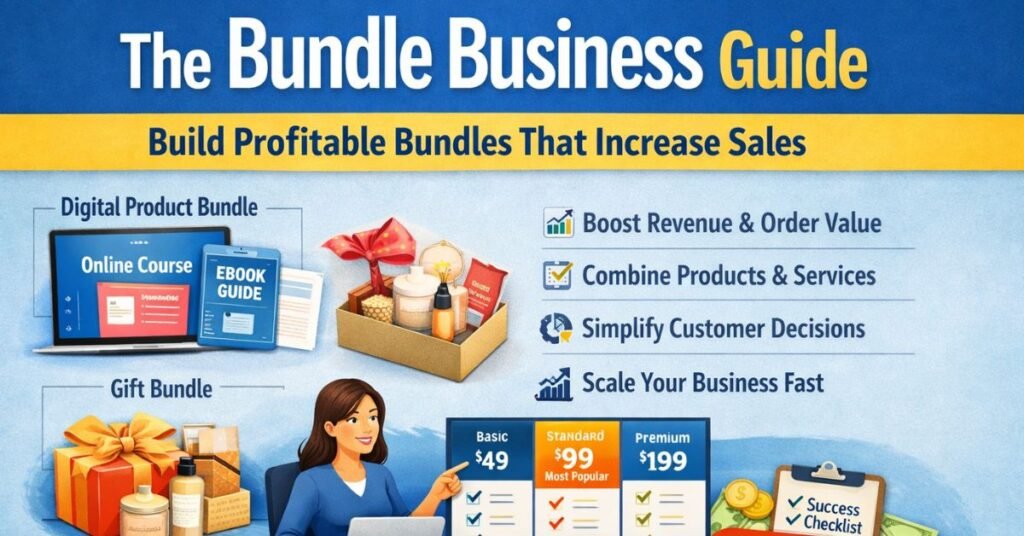
Step 3: Create Tiered Bundle Levels
Top bundle businesses rarely sell just one package.
Common structure:
- Basic bundle (entry-level)
- Standard bundle (best value)
- Premium bundle (maximum transformation)
This pricing ladder:
- Anchors value
- Encourages upgrades
- Maximizes revenue per customer
Step 4: Price for Perceived Value, Not Just Cost
A common mistake is adding item prices and subtracting a small discount.
Instead, ask:
What is the full outcome worth?
If your bundle helps someone:
- Start a business
- Save months of time
- Earn real income
The value may justify premium pricing—even with a discount.
Step 5: Craft Messaging Around Results
Don’t sell:
- 10 videos
- 5 templates
- 3 checklists
Sell:
- “Launch your online store in 7 days.”
- “Complete beginner to confident designer.”
- “From idea to income.”
Outcome-focused bundles convert dramatically better.
Step 6: Test, Measure, Improve
Track:
- Conversion rate
- Average order value
- Refund rate
- Customer feedback
Then refine:
- Bundle contents
- Pricing
- positioning
A bundle business is never static. The best performers evolve continuously.
Tools, Platforms, and Recommendations for Running a Bundle Business
Choosing the right tools saves time and prevents technical headaches.
E-commerce Bundle Tools
Popular options include:
- Shopify bundle apps for physical products
- WooCommerce product bundles for WordPress stores
- Gumroad or Lemon Squeezy for digital bundles
Free tools often:
- Limit customization
- Restrict analytics
- Reduce automation
Paid tools typically provide:
- Upsell funnels
- A/B testing
- Advanced pricing rules
- Subscription bundling
For serious growth, paid solutions usually pay for themselves quickly.
Marketing and Sales Tools
Successful bundle businesses rely heavily on:
- Email marketing platforms
- Landing page builders
- Analytics dashboards
- Affiliate systems
These help you:
- Launch bundles faster
- Track buyer behavior
- Optimize conversions
Without measurement, scaling becomes guesswork.
Design and Presentation Tools
Perception matters in bundles.
Useful tools include:
- Canva for bundle mockups
- Figma for UI previews
- Notion for organizing digital products
Professional presentation increases perceived value instantly.
Common Bundle Business Mistakes and How to Fix Them
Even great entrepreneurs make these errors early on.
Mistake 1: Overstuffing the Bundle
More isn’t always better.
Too many items create:
- Confusion
- Lower perceived quality
- Decision fatigue
Fix: Focus on essentials that deliver the promised result.
Mistake 2: Discounting Too Aggressively
Huge discounts can signal:
- Low quality
- Desperation
- Unsustainable margins
Fix: Emphasize value, not price cuts.
Mistake 3: Ignoring Customer Feedback
Bundles built in isolation often miss real needs.
Fix:
- Survey buyers
- Track usage
- Update bundles regularly
Customer insight is your strongest optimization tool.
Mistake 4: No Clear Outcome
If customers can’t quickly answer:
“What will this do for me?”
They won’t buy.
Fix: Rewrite messaging around transformation, not features.
Mistake 5: One-Time Launch Mentality
Bundles shouldn’t disappear after launch.
Fix:
- Turn winners into evergreen offers
- Create seasonal variations
- Introduce upgrades and add-ons
Longevity multiplies revenue.
Advanced Strategies to Scale a Bundle Business
Once your first bundle works, real growth begins.
Subscription Bundles
Recurring bundles create predictable income through:
- Monthly resource packs
- Ongoing training libraries
- Product refill kits
Subscriptions stabilize cash flow and increase lifetime value.
Limited-Time Themed Bundles
Scarcity drives action.
Examples:
- Holiday bundles
- Back-to-school kits
- Black Friday mega bundles
Time-based urgency boosts conversions significantly.
Partnership and Cross-Creator Bundles
Collaborating with others allows:
- Shared audiences
- Higher perceived value
- Lower creation workload
Joint bundles often outperform solo offers.
Upsell and Downsell Funnels
After purchase, offer:
- Premium upgrades
- Payment plans
- Smaller entry bundles
Smart funnels can double total revenue per customer.
Conclusion: Why a Bundle Business Can Transform Your Income
A bundle business isn’t just a pricing trick. It’s a smarter way to deliver value, simplify decisions, and grow revenue without constantly chasing new customers.
When built around:
- Clear outcomes
- Strategic packaging
- Strong messaging
- Continuous optimization
Bundles become one of the most reliable growth engines available to modern entrepreneurs.
If you already sell products or services, the opportunity is sitting right in front of you. You don’t need something new. You just need to package what you already have in a way that feels complete, valuable, and irresistible.
Start small. Test one bundle. Learn from real buyers. Improve relentlessly.
That’s how sustainable bundle businesses are built.
And once the first one works, scaling becomes far easier than starting from zero.
FAQs
What is a bundle business in simple terms?
A bundle business sells multiple related products or services together as one combined offer, usually at a better perceived value than buying each item separately.
Are bundles only for digital products?
No. Bundles work for physical goods, services, subscriptions, coaching programs, and software—across nearly every industry.
How do I price a bundle correctly?
Price based on the value of the outcome delivered, not just the sum of individual item costs. Strategic discounts and tiered pricing improve conversions.
Do bundles reduce profit margins?
Not necessarily. Bundles often increase total revenue and average order value, which can improve overall profitability even with small discounts.
How many items should be in a bundle?
Enough to deliver a clear result—usually three to seven complementary items. Avoid unnecessary extras that dilute value.

Michael Grant is a business writer with professional experience in small-business consulting and online entrepreneurship. Over the past decade, he has helped brands improve their digital strategy, customer engagement, and revenue planning. Michael simplifies business concepts and gives readers practical insights they can use immediately.