Few institutions have shaped the modern world quite like the Massachusetts Institute of Technology. Nestled along the banks of the Charles River in Cambridge, Massachusetts, MIT has stood for over 160 years as the place where scientific ambition meets practical purpose — where brilliant minds are challenged not merely to understand the world, but to transform it. Founded in 1861 on the belief that knowledge must be useful, MIT today holds the top position in the QS World University Rankings and counts among its community more than 105 Nobel laureates, some of the most consequential companies in history, and discoveries that have reshaped medicine, computing, economics, and beyond. Whether you’re a prospective student, a researcher, or simply curious about one of the most remarkable universities on Earth, this guide covers everything you need to know about MIT.
Quick Facts: MIT at a Glance
Core Information
| Detail | Information |
|---|---|
| Full Name | Massachusetts Institute of Technology |
| Location | Cambridge, Massachusetts, USA |
| Founded | April 10, 1861 |
| Type | Private research university |
| Motto | Mens et Manus (“Mind and Hand”) |
| Founder | William Barton Rogers |
| President | Sally Kornbluth |
| Colors | Cardinal red and steel gray |
| Nickname | The Engineers |
| Mascot | Tim the Beaver |
| Endowment | ~$27.4 billion |
Key Statistics (2024–2025)
| Metric | Figure |
|---|---|
| Undergraduates | 4,535 |
| Graduate Students | 7,047 |
| Total Enrollment | ~11,580 |
| Faculty | ~1,090 |
| Campus Size | 166–168 acres |
| Student-Faculty Ratio | 3:1 |
| Acceptance Rate | ~4.5% |
| Tuition & Fees | ~$64,730 |
| QS World Ranking | #1 (2026 edition) |
Where Is MIT? A Guide to Its Cambridge Campus and Location
The Heart of Kendall Square
MIT’s 166-acre urban campus stretches approximately one mile along the north bank of the Charles River basin in Cambridge, Massachusetts — directly across from Boston. The campus is neatly divided by Massachusetts Avenue: most academic buildings sit to the east, while dormitories and student life facilities are concentrated to the west. The main entrance at 77 Massachusetts Avenue opens onto one of the most recognizable academic courtyards in America.
The neighborhood immediately surrounding MIT is Kendall Square, widely regarded as one of the most productive innovation ecosystems on the planet. Within a short walk of the campus, you’ll find the offices and research labs of major technology and biotech companies including Google, Amazon, Pfizer, Biogen, and dozens of startups spun directly out of MIT research. The area’s transformation from a post-industrial district into a global hub for science and entrepreneurship is, in many ways, MIT’s most visible gift to its city.
The closest subway station is Kendall/MIT on the Red Line of the MBTA, located on the northeastern edge of campus — making the university easily accessible from downtown Boston in under ten minutes.
Iconic Campus Architecture
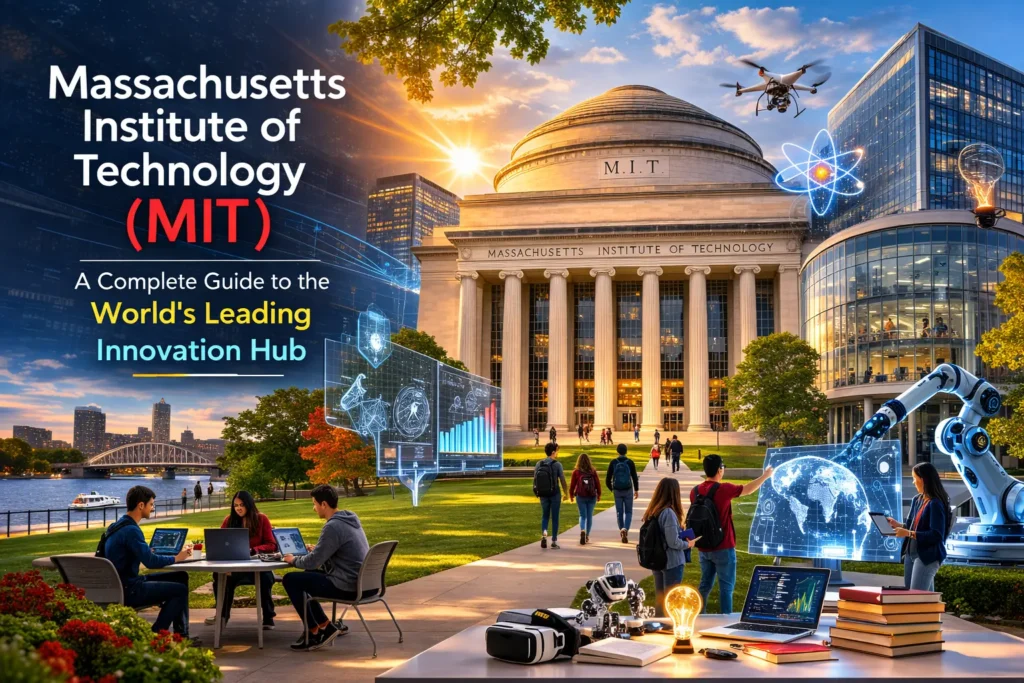
MIT’s campus is a study in architectural contrasts, and all the more fascinating for it. The neoclassical core — crowned by the Great Dome above Building 10, overlooking Killian Court — was designed by architect William W. Bosworth and dedicated in 1916. Today it remains the symbolic heart of the campus and the backdrop for Commencement each spring.
A short walk away stands the Stata Center, the Frank Gehry–designed complex completed in 2004. With its deliberately tilting walls, clashing angles, and playful geometry, it houses the Computer Science and Artificial Intelligence Laboratory (CSAIL) and the Laboratory for Information and Decision Systems — a fitting home, many would argue, for boundary-breaking research. Other notable structures include the List Visual Arts Center, the Media Lab, and the Ray and Maria Stata Center, each reflecting a different chapter in MIT’s evolving architectural story.
Perhaps the most beloved feature of the campus is the Infinite Corridor — a 251-meter-long hallway that bisects the main academic buildings. Twice a year, in November and January, the sun aligns perfectly with the corridor in a phenomenon students have dubbed “MIThenge,” flooding the entire passage with golden light.
The Surrounding Neighborhoods
MIT sits at a rare intersection of worlds. To the northeast, Kendall Square pulses with biotech and tech energy. Head west along Massachusetts Avenue and you’ll reach Central Square, a lively, culturally diverse neighborhood with excellent restaurants and live music. Continue further and you’ll hit Harvard Square — home to Harvard University, independent bookshops, street performers, and some of the best coffee in Greater Boston. The proximity of these two legendary institutions within a single square mile of each other has made Cambridge one of the most intellectually stimulating cities in the world.
Academics at MIT: Schools, Programs, and Research Excellence
The Five Schools and One College
MIT is organized into five schools and one college, each with a distinct focus but united by the institute’s commitment to hands-on, interdisciplinary learning.
The School of Engineering is MIT’s largest division and the one most closely associated with the institute’s global reputation. It encompasses 19 undergraduate degree programs in fields from aerospace and electrical engineering to materials science and nuclear engineering. In the 2024 fall term, it enrolled 72% of all undergraduates who had declared a major — a testament to its depth and prestige.
The School of Science is home to departments in Biology, Brain and Cognitive Sciences, Chemistry, Earth and Planetary Sciences, Mathematics, and Physics. It has produced a remarkable share of MIT’s Nobel laureates and hosts some of the world’s most advanced basic science research programs.
The School of Architecture and Planning covers architecture, urban studies, media arts, and real estate development. It is home to the famous MIT Media Lab, a hub of unconventional research at the intersection of technology, media, and human experience, founded in 1985 by Nicholas Negroponte.
The School of Humanities, Arts, and Social Sciences (SHASS) is perhaps the least expected and most quietly essential part of MIT. Its faculty have won Nobel Prizes in economics, produced foundational work in linguistics (Noam Chomsky spent decades here), and include Pulitzer Prize–winning writers. SHASS ensures that every MIT graduate engages seriously with history, ethics, language, and the social dimensions of science.
The MIT Sloan School of Management is one of the world’s elite business schools, known for its rigorous, data-driven approach to management education. Its faculty regularly shape global economic policy — two Sloan professors, Daron Acemoglu and Simon Johnson, were awarded the 2024 Nobel Prize in Economic Sciences for their work on how political institutions shape national prosperity.
The Schwarzman College of Computing, established in 2019, reflects MIT’s recognition that computing has become infrastructure for every field of human endeavor. It spans the entire institute, supporting AI and computing research across all five schools.
What Can You Study? Notable Programs and Disciplines
MIT awards 44 undergraduate degree programs, all conferring the Bachelor of Science (SB). While engineering dominates enrollment, the breadth of academic offerings is wider than its reputation suggests. Top programs and departments include Computer Science and Electrical Engineering (Course 6), Physics, Mathematics, Biology, Mechanical Engineering, Chemical Engineering, Economics, Brain and Cognitive Sciences, Linguistics, and Urban Studies and Planning. Among the most distinctive offerings are truly interdisciplinary programs such as Computation and Cognition, Mathematics with Computer Science, and programs that combine electrical engineering with biology or economics with data science.
One point worth emphasizing for prospective students: MIT uses a course numbering system rather than department names. Students major in “Course 6” (EECS) or “Course 18” (Mathematics) — a quirky but beloved tradition that also reflects a culture where crossing disciplinary lines is the norm rather than the exception.
The Heart of Discovery: Research at MIT
MIT’s research enterprise is staggering in scope. The institute operates more than 30 research centers and laboratories, many of which have driven some of the most significant technological breakthroughs of the past century.
MIT Lincoln Laboratory, located in Lexington, Massachusetts, is a federally funded research and development center that has worked on radar systems, satellite communications, cybersecurity, and missile defense since its founding during World War II. Haystack Observatory conducts radio science and atmospheric research. The Broad Institute of MIT and Harvard is a world leader in genomics and biomedical research. The Whitehead Institute focuses on fundamental biology and its application to human health. The Koch Institute for Integrative Cancer Research brings together biologists and engineers to develop new cancer diagnostics and treatments.
Beyond these flagship labs, MIT researchers are at the forefront of artificial intelligence (through CSAIL, one of the largest AI research labs in the world), climate science (through the MIT Climate Portal and the Joint Program on the Science and Policy of Global Change), robotics, quantum computing, and nuclear energy.
Historically, MIT’s research role transformed during World War II, when the Radiation Laboratory — the famous “Rad Lab” — developed radar technology that many historians credit with turning the tide of the war. Vannevar Bush, MIT’s vice president at the time, orchestrated the massive national science mobilization that the Rad Lab represented, setting the template for the modern relationship between universities and the federal government in research funding.
Interdisciplinary Initiatives
Some of MIT’s most impactful work happens at the intersection of disciplines. The Abdul Latif Jameel Poverty Action Lab (J-PAL), co-founded by Nobel laureates Abhijit Banerjee and Esther Duflo, pioneered the use of randomized controlled trials to evaluate anti-poverty programs and has influenced policy in more than 100 countries. The MIT Energy Initiative (MITEI) brings together researchers, industry partners, and policymakers to accelerate the transition to clean energy. The Quest for Intelligence initiative coordinates MIT’s work on both the science of intelligence and the engineering of AI systems.
Life as an MIT Student: Culture, Community, and Activities
A Culture of “Mind and Hand”
The student experience at MIT is defined by an ethos that is hard to find anywhere else: intellectual intensity combined with a genuine, irreverent playfulness. The motto Mens et Manus — Mind and Hand — is not decorative. It describes a culture where building, making, and experimenting are considered just as important as theorizing.
MIT is famous for its “hacks” — elaborate, creative, often technically impressive pranks carried out by students. Over the decades, these have included placing a full-size replica of a fire truck on top of the Great Dome, converting a campus building into a giant game of Tetris using its lit windows, and installing a functional police cruiser (complete with flashing lights and a box of donuts) atop the same Dome. The hack tradition is taken seriously as a creative institution — one that requires real engineering ingenuity to execute — and is widely seen as a healthy expression of MIT’s spirit.
The campus also has a deeply maker culture. The MIT Hobby Shop, Edgerton Center, and various makerspaces give students access to machine tools, electronics labs, woodworking equipment, and more. It is not unusual for an undergraduate student to design and build something entirely novel as part of a class project, an extracurricular activity, or pure curiosity.
Athletics and Recreation: 31 Varsity Sports
MIT sponsors 31 varsity sports — one of the largest athletics programs among Division III schools in the country. The teams compete as the Engineers, with Tim the Beaver as the official mascot (chosen, the story goes, because the beaver is nature’s engineer). About 20% of MIT undergraduates participate in varsity athletics, and many more take part in club and intramural sports. The MIT Recreation facilities include an Olympic-size swimming pool, a sailing pavilion on the Charles River, and a full fitness center.
Arts, Music, and Museums on Campus
MIT invests seriously in arts and culture, both to enrich student life and to challenge the false divide between scientific and artistic creativity. The MIT Museum houses exhibits on robotics, holography, kinetic sculpture, and the history of the institute itself. The List Visual Arts Center is a major contemporary art gallery that presents rotating exhibitions of significant works. MIT’s public art collection spans the campus and includes pieces by Pablo Picasso, Alexander Calder, and Louise Nevelson.
Musically, MIT supports dozens of ensembles, from the MIT Symphony Orchestra and Concert Choir to jazz bands, chamber groups, and South Asian classical ensembles. Students can take dance classes, perform in theater productions through the MIT Shakespeare Ensemble, and participate in creative writing workshops. Contrary to popular caricature, many MIT students are deeply serious about the arts — and the institute actively cultivates that.
Housing, Dining, and Student Traditions
All first-year undergraduates live in MIT residence halls, and the dormitory system is famously diverse in character. Each dorm has its own culture: Burton-Conner is known for its collaborative, communal vibe; East Campus is a hub of the hacker and maker community; MacGregor House has a more buttoned-up reputation. Many upperclassmen join Fraternities, Sororities, and Independent Living Groups (FSILGs), which are an important part of campus social life.
MIT’s academic calendar runs on a 4-1-4 system: two full semesters bracketed by January, known as Independent Activities Period (IAP). During IAP, students can take short courses, pursue independent research, participate in competitions, travel, or work. It is one of the most distinctive features of the MIT calendar and one students cite consistently as a highlight of their time at the institute.
Key traditions include Campus Preview Weekend (CPW), a multi-day event each spring when admitted students visit and experience the campus firsthand, and Tech Regs, the colorfully named student publication of MIT’s rules and regulations, which students have satirized for generations.
The MIT Impact: Alumni, Innovation, and the Global Economy
By the Numbers: MIT’s Economic Footprint
The economic impact of MIT’s alumni is almost impossible to fully comprehend. According to data from MIT’s institutional research, living MIT alumni have founded approximately 30,000 active companies, which together employ around 4.6 million people and generate annual revenues estimated at $1.9 trillion. If the companies founded by MIT graduates were a national economy, they would rank among the ten largest in the world. The industries most represented include technology, defense, biotechnology, clean energy, and financial services.
Distinguished Alumni and Nobel Laureates
As of October 2024, 105 Nobel laureates have been affiliated with MIT as alumni, faculty, or researchers — a figure that few institutions anywhere can approach. In 2024 alone, four Nobel Prize winners had MIT ties: economists Daron Acemoglu and Simon Johnson shared the Economics Prize for demonstrating how political institutions shape long-run prosperity, while biologist Victor Ambros (MIT Class of 1975, PhD 1979) shared the Physiology or Medicine Prize for the discovery of microRNA.
Beyond Nobel laureates, MIT counts 26 Turing Award winners (computing’s equivalent of the Nobel Prize), 8 Fields Medalists (mathematics’ highest honor), 58 National Medal of Science recipients, and 84 MacArthur Fellows among its community. 41 MIT-affiliated astronauts have flown in space, and 8 alumni have served as heads of state in countries around the world.
Some of the most celebrated MIT alumni across different fields include:
- Buzz Aldrin (SB ’63) — astronaut and second human to walk on the moon
- Kofi Annan (Sloan ’72) — former Secretary-General of the United Nations and Nobel Peace Prize laureate
- Richard Feynman (SB ’39) — Nobel Prize–winning physicist, one of the greatest science communicators in history
- Paul Krugman (PhD ’77) — Nobel Prize–winning economist and New York Times columnist
- Esther Duflo (PhD ’99) — Nobel Prize–winning economist and pioneer of poverty alleviation research
- Tom Scholz (SB ’69, SM ’70) — guitarist and founder of the rock band Boston
- Noam Chomsky (longtime faculty) — founder of modern linguistics and one of the most cited scholars alive
MIT alumni and faculty have also founded or led companies including Qualcomm, Dropbox, Bose, iRobot, HubSpot, Akamai Technologies, and Campbell Soup Company, among thousands of others.
How to Get Into MIT: A Guide to Admissions and Financial Aid
Understanding the Admissions Process
MIT’s admissions process is among the most selective in the world. In 2025, approximately 4.5% of applicants were admitted for first-year enrollment — meaning more than 95% of candidates, many of them extraordinary students, receive rejection letters. The institute does not use the Common Application; instead, applicants submit materials through MIT’s own admissions portal.
MIT offers two rounds of admissions: Early Action (EA), with a November deadline and decisions released in mid-December, and Regular Action (RA), with a January deadline and decisions in late March. Crucially, Early Action at MIT is non-binding — students admitted early are not obligated to enroll and can continue to apply to other universities. This makes EA at MIT a relatively low-risk way for strong candidates to learn their status early. Historically, the EA round has been slightly more favorable than Regular Action, though both are extraordinarily competitive.
MIT does not accept transfer students in large numbers. For Fall 2024, only 32 of 1,346 transfer applicants were admitted — a transfer acceptance rate of roughly 2.4%.
What MIT Looks For: Beyond Grades and Scores
MIT has reinstated its standardized testing requirement: all applicants must submit either SAT or ACT scores. For enrolled students in Fall 2024, the 75th percentile SAT score was around 1570, and the 75th percentile ACT composite was 36. However, MIT has always been explicit that scores are only one part of a holistic review.
Admissions officers describe looking for five qualities in applicants: excellence and drive in their academic preparation, curiosity and passion for learning, talent in collaboration, concern for the community, and a genuine sense of “fit” with MIT’s culture of hands-on, ambitious problem-solving. The admissions office uses the phrase “matching” — they’re not just evaluating whether a student is qualified, but whether MIT is the right place for that specific student’s ambitions and learning style. The process does not give preference to legacy applicants (children of alumni), which distinguishes MIT from many other elite institutions.
MIT’s application essays are notably personal. Prompts typically ask students to describe their favorite problem, something that has shaped their perspective, or what they would bring to campus. The best responses tend to be specific, genuine, and revealing of how the student thinks — not polished performances of achievement.
Cost and Affordability: Making MIT Possible
MIT is more affordable than its sticker price suggests, thanks to one of the most generous financial aid programs in American higher education. Published tuition and fees for 2024–2025 sit at approximately $64,730, and the full cost of attendance — including housing, meals, and personal expenses — approaches $82,000 per year. However, very few students actually pay that amount.
MIT is need-blind in admissions for all undergraduate applicants, including international students, meaning financial circumstances play no role in admissions decisions. It is one of only nine American universities to offer this policy universally. All financial aid is need-based — MIT offers no merit scholarships or athletic scholarships. Beginning with the 2025–2026 academic year, tuition is not charged to students from families with incomes below $200,000 with typical assets. Across the student body, the average net price for federal loan recipients is approximately $20,338 per year — less than a third of the sticker price.
The vast majority of MIT graduate students are funded through research assistantships, teaching assistantships, and fellowships, meaning they typically pay no tuition and receive a stipend for living expenses. This funding model reflects MIT’s expectation that graduate students are, in the truest sense, junior researchers contributing to the advancement of knowledge.
Planning Your Visit to MIT
MIT Welcome Center and Campus Tours
MIT welcomes visitors and prospective students throughout the year. The MIT Welcome Center, located at 292 Main Street in Kendall Square, is the best starting point for any campus visit. It offers free campus tours led by current students, as well as information sessions for prospective undergraduates and their families. Tours and information sessions should be registered for in advance through the MIT admissions website, as they fill quickly. The Welcome Center is open Monday through Saturday (hours may vary by season, so checking mit.edu/visit before your trip is recommended).
Self-guided tour maps are also available for those who prefer to explore at their own pace. The Infinite Corridor, Killian Court, the Stata Center, and the MIT Museum are all highlights worth seeking out independently.
Getting to MIT: Transportation and Parking
The easiest and most recommended way to reach MIT is by public transit. The Kendall/MIT station on the Red Line of the MBTA places visitors directly on the northeastern edge of campus, with downtown Boston just two stops away at Park Street. Buses also serve the area, and the EZRide Shuttle connects MIT to North Station and other Cambridge destinations. Logan International Airport is accessible via the Red Line with a transfer, typically taking about 45–60 minutes.
Driving to MIT is possible but not particularly recommended. Parking near campus is limited and expensive. The closest parking garage is located at the Cambridge Center, and street parking in Kendall Square is metered and scarce. For day visits, arriving by transit is significantly easier.
Rideshare services (Uber, Lyft) are plentiful in the area, and the campus is Bluebikes-friendly (Boston’s bike-share network), with docking stations near the main campus entrances.
Beyond Campus: Exploring Boston and Cambridge
A visit to MIT pairs naturally with exploring the broader Boston-Cambridge area. Within walking distance or a short subway ride you’ll find the MIT Museum (now located in Kendall Square), the Harvard Art Museums, the Museum of Science, and Cambridge’s eclectic dining scene. Across the river, Boston proper offers the Freedom Trail, the Isabella Stewart Gardner Museum, the Museum of Fine Arts, Boston Harbor, and Fenway Park — home to the Red Sox. For first-time visitors, a day that combines a morning campus tour with an afternoon exploring Cambridge’s neighborhoods and an evening in Boston represents an excellent introduction to why this corner of Massachusetts is such a uniquely vibrant place.
faqs
What does MIT stand for?
MIT stands for Massachusetts Institute of Technology.
What is MIT’s motto?
MIT’s motto is Mens et Manus, Latin for “Mind and Hand.” It captures the institute’s core philosophy that knowledge must be applied to real-world problems.
Is MIT an Ivy League school?
No. MIT is not a member of the Ivy League, which is a specific athletic conference comprising eight northeastern universities (Harvard, Yale, Princeton, Columbia, Penn, Brown, Dartmouth, and Cornell). However, MIT is widely considered the academic peer — and in many technical fields, the superior — of any Ivy League institution.
Is MIT public or private?
MIT is a private research university, though it was originally chartered with the assistance of a federal land grant in 1861.
Where exactly is MIT located?
MIT’s main campus is at 77 Massachusetts Avenue, Cambridge, Massachusetts 02139.
What is MIT known for?
MIT is globally known for engineering, computer science, physics, mathematics, and economics — but it also has outstanding programs in architecture, management (Sloan), linguistics, biology, and the humanities. It is above all known for its research impact and for producing graduates who go on to transform industries and institutions.
How much does it cost to attend MIT?
Published tuition and fees are approximately $64,730 per year. However, most students receive significant financial aid. Families earning under $200,000 per year with typical assets are not charged tuition beginning in the 2025–2026 academic year.
What GPA and test scores do you need to get into MIT?
Almost all admitted students who reported class rank were in the top 10% of their high school graduating class. The 75th percentile SAT score for enrolled students is around 1570; the 75th percentile ACT composite is 36. That said, MIT conducts a holistic review — scores and grades alone are not sufficient for admission.
What is it like to be a student at MIT?
Demanding, exhilarating, and deeply social in unexpected ways. Students describe an environment of intense intellectual engagement and collaborative problem-solving, balanced by a culture of creativity, humor, and hands-on experimentation. The workload is genuinely challenging, but students typically find their peers supportive rather than competitive.
Last updated: 2026. For the most current admissions deadlines, financial aid details, and event schedules, always refer to the official MIT website at mit.edu.

Adrian Cole is a technology researcher and AI content specialist with more than seven years of experience studying automation, machine learning models, and digital innovation. He has worked with multiple tech startups as a consultant, helping them adopt smarter tools and build data-driven systems. Adrian writes simple, clear, and practical explanations of complex tech topics so readers can easily understand the future of AI.